

At a time when a truly global effort is required to tackle the coronavirus pandemic, the unseemly spat between the EU and the leading pharmaceutical companies responsible for making the vaccines designed to beat the virus threatens to undermine the global response.
At the heart of the dispute is a growing awareness within the higher echelons of the EU that it has badly mishandled its approach to acquiring a vaccine that would help to inoculate its 448 million citizens from the effects of Covid-19. This is the strategy that highly-respected bodies like the World Health Organisation contend is the best means of ultimately defeating the pandemic.
But when countries like the US and Britain were actively working with key international pharmaceutical manufacturers such as the Pfizer-BioNTech partnership and AstraZeneca, the EU, reportedly responding to pressure from powerful lobby groups, decided to go its own way and back a number of alternative providers. It ordered 300 million doses of the GSK-Sanofi vaccine, and that bet backfired – a major trial setback means what has been billed as a “French” vaccine (GSK is British) won’t be ready until at least the end of 2021.
-
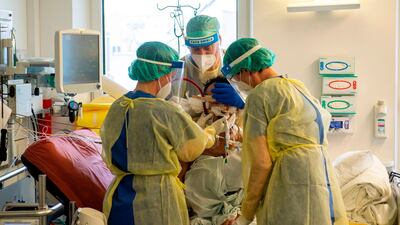
Senior doctor Markus Keim and medical staff colleagues examine a patient on the Covid-19 intensive care unit of the Klinikum Rechts der Isar hospital in Munich, southern Germany. AFP -
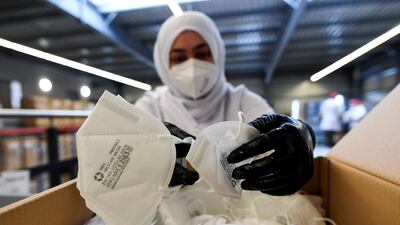
An employee packs FFP2 masks at a SWS Medicare factory in Altheim near Landshut, Germany. Reuters -

A passenger walks through a terminal at the international airport in Frankfurt. The German government has increased the border controls for some flights. AP Photo -

A police officer talks to a driver while people, many of them Czechs on their daily commute to their workplace in Germany, wait in line for a rapid Covid-19 test near the Czech-Germany border. Getty Images -

People wait to receive the coronavirus vaccine at a temporary vaccination centre at the International Fair in Poznan, Poland. Reuters -
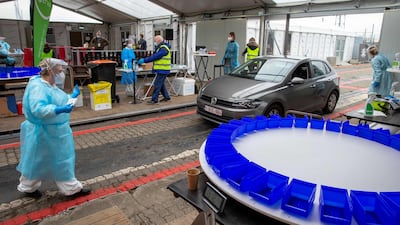
A Covid-19 testing facility at the Spoor Oost site in Antwerp, Belgium, where city authorities are asking some 6500 of its inhabitants who live in districts with infection rates higher than average to get tested. AFP -

A health worker takes a swab sample at a drive-through covid testing site at La Fe Hospital in Valencia, Spain. EPA -

A worker sweeps the floor of a restaurant which is closing due to a curfew in Madrid, Spain. Reuters -
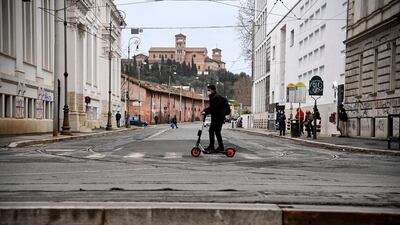
A man on a scooter wearing a face mask in the Trastevere neighborhood in Rome, Italy. EPA -
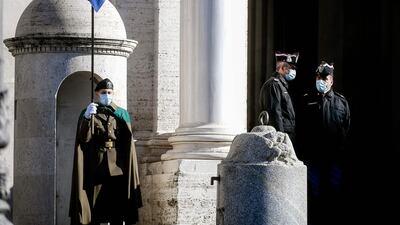
A 'Corazzieri', member of the presidential military corps, stands prior to the arrival of Italian Prime Minister Giuseppe Conte at The Presidential Quirinale Palace in Rome. AFP -
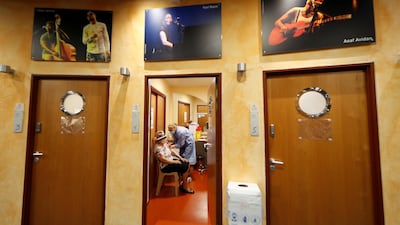
A senior citizen receives a coronavirus vaccine at the Theatre de Verdure in Nice, France, which has been transformed into a vaccination centre. Reuters -

A woman, wearing a protective face mask, walks past Champs Elysees avenue near the Arc de Triomphe in Paris, France. Reuters -
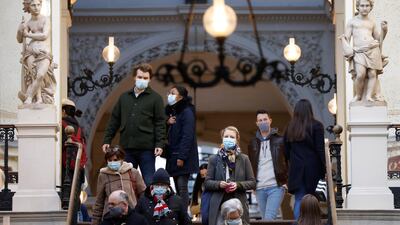
People walk in the passage Pommeraye in Nantes, France. Reuters -

A view shows the deserted Pont de Bir-Hakeim Bridge and the Eiffel Tower during a nationwide curfew, from 6pm to 6am, in Paris, France. Reuters


Accordingly, because of the EU’s clumsy bureaucratic response to the crisis, the bloc now finds itself lagging behind in embarking upon on a mass vaccination project. It now finds itself in the invidious position of not having sufficient quantities of vaccine for its citizens.
The figures speak for themselves. In Britain, for example, the fact that Boris Johnson’s government was able to authorise use of the vaccines developed by Pfizer-BionTech and AstraZeneca means that the UK has, to date, administered 11 doses for every 100 people, including four fifths of those over the age of 80.
By comparison, no EU nation comes close to that. Malta has managed less than half that number, and Denmark around a third. Germany has given just 2.4 doses per 100, the EU average is 2.1 and it’s 1.8 in France. Other member states, such as the Netherlands and Sweden, are lagging further behind.
Now, in an attempt to divert attention away from its own bureaucratic incompetence, the EU has launched what have been dubbed "vaccine wars". On Monday, Bild and Handelsblatt, two leading German newspapers, cited anonymous German officials in reporting that the efficacy of the AstraZeneca vaccine, developed in conjunction with scientists at the University of Oxford, is much lower for the elderly than the company claims. AstraZeneca vehemently denies that to be the case, suspecting that the officials must have misinterpreted the data.
Although the German government has sought to distance itself from the claims, it is suspicious that they came as the EU is locked in a row with the company over the news that it will not be able to supply the bloc with the number of vaccines it originally anticipated. The EU is now threatening to withhold supplies of the Pfizer/BioNtech jab, which is made in Belgium, from Britain on the grounds that AstraZeneca is failing to meet its contractual obligations.
It is curious why officials from a powerful EU member state are so determined to discredit a vaccine that the EU itself seems equally determined to acquire. What is more clear is that, in its public-messaging campaign against AstraZeneca, the EU is now desperately trying to seek a scapegoat for its own missteps as it sought to forge a collective vaccine procurement approach among its member states. That approach, in which Brussels spent weeks haggling over price, resulted in uncertain contracts and production delays.
Moreover, the EU’s fury is clearly linked to an ongoing sense of grievance over Brexit and the UK’s decision to go it alone on vaccination strategy, rather than join the collective European effort. Certainly the EU’s allegation that AstraZeneca is deliberately prioritising the UK and US, which approved the vaccine and signed contracts long before the EU, amounts to little more than sour grapes.

For a start, AstraZeneca is not beholden commercially to either the British or American governments. It is as much a Swedish company as it is a British one, and it is run by a French national, Pascal Soriot. Moreover, it is selling its vaccine at no profit to itself, and has committed to establishing local sources of production around the world as fast as is logistically possible to ensure that the entire globe will benefit from the vaccine breakthrough, and not just a few select western nations.
This is reflected in the fact that 1 billion of the 3bn doses the company plans to supply globally this year are to be produced by the Serum Institute in Pune, near Mumbai, which will help to guarantee supplies to India and other developing markets. That is hardly the conduct of a company that, as some within the EU are claiming, is seeking to prioritise the UK and other favoured western markets over the EU and the developing world.
Moreover, rather than threatening AstraZeneca, the EU should have the decency to accept that the company’s collaboration with academics at Oxford University to produce an effective vaccine in such a short space of time is an outstanding achievement for which Europe as a whole can feel proud.
But while the EU is trying to deflect blame for its own woeful performance, there is increasing disquiet within Europe about its unimpressive response to the vaccine challenge. There have been riots in some member states, such as the Netherlands, where protesters see no realistic hope of an exit from lockdown. The concern now is that this Brussels-made vaccine fiasco will ultimately result in more deaths, a longer lockdown and a deeper recession. And the longer the pandemic continues, the more likely it is that government debt ratios across the bloc will spiral upwards, heightening the risk of a repeat of the 2011 European debt crisis.
Certainly, in terms of assisting the global effort to end the pandemic, the EU’s response can hardly be deemed to have been helpful. In its latest move, the EU is demanding the AstraZeneca prioritise delivery of the vaccine to Europe ahead of Britain, even though the EU has still not officially given the vaccine its approval (a final decision is expected next week) while the British government authorised its use last month, thereby paving the way for its highly successful vaccination programme.
The EU, by its response, therefore threatens to undermine about the only positive development that has so far emerged in Europe from this terrible global pandemic.
Con Coughlin is a defence and foreign affairs columnist for The National

