


Nearly a month after a coup ousted Malian president Ibrahim Boubacar Keita from power, concerns remain within the country and in the international community about its democratic future – and the impact of the coup on counterterrorism operations under way in the region.
Last week, the country's military leaders launched public consultations with political parties as well as members of civil society, supposedly to accommodate the growing concerns of the political class in Bamako, as well as the country's allies, including France.
Even though the coup in mid-August was executed by a group of Malian officers, it followed months of civilian protests against the government of "IBK", given its struggles to tackle the socio-economic and security problems of the country.
Soon after this initial relief, however, uncertainties arose over the implications of the coup. Many of the civilian activists who participated in the demonstrations of the past few months felt ignored by the military junta. In particular, the leaders of the so-called "Movement of the June 5-Rally of Patriotic Forces" publicly shared their exasperation over the way the officers ignored their claims.
-
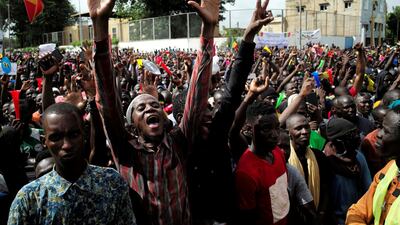
Supporters of Imam Mahmoud Dicko and other opposition political parties protest. Reuters -

Supporters of Imam Mahmoud Dicko and other opposition political parties protest. Reuters -
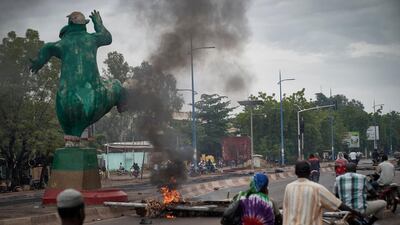
Protesters set barricades to block the circulation on the Martyrs bridge of Bamako. AFP -
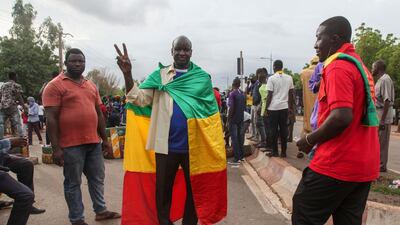
Anti-government protesters demonstrate in the capital Bamako, Mali. AP -

June 5 protesters gather last week in Mali. Reuters -

People run away at the arrival of the riot police as protesters set barricades to block the circulation on the Martyrs bridge of Bamako. AFP -
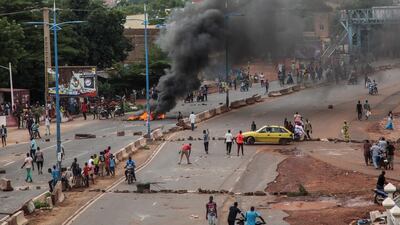
Anti-government protesters burn tires and barricade roads in the capital Bamako, Mali. AP Photo -

Anti-government protesters burn tires and barricade roads in the capital Bamako, Mali. Reuters -

Anti-government protesters burn tires and barricade roads in the capital Bamako, Mali. AP Photo -
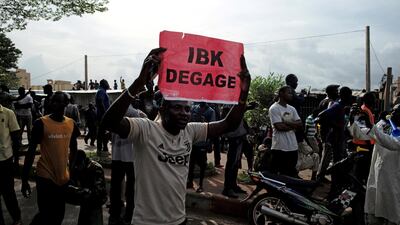
A protester holds a sign during a protest reading "Ibrahim Boubacar Keita get out". Reuters


Meanwhile, the international community expressed its consternation and promptly called for a transition back to civilian rule. During the latest political consultations, the junta announced a 18-month transitional period but this significant duration raised alarms both in foreign capitals and in Bamako where the opposition rejected the plan last Sunday.
As a result, the Economic Community of West African States – a regional bloc comprising 15 countries – imposed sanctions on the new rulers and urged them to designate a civilian leader while organising elections within the next 12 months. Likewise, the G5 Sahel Joint Force – a security organisation that includes Mali alongside Burkina Faso, Chad, Mauritania and Niger – also condemned the putsch. Maman Sidikou, executive secretary of the G5 Sahel, stated in an interview with German media that “the time of coups d’etat is over”. Similar statements were issued by the African Union, the charter for which explicitly rejects unconstitutional changes of government. It then suspended Mali from the 55-member grouping.
Beyond Africa, the coup also has major implications for the European Union, which not only called for a rapid return to the rule of law but suspended its training mission in the country. Since its inception in February 2013, this mission had trained about 10 battalions, with plans to ramp up the exercise after political pledges were made at an international summit in the French city of Pau last January.
It may be for France, the country most involved in Malian affairs since 2013, that IBK's exit and the establishment of the junta constitute the biggest setback. French diplomats and politicians had been somewhat critical of the former president's inability to address a number of critical security issues – in particular his reluctance to apply the Algiers Accords of 2015 that aimed to demobilise and reintegrate the former rebels. But the military takeover not only compromises past efforts to create good governance in Mali, it also reminds Paris of the very reasons it intervened militarily, back in 2013 with Operation Serval. At the time, the collapse of the state and the march of extremist forces towards Bamako were the consequences of a previous military coup, orchestrated eight years ago.
-
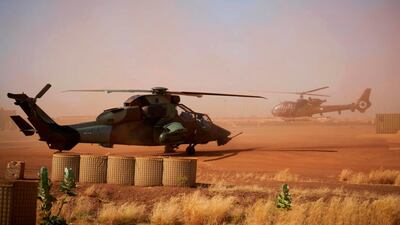
A Eurocopter Tiger at the French Military base in Gao in November 2019. Thirteen soldiers were killed after two helicopters collided during an operation. AFP -
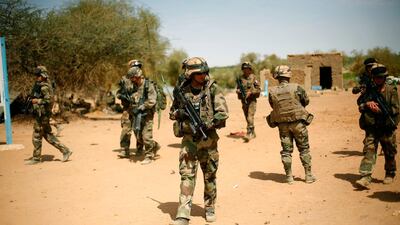
France has more than 4,500 troops in Africa's Sahel region. AP Photo -
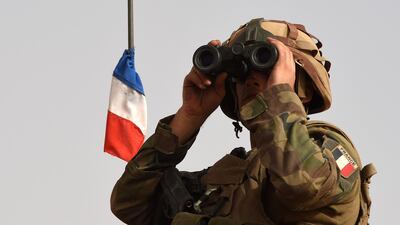
The helicopter crash was the deadliest attack since the French intervention began in 2013. AFP -
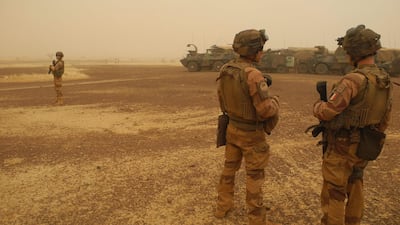
In total, 38 French soldiers have been killed in the region. AFP -
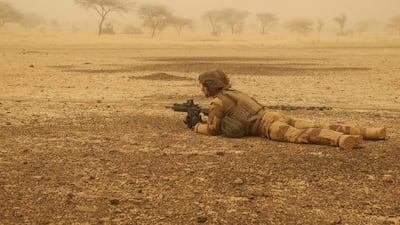
A French soldier secure a perimeter during a break in the military convoy's trip between Gossi and Hombori in March. AFP -
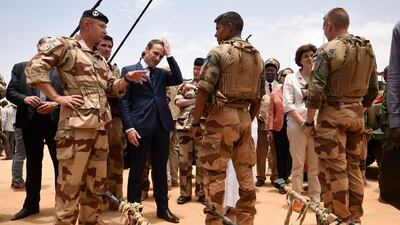
French President Emmanuel Macron visits soldiers of Operation Barkhane in Gao in 2017. He expressed his 'deep sadness' at the news. AP -
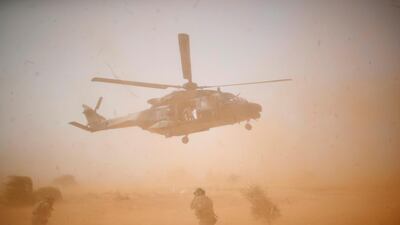
UN Secretary General Antonio Guterres warned that terrorist groups have strengthened their foothold across the Sahel. Reuters -
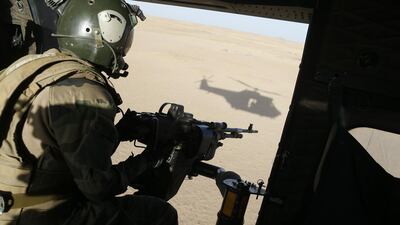
A French gunner sits in a Puma helicopter flying near Tessalit in 2013. AFP -
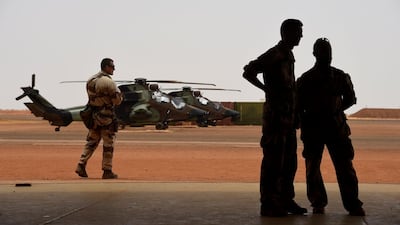
French soldiers of France's Barkhane are pictured next to a Eurocopter Tiger helicopter during the 2017 visit of the French President in Gao. AFP -
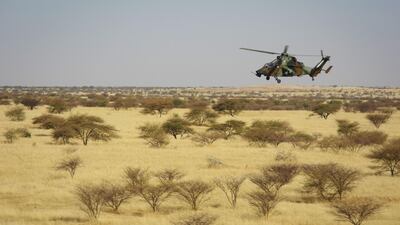
France's Barkhane mission in central Mali in 2017. AFP


Today, as in 2012, Mali remains the centre of the fight against terrorism in the Sahel. Over the past seven years, France has dedicated its biggest deployment of armed forces overseas for this purpose. In early 2020, after witnessing an increase in terrorist attacks in the region, President Emmanuel Macron signed off on a troop surge, with 5,100 French personnel now engaged as part of Operation Barkhane.
Much like with the Americans in Iraq and Afghanistan, the French military strategy in Mali – and more broadly in the Sahel – has put an emphasis on strengthening local partners, either through joint counterterrorism operations or training missions. At the same time, French officials have repeatedly stressed that long-term security would be possible only if it is accompanied by socio-economic reforms. In fact, the two pillars of the G5 Sahel, founded in 2014, are security and development.
However, the military coup in Mali represents a rebuttal of this strategy. By ignoring the rule of law, it has compromised the aspirations for better governance. Moreover, by stirring up political instability in Bamako, it risks jeopardising national security against terrorist organisations.

On the one hand, the longer the uncertainty remains over a return to civilian rule and a democratic transition, the harder it will be for France to maintain its military efforts in the country without exacerbating anti-French sentiments among a population that already questions the presence of the former colonial power. On the other hand, the protracted political crisis may also complicate the ability of its security forces to address the immediate challenge posed by the extremist forces.
The recent suspension of the EU's training mission is an immediate example of the implications of the coup for international co-operation.
France has not gone as far as the EU. General Francois Lecointre, the French Chief of Joint Forces, stated that Paris was urging the Malian army to sustain its engagement against armed groups. For Paris, maintaining co-operation with Mali's armed forces in counterterrorism operations while forcing the junta to hand power back to the civilians could prove to be a delicate exercise. But right now it seems the only feasible option if it wants to prevent a return to the 2013 crisis.
Jean-Loup Samaan is an Abu Dhabi-based researcher in strategic affairs

