

As I packed my groceries at the supermarket, the checkout lady said: "How can you even listen to the news these days? It's so depressing." She had a point. So here is something to cheer us up: even after coronavirus and economic dislocation, it is still possible to save the planet from climate change.
That is the opinion of leading business people, climate scientists and campaigners I was with at a summit I co-chaired in London, the Net Zero Festival.
It was planned to preview the world leaders climate summit called COP26, which was supposed to take place in Glasgow next month. The pandemic means it is now postponed for a year. But tackling climate change cannot – and thankfully often is not – being postponed.
Floods in northern England, forest fires in Australia and the US, the threat to low-lying coastal areas from Bangladesh to the Maldives and Florida cannot wait. The festival organisers took the decision to push ahead with an ambitious conference.
I have always had serious reservations about how the climate change debate is sometimes framed. Accepting that climate change is real and very serious does not mean we should turn away and see it as hopeless. A human-created catastrophe can be reversed by human action.
Second, the blame game is counterproductive. Countries blaming other countries for not doing enough can be an excuse for everyone doing nothing. Targeting businesses, notably the oil and gas industry, as if they are led by monsters doesn’t bring about change.
Of course some polluters and high carbon emitters – both countries and corporations – may be motivated only by greed and self-interest, but as the Net Zero Festival revealed, they are on the wrong side of history. They will miss out on great opportunities ahead.
And that is the good news. Participants at the festival included big corporations, among them Unilever, whose former chief executive Paul Polman is internationally respected as an evangelist for businesses to plan for reducing their carbon footprint and moving to zero emissions.
-
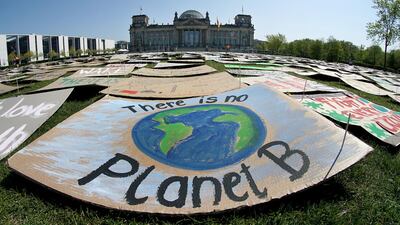
Signs from Fridays for Future movement in Berlin, Germany. Ten cities joined New York and London in committing to divest from fossil fuel companies as part of efforts to combat climate change. AP -
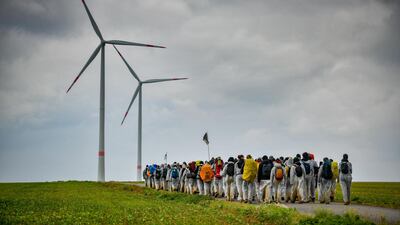
Climate activists march in an attempt to occupy the Garzweiler open-cast coal mine and nearby gas infrastructure on a day of civil disobedience near Grevenbroich, Germany. Getty -

A child wears plastic bottle waste provided by climate and environmental activists during a protest in Nairobi, Kenya. Reuters -
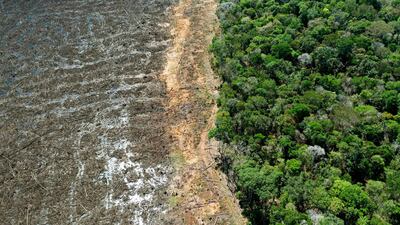
A deforested area close to Sinop, Mato Grosso state, Brazil. The number of bushfires raging in Brazil's Amazon increased 61 per cent in September last year, compared to the same period in 2019. AFP -
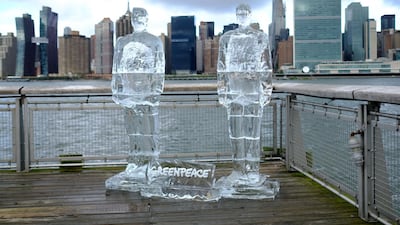
Ice sculptures of Donald Trump and Jair Bolsonaro comprise the artwork 'Meltdown', which was on display last September during the UN Summit On Biodiversity in New York City. AFP -

A Jaguar named Ousado, who suffered second-degree burns during fires in the South American Pantanal region, rests in his cage after treatment in Brazil. AP -
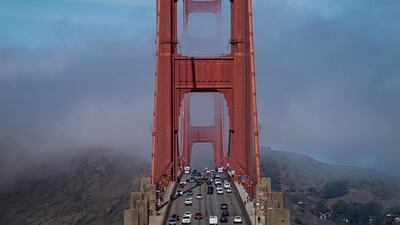
Cars on the Golden Gate Bridge in San Francisco, California. The US state plans to phase out sales of new, petrol-powered cars by 2035. Bloomberg -
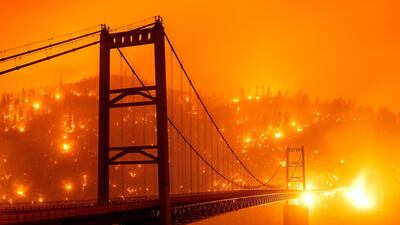
Deadly bushfires in California burnt more than 16,000 square kilometres of land last year — more than double the previous record for the most land burnt in a single year in the state. AP -
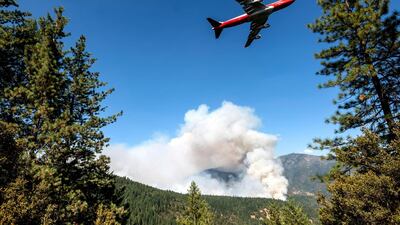
An aircraft prepares to drop fire retardant while battling a blaze in the Mendocino National Forest, California. AP -

Filipino climate activists hold placards calling for climate action as a part of global climate change protests in Quezon City. Reuters -
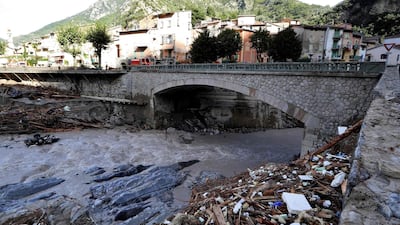
Debris collects in a river after heavy rains and floods hit Breil-sur-Roya, a French village close to the Italian border. AFP -

Climate and environmental activists make their way through a forest next to the village of Shipunovo, 170 km south of the Siberian city of Novosibirsk, to extinguish a peat fire. AFP -

A man holds a banner with the message "United for climate" during a small climate change protest in Brussels. AP -
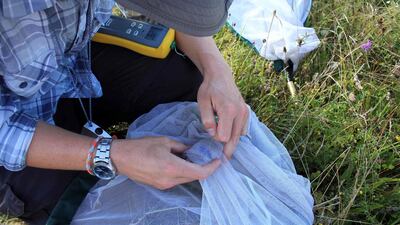
British zoologist Andrew Bladon takes the temperature of a butterfly near Pegsdon, England. Whether a butterfly's wings absorb or reflect heat from the sun could be a matter of life and death in a warming world, British researchers said. AFP -
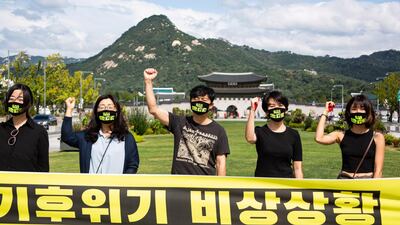
Members of an environmental group in Seoul, South Korea, take part in a protest against climate change. EPA -
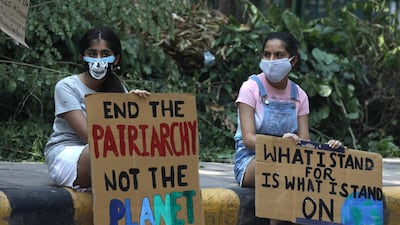
Activists from various environmental groups take part in a protest against climate change in New Delhi, India. EPA -
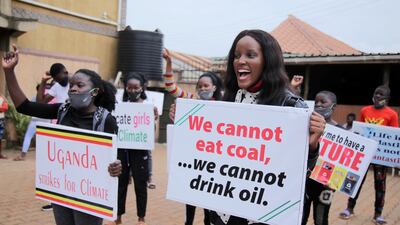
Ugandan climate change activist Vanessa Nakate takes part in a demonstration in the Luzira suburb of Kampala, Uganda. Reuters -
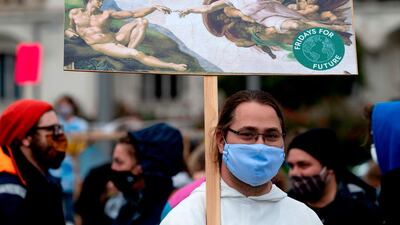
A climate change demonstration in Vienna, Austria. AFP -
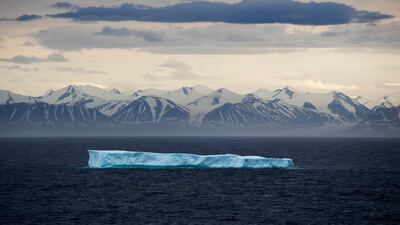
An iceberg floats past Bylot Island in the Canadian Arctic Archipelago in 2017. AP -
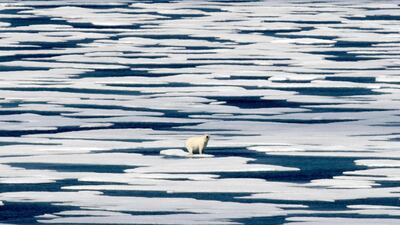
A polar bear stands on the ice in the Franklin Strait in the Canadian Arctic Archipelago in 2017. AP


Also present were food producers, investment and pension fund companies, utilities such as Yorkshire Water, local government organisations, the electricity industry and, yes, the oil and gas industry.
One of the biggest corporations, Shell, explained the enormous changes they have planned for themselves and spoke of changes required in the wider energy sector. Some in the environmental movement complained that a company like Shell should be involved in discussions of net zero emissions. I disagree.
The conference tag line was “Faster, Together”. And in order to move fast to cut emissions, it is essential for airlines, car companies and fossil fuel corporations to engage, spell out their plans for change – and be held to account.
Sceptics retort with the the term “greenwash”, meaning a company can announce plans for 2040 or 2050 without any real change in 2020. But the reason the conference had such a sense of empowerment and optimism was that so many corporations, large and small, have already adopted credible plans, encouraged outside monitoring, set up systems of measurement and announced that they will be open to constructive criticism.
The impressive chief executive of Yorkshire Water, Liz Barber, accepted that her focus had been on water quality at the expense of other environmental factors. That has changed.
A soft drink manufacturer said his company was offering incentives to all staff to do better.
Jack Hemingway of Wakefield Council said some local people were sceptical but the council was determined to make the area greener and cleaner for everyone.
Finance experts repeated that the risk to corporations of not cleaning up their businesses was ultimately far greater than the cost of doing so. And strikingly, many business and financial experts accepted that most talented people in their twenties would not want to spend a career working for a company that did not take climate change seriously.
Yes, there is pain. Shell is axing 9,000 jobs and set a target of “net zero” by 2050. But there is also profit in doing the right thing, and a real risk in doing nothing.
The sceptic in all of us will say that talk is cheap, but what about action? Yet every major business leader I have met says that what you measure is what is important. Forward-thinking businesses are now measuring profit and loss, of course, but environmental performance too.
Business investors have often been conditioned to think of the next three months' share price rather than that of the next 30 years. But the coronavirus pandemic and economic downturn have opened our eyes to the need for long-term thinking.
When lockdowns meant business activity stalled, carbon emissions fell hugely. The key question is whether we can have a green recovery – benefiting businesses, and also bringing some good news to all of us.
If the environmental movement wants support from the lady at the supermarket checkout, tell her some good news. She wants to hear it, and so do the rest of us.
Gavin Esler is a UK columnist for The National

