Annexation by Israel of occupied Palestinian territory in the West Bank was never likely to happen on July 1, as many observers assumed. The date was not a deadline; it was a window opened by the Israeli government to carry out annexation before US President Donald Trump leaves office.
Unhappily for Israeli Prime Minister Benjamin Netanyahu, that window could slam shut in a matter of months, if current polling trends continue and Mr Trump loses the presidential election in November.
Certainly, the fact that no dramatic move took place last week does not indicate that annexation is off the table. Indeed, following meetings in Israel with US officials last week, Mr Netanyahu's office suggested that a US announcement on annexation could happen within days.
The dithering, according to the Israeli media, reflects divisions inside the US administration – despite the fact that its so-called "Middle East peace plan", published earlier in the year, approved Israel's annexation of as much as a third of Palestinian land in the occupied West Bank.

Jared Kushner, Mr Trump’s son-in-law and the architect of that plan, has reportedly been at loggerheads with David Friedman, the US ambassador to Israel, over the timing and scale of annexation.
Both are fervent supporters of the settlements. But while Mr Friedman’s circle of intimates is dominated by Mr Netanyahu and settler leaders, Mr Kushner has had to weigh wider pressures. It is Mr Kushner who is fielding anxious calls from Arab and European leaders about annexation.
Mr Trump's attention, meanwhile, is focused on other pressing matters, such as how to stop a dangerous fall in his popularity as the pandemic runs wild with potentially catastrophic consequences for the US economy.
Nonetheless, according to a report on Friday in the Israeli daily newspaper Haaretz, Mr Netanyahu and Mr Friedman's position may slowly be winning out. Mr Kushner is reportedly less in Mr Trump's favour after recent disagreements on domestic policy matters.
Annexation has already served Mr Netanahu's immediate needs. It was a large carrot that incentivised his voting base to keep turning out in three inconclusive elections over the course of a year. It has distracted from his current corruption trial, as well as from his failure to maintain a grip on the Covid-19 pandemic.
Some have speculated that he may no longer feel the need to go through with annexation. Although backed by many Israelis, it is low on their list of priorities as they grapple with disease and recession.
Nonetheless, Mr Netanyahu would struggle to forego it.
-
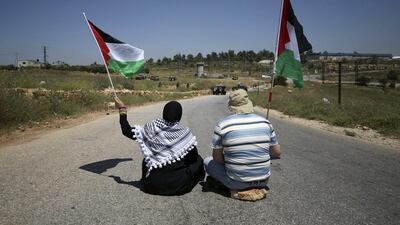
Palestinian protesters wave flags as Israeli troops take position during a protest against Jewish settlements in the West Bank village of Nabi Saleh, near Ramallah. Reuters -
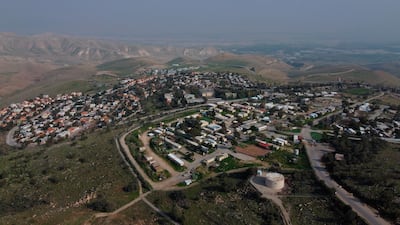
Now that Prime Minister Benjamin Netanyahu has secured a new term in office, there’s little to prevent him from annexing large parts of the West Bank as early as this summer. AP -
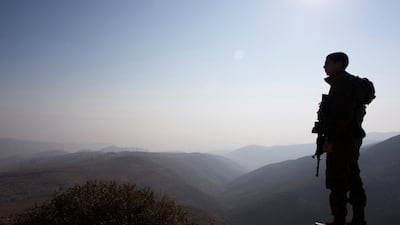
An Israeli soldier stands guard during a tour made by Israeli parliament members in the Jordan Valley near the Jewish settlement of Maale Efrayim. Reuters -
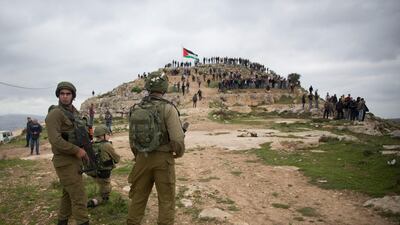
Israeli soldiers take position as Palestinian demonstrators gather during a protest against expansion of Israeli settlements in the West Bank. AP -
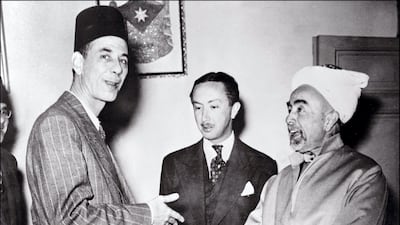
King Abdullah (r) of Transjordan on May 13, 1948 in Amman with Abed Al Rahman Azzam, the secretary general of the Arab League and Abd Al Elah Ibn Ali, the Prince Regent of Iraq, the day before the beginning of the first Arab-Israeli War. AFP -
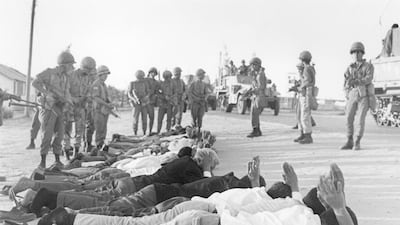
Palestinians surrender to Israeli soldiers in June 1967 in the occupied territory of the West Bank after Israel launched a pre-emptive attack on Egypt and Syria and seized the Gaza Strip, Sinai Peninsula and the Golan Heights in Syria as well as the West Bank and Arab East Jerusalem. AFP -
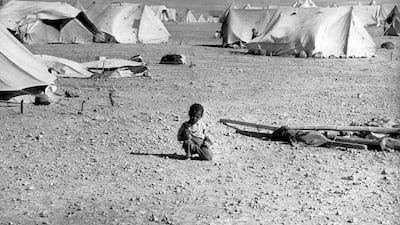
A Palestinian child plays in a refugee camp in Jordan on June 23, 1967. AFP -
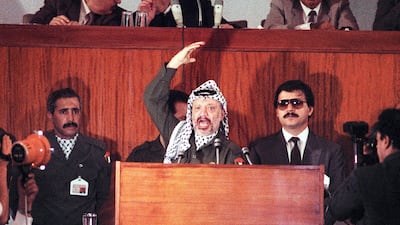
PLO chairman Yasser Arafat delivers a speech to the Palestine National Council meeting to make the historic proclamation of a Palestinian state in the Israeli-occupied territories and to recognize Israel in the Palace of Nations conference hall on November 12, 1988, in Algiers. AFP -

US President Bill Clinton stands between PLO leader Yasser Arafat and Israeli Prime Minister Yitzahk Rabin as they shake hands for the first time on September 13, 1993 at the White House. AFP -
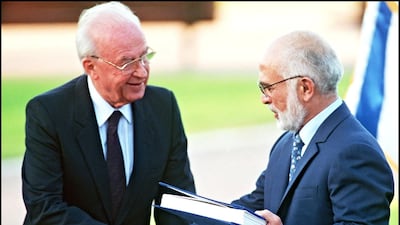
Hussein Ibn Talal, King of Jordan and Israeli Premier Yitzhak Rabin shake hands after they exchanged the documents of the Peace Treaty at Beit Gabriel conference centre on November 10, 1994 on the southern shore of the Sea of Galilee. AFP -
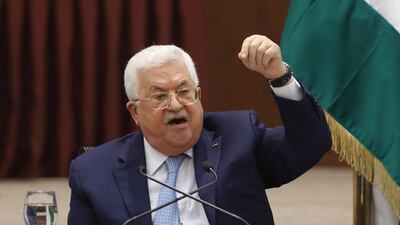
Palestinian President Mahmoud Abbas speaks during the Palestinian leadership meeting and threatened to end security coordination with Israel and the United States, saying Israeli annexation would ruin chances for peace. AFP -
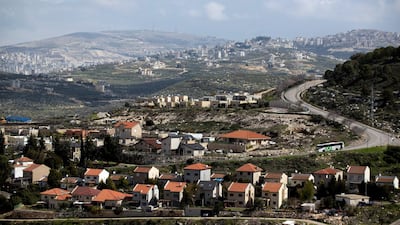
Houses in the Israeli settlement of settlement of Kedumim are seen in the foreground as part of the Palestinian city of Nablus is seen in the background (far left) in the Israeli-occupied West Bank. Reuters -
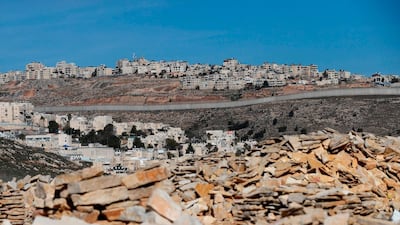
Israel's controversial concrete barrier (C) separating the Jewish settlement of Neve Yaakov (foreground) in the northern part of east Jerusalem and the Palestinian area of al-Ram (background) in the occupied West Bank. AFP -
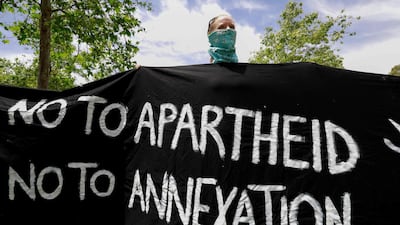
An Israeli activist holds a banner during a protest against the US peace plan for the Middle East, in front of the US ambassador's residence in Jerusalem, on May 15, 2020, as Palestinians commemorate the 72nd anniversary of the 1948 Nakba or "catastrophe". AFP -
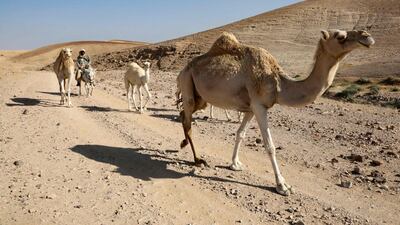
A Palestinian shepherd tends to his camels on arid land considered to be in "Area C" (under Israeli security and administrative control), southeast of Yatta town in the southern West Bank district of Hebron. AFP -
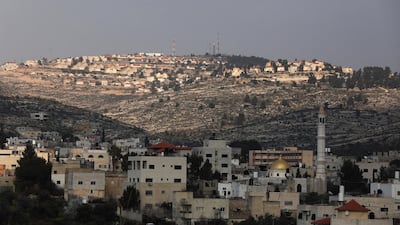
A general view of the Israeli settlement of Elon Moreh, as seen from the Palestinian village of Azmout near the West Bank City of Nablus. EPA -
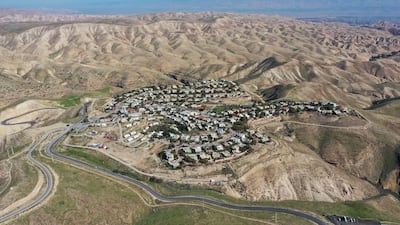
The West Bank Jewish settlement of Maale Michmash. AP


This is in part because he made too much of it – and of his special relationship with Mr Trump – during the election campaigns. He will not be forgiven by many on the right should he fail to capitalise on a once-in-a-lifetime opportunity to grab the title deeds to occupied Palestinian land with US blessing.
Furthermore, Mr Netanyahu’s own vanity should not be discounted. This is his chance to take his place in Israel’s history books – not as Israel’s first prime minister to stand trial while in office, but as the leader who secured recognition of the settlements and killed off any chance of a viable Palestinian state.
The question for Mr Netanyahu is how much of a concession he seeks to extract from the White House. The answer may depend on whether Mr Trump looks likely to win a second term.
Israeli media reports suggest that Mr Netanyahu may settle for a two-stage annexation. In this view, Israel would quickly annex the larger settlements around Jerusalem, cementing the loss to the Palestinians of their future capital.

That would be the effective sequel to Mr Trump's decision to move the US embassy to Jerusalem two years ago. It would also presumably play well once again with the Christian evangelicals on whose vote Mr Trump relies.
The more remote settlements and the Jordan Valley might follow, but possibly only if Mr Trump wins in November, when he can protect Mr Netanyahu from the likely backlash.
There are advantages – for the Israeli government – to a staged annexation.
It would diminish the threat of destabilising neighbouring Jordan, which has a large population of Palestinian refugees.
It may also mitigate the danger of the collapse of the Palestinian Authority, effectively Israel's security contractor in the West Bank. The Israeli army is reportedly worried about whether it can absorb the burden of again policing the West Bank's cities directly, especially if they are in foment.
-
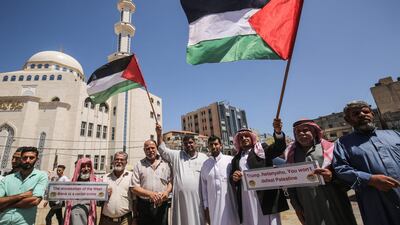
Palestinian protesters take part in a demonstration against Israel's plans to annex parts of the occupied West Bank, in Khan Yunis in the southern Gaza Strip. AFP -
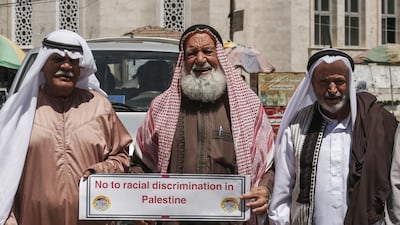
Palestinian protesters shout slogans as they take part in a demonstration against Israel's plans to annex parts of the occupied West Bank, in Khan Yunis in the southern Gaza Strip. AFP -

Palestinian protesters shout slogans as they take part in a demonstration against Israel's plans to annex parts of the occupied West Bank, in Khan Yunis in the southern Gaza Strip. AFP -
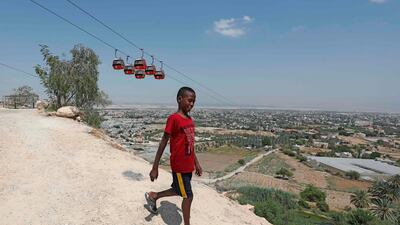
A Palestinian youth walks down a hillside overlooking the West Bank city of Jericho. When Israeli Prime Minister Benjamin Netanyahu unveiled a map of his plans in September, he pointed to a long blue zone to be annexed, leaving a brown speck in the middle: Jericho. Now the city's farmers in the occupied West Bank fear being marooned on a scrap of Palestinian land if Israel forges ahead with its plans to annex the Jordan Valley. AFP -
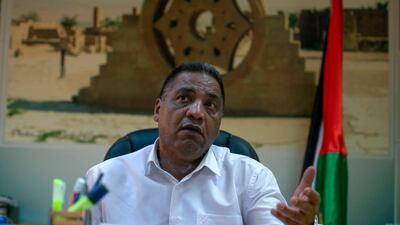
Palestinian mayor of Jericho Salem Ghrouf speaks during an interview at his office in the West Bank city. When Israeli Prime Minister Benjamin Netanyahu unveiled a map of his plans in September, he pointed to a long blue zone to be annexed, leaving a brown speck in the middle: Jericho. Now the city's farmers in the occupied West Bank fear being marooned on a scrap of Palestinian land if Israel forges ahead with its plans to annex the Jordan Valley. AFP -
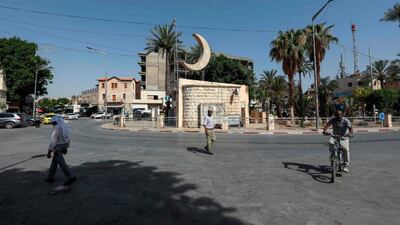
Palestinians pass by on a street of the West Bank city of Jericho. When Israeli Prime Minister Benjamin Netanyahu unveiled a map of his plans in September, he pointed to a long blue zone to be annexed, leaving a brown speck in the middle: Jericho. Now the city's farmers in the occupied West Bank fear being marooned on a scrap of Palestinian land if Israel forges ahead with its plans to annex the Jordan Valley. AFP -
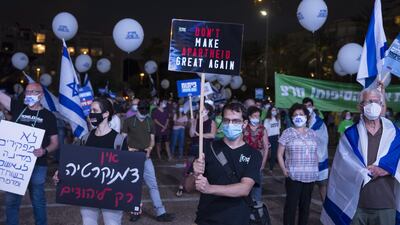
Israelis hold signs as they protest against the Israeli goverment's plan to annex parts of the West Bank in Tel Aviv, Israel. Getty Images -
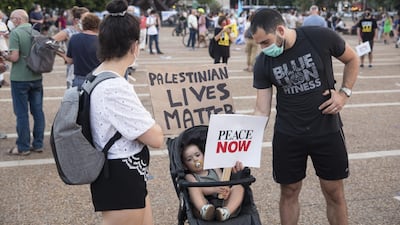
Israelis hold signs as they protest against Israel goverment's plan to annex parts of the West Bank in Tel Aviv, Israel. Getty Images -
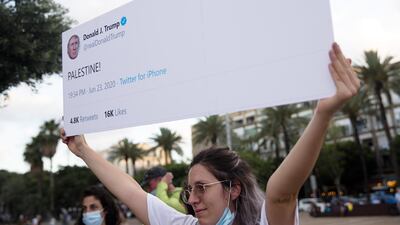
An Israeli woman holds a sign as she protests against Israel goverment's plan to annex parts of the West Bank in Tel Aviv, Israel. Getty Images -

Protesters, wearing masks of Israel's Prime Minister Benjamin Netanyahu and his coalition partner Defence Minister Benny Gantz, take part in a demonstration in Tel Aviv's Rabin Square to denounce Israel's plan to annex parts of the occupied West Bank. AFP -
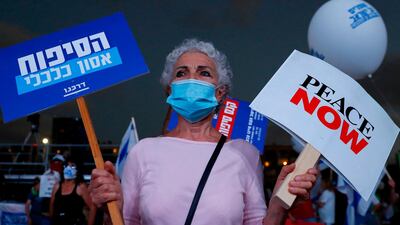
A protester, wearing a protective mask due to the COVID-19 pandemic, holds placards during a demonstration in Tel Aviv's Rabin Square to denounce Israel's plan to annex parts of the occupied West Bank. AFP -
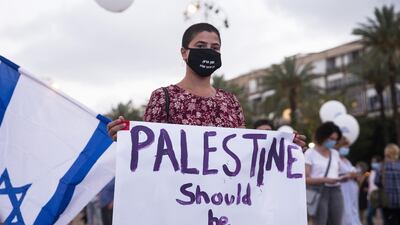
TEL AVIV, ISRAEL - JUNE 23: An Israeli woman holds a sign that reads "Palestine should be free" as she protest against Israel goverment's plan to annex parts of the West Bank in Tel Aviv, Israel. Getty Images


It would let the Europeans cling a little longer to the fig leaf of a moribund peace process, one that has provided a pretext for inaction against Israel for so long.
It has been revelatory watching European governments, even that of Britain's go-it-alone Boris Johnson, suddenly rediscover the importance of international law when faced with annexation and the formal death of the two-state solution.
But whether Mr Netanyahu gets his annexation – all of it or some of it – the Israeli right will emerge strengthened once again in their battle against the Palestinian national movement.
Since the Oslo accords were signed more than a quarter of a century ago, there has been a continual erosion of language and principles, to the detriment of the Palestinian cause.
In those days, the international community’s focus was on ending the occupation, dismantling Israel’s settlements and developing a Palestinian state in the territories vacated by Israel. In his first term as prime minister, in the late 1990s, Mr Netanyahu was forced to cede control of small parts of the West Bank to the Palestinian Authority.
Later, the debate shifted: to where the borders of a future state should be drawn and which settlement “blocs” were too indispensable for Israel to be expected to give them up.
Now a conceptual shift is occurring again. The diplomatic conversation is about how to stop annexation, or at least which parts of annexation, cannot be allowed to proceed.
The occupation and the settlements – and the terrible toll they have inflicted on the lives of Palestinians – are no longer the international community's red line. Annexation is.
As international observers try to stop Israel's formal annexation of the West Bank, they are again losing sight of the incremental thefts of land and displacements of Palestinians taking place on a daily basis.
This kind of concrete annexation – that slowly eats away at Palestinian hopes of dignity and self-determination – will continue apace whatever President Trump decides over the coming days.
Jonathan Cook is a freelance journalist in Nazareth