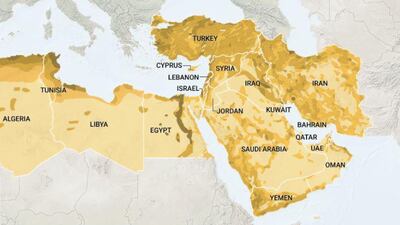
The Middle East has been a region in search of a map from the beginning of time. With vast swaths of the landscape divided along tribal lines or those of principalities for much of history and other divisions ebbing and flowing with the ambitions or whims of empires, the only thing that has been certain about Middle Eastern borders is that they would drift like sand dunes.
What seemed stable amid the shifts were the importance of the three enduring civilisations that have withstood the twists offered up the centuries: those represented today by Egypt, Turkey and Iran. Over time, whether they were rising or falling, they were constants and in their way, stabilising or at least factors that could be counted on.
But today’s Middle East has a new look about it. And it is not a comforting one.
During the past century, the map has been effectively redrawn by the “spheres of influence” of Sykes-Picot, two wars, the fall of colonialism, the realities of the Cold War and a steady stream of local conflicts. But throughout, despite all the upheavals, there were also substantial stabilising factors. For example, during the Cold War, conflicts involving Israel and the Arab world were constrained by the threat of escalation that would draw in the Cold War powers more directly. At other times, regional balance, such as that between Iraq and Iran, was used to contain the ambitions of each.
______________
Read more from Opinion
Lebanon must not get caught in the crossfire between Hizbollah and its critics
ISIL 2.0: a terror group in full insurgency mode
Tehran's domestic divisions are keeping Nazanin Zaghari-Ratcliffe in jail
______________
But we are in very different circumstances today. As far as the great regional civilisations go, Egypt has become, by necessity, inward-looking. Turkey has profoundly alienated its Nato allies and is riven by internal political tensions. Only Iran, among these is strengthening.
Iraq, the one-time counterbalance to Iran, has been shattered and today, Baghdad is closer to Tehran than at any time in recent memory. Indeed, the reality is that thanks to America’s ill-considered war in Iraq and the subsequent rise of ISIL as well as the war in Syria, Iran is now in a highly influential position across the entire northern tier of the Middle East. From Lebanon to western Afghanistan, Iran has grown to be the dominant regional force.
They have done so with the assistance of Russia, a state committed to active involvement in Syria for a long time to come and one supplying Iran with vital arms. And who is there to counterbalance them?
With Egypt sidelined, a new coalition led by Saudi Arabia must play that role. But the kingdom is both going through a leadership transition and is unaccustomed to playing such a leading role. The coalition behind it consists of some rich states but also states that are small. While it is possible that these states may form the moderate Arab coalition the region has long needed to counterbalance Iran and keep the peace from within, today that coalition is nascent and all the actors are learning their parts.
What is more, the greatest supporter of that coalition, the United States has through two presidents now reduced its role and signalled a lesser commitment to be involved. Further, a key element of the Saudi ability to counteract Iran is an unspoken partnership with Israel - a fragile proposition at best given history and politics in both countries.
______________
Read more from David Rothkopf
Trump in the White House: will the great disrupter unsettle America's checks and balances?
From city streets to corporate suites, harassment is an epidemic
______________
In essence, the region has become bipolar, orbiting primarily around Saudi Arabia and Iran, two countries divided by 1,000 years of history. Both sides have shown they are in a combative mood, willing to engage each other in proxy contests and to talk more openly of something larger and more devastating. The outside actors are involved enough to stoke the confidence of the two sides but not engaged enough diplomatically to be effective stabilisers.
In other words, at a time of high tensions, there is a new geopolitical calculus in the region, some of the key leaders are either inexperienced or leading countries inexperienced in active regional foreign policy, potentially stabilising forces outside the region are not playing a constructive role, and the open wounds of recent conflicts are certain to fester because none will step up with political, humanitarian and economic initiatives required to bring about healing and stabilisation.
Compound all this with the fact that some leaders, like Donald Trump in the US, might soon actually feel that they would benefit from the distractions further regional conflict might bring and it is hard not to draw ominous conclusions. At least it is, if the moderate Arab coalition does not soon come to recognise that beyond demonstrating their toughness and their strength they also being to show that they can be peacemakers, stabilisers, healers and regimes inexperienced in such high stakes security issues quickly master their briefs.
That is not impossible. However, finding a winner will be, if this new bipolar reality produces the kind of region-wide conflict that is all too imaginable. In other words, it will take the triumph of considerable wisdom over experience to ensure that the next map of the Middle East is not written in blood. And for the first time in memory, the responsibility for ensuring such an outcome lies largely with the Sunni Arabs of the Gulf.
David Rothkopf is CEO of The Rothkopf Group, senior fellow at the Johns Hopkins School of Advanced International Studies, a visiting scholar at the Carnegie Endowment for International Peace and most recently author of The Great Questions of Tomorrow

