Britain's Prime Minister Boris Johnson (left), US President Donald Trump (centre), German Chancellor Angela Merkel (second right), Turkey's President Recep Tayyip Erdogan (right) and other Nato leaders leave the stage after the family photo to head to the plenary session at the NATO summit at the Grove hotel in Watford. AFP
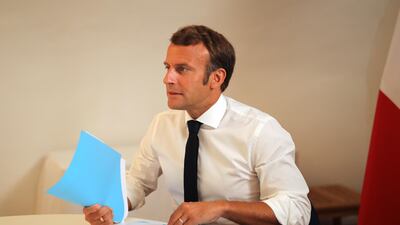
Emmanuel Macron, France's president, gestures while speaking during a news conference. Bloomberg
Britain's Princess Anne, right, talks to Nato delegates from left, Canadian Prime Minister Justin Trudeau and Britain's Prime Minister Boris Johnson. AP
US President Donald Trump speaks during a bilateral meeting with Italy's Prime Minister Giuseppe Conte (unseen) at the Nato summit at the Grove hotel in Watford. AFP
Donald Trump and Italian Prime Minister Giuseppe Conte meet on the sidelines of the Nato summit in Watford. Reuters
France's President Emmanuel Macron (right) greets Poland's President Andrzej Duda (left) during a meeting at the Nato summit at the Grove hotel in Watford. AFP
France's President Emmanuel Macron gives a press conference. AFP
US President Donald Trump speaks during a bilateral meeting with Italy's Prime Minister Giuseppe Conte. AFP
if Nato didn’t already exist, would it be necessary to invent it today?
Several factors make this a timely question. The first, involving as it does Donald Trump, has provoked fits of the vapours in the usual quarters. According to a new book, the US President's former chief of staff, retired marine general John Kelly, said that "one of the most difficult tasks he faced with Trump was trying to stop him from pulling out of Nato". Even if Mr Trump doesn't officially do so – either before the presidential election or after, if he wins – there is speculation that he could effectively destroy Nato by reinterpreting Article 5 of Nato's founding treaty.
This has always been deemed to mean that an attack on one member would be followed by collective, armed self-defence. But the wording is not strict. In such circumstances, each member is bound to take "such action as it deems necessary, including the use of armed force". But as Thomas Wright of the Brookings Institution told The New York Times: "He could just reinterpret it as, 'I could just send a strongly worded letter'."
This may have partisans of the Atlantic alliance wringing their hands, but in a period when Nato members Turkey and Greece have exchanged threats of war over disputed gas resources in the Mediterranean – and may escalate further – instant invocation of armed collective action would be impossible. Nato could not come to the defence of both sides, after all.
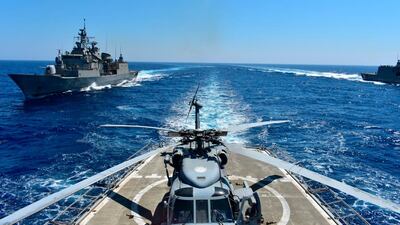
Greek warships take part in military exercises in Eastern Mediterranean sea, as tensions rise with Turkey over the waters. Greek Defense Ministry/AP
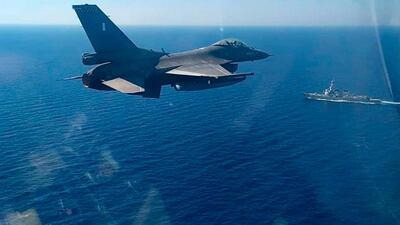
The Greek air force joined the exercises. Greek Defense Ministry/AP
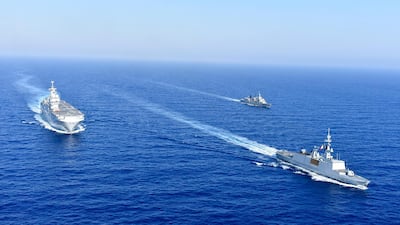
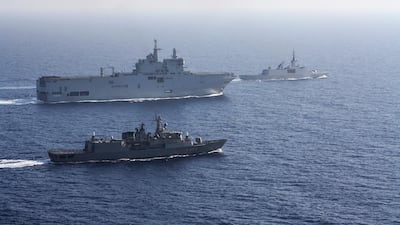
The Tonnerre is escorted by Greek and French military vessels. Greek National Defence/AP)
The French Tonnerre helicopter carrier, rear left, is escorted by Greek and French military vessels during a maritime exercise in the Eastern Mediterranean, where Greek and Turkish warships are also closely shadowing each other. (Greek National Defence/AP)
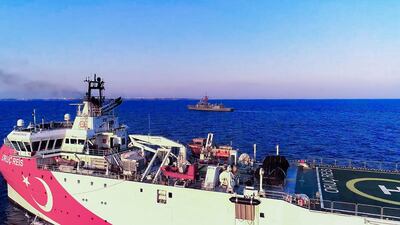
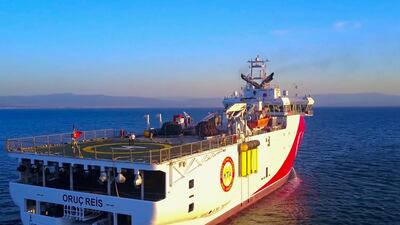
The Turkish seismic research vessel 'Oruc Reis' heading west of Antalya in the Mediterranean Sea. Turkish Defence Ministry/AFP
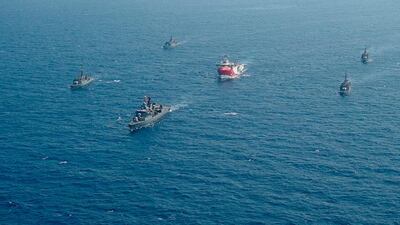
Tension are high between Greece and Turkey, over the 'Oruc-Reis' and its mission in the eastern Mediterranean. IHA via AP
Turkey’s claims to the waters, which it says are on its continental shelf, have repeatedly been dismissed as illegal by Greece and its allies. Turkish Defence Ministry/AFP
Turkish ships accompany the 'Oruc Reis,' a seismic research vessel. Turkish Defence Ministry/AFP
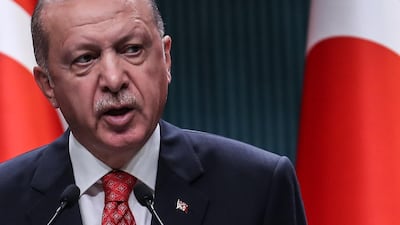
Turkish President Recep Tayyip Erdogan has called for dialogue while still pushing ahead with a Mediterranean gas development plan that has outraged Greece. AFP
Greek Prime Minister Kyriakos Mitsotakis warned of the potential for a mishap with Greek and Turkish navies both in the area.. EPA
France will strengthen its military presence in the eastern Mediterranean. Reuters
Further, Nato has expanded so egregiously in recent decades that there is uncertainty that Article 5 is the same cast-iron guarantee that it was during the Cold War. Would all parties go to war for North Macedonia, or over an "accidental" Russian border incursion into Estonia?
Mr Trump is not alone in asking what Nato is for these days. He is echoed by French President Emmanuel Macron, who last November declared that the organisation was "brain dead". Mr Macron also queried whether Article 5 would still trigger a collective response.
This not only a matter for the 30 members of the alliance. For Nato has long been looking east. It established Global Partnerships with South Korea, New Zealand, Mongolia, Australia and Japan in the first half of the last decade, and is now focusing increasingly on China. Other voices are urging the “Quad” of the US, Japan, Australia and India to become the basis of an “Indo-Pacific Nato”, as the US Deputy Secretary of State Stephen Biegun put it at the end of last month.
If Nato is to have a larger presence and an enhanced role in East Asia, or is to be joined by a regional version, the question still remains: what is its purpose?
One answer to that is that it is an alliance of democracies. Mr Biegun alluded to that in his remarks, saying that the Trump administration’s “Indo-Pacific strategy is focused around democracies”. Nato’s London Declaration issued last December also states in the second sentence that the organisation “guarantees… the values we share, including democracy, individual liberty, human rights, and the rule of law”.
As a core raison d'etre of the alliance this is problematic, however. Firstly because one of Nato's current challenges is that a number of members – including Hungary, Poland and Turkey – remain democracies but are deemed to have taken a markedly illiberal or even authoritarian turn. Secondly, as the US academics James Goldgeier and Garret Martin pointed out in a recent article, being a democracy during the Cold War was not a pre-condition of membership: "Portugal did not become a democracy until 1974. As for Greece and Turkey, the former was governed by a military dictatorship from 1967 to 1974, while the latter was the subject of multiple military-led coups."
President Macron’s pointed questions remain the key ones. “Who is our common enemy?” he said. “This question deserves to be clarified. Is our enemy today, as I hear sometimes, Russia? Is it China? Is it the Atlantic alliance’s purpose to designate them as enemies? I don’t think so.”
It is worth asking whether Nato today should consider Vladimir Putin's Russia or Xi Jinping's China as enemies or as partners against a common threat. AP Photo
I agree with Mr Macron, but there are plenty of Nato boosters who don’t. For instance Ian Brzezinski, a senior defence official under former US president George W Bush, proposes setting up a Nato-China Council, which sounds promising. He then writes, though, that “its establishment would underscore that this dimension of great power competition is not between China and the United States but between China and the transatlantic community".
The London Declaration similarly oscillates between sounding conciliatory – “Nato is a defensive Alliance and poses no threat to any country” – and more bellicose, declaring that “Russia’s aggressive actions constitute a threat to Euro-Atlantic security” and that “China’s growing influence and international policies present both opportunities and challenges that we need to address together as an alliance".
Nato leaders at the highest level have agreed to assemble the 19-nation armada during the Covid-19 outbreak. AFP
The truth is that for all the airy talk of “the values we share”, what bound Nato together during the Cold War was standing up to the Soviet Union. It is a security alliance; it is not and cannot be an alliance of liberal democracies (otherwise several members would have to be expelled and others in Asia would not want to join). For it to be strong, perhaps it does need a common enemy; but that is not an argument for choosing one that makes confrontation more likely.
Better, perhaps, for Nato to expand to become a global security umbrella and agree with Mr Macron when he said that our common enemy is “terrorism, which has hit all of our countries".
This would be a much scaled-down, less ambitious Nato. It would be a shadow of the military alliance that once kept the West safe – no disadvantage in the Covid-19-straitened present. But with Russia and China inside it, or at least as strong partners, it would be a better one for our times. And it would be a Nato that could adequately answer the question: “what is it for?”
Sholto Byrnes is an East Asian affairs columnist for The National

UAE currency: the story behind the money in your pockets
Position: legal consultant with Al Rowaad Advocates and Legal Consultants.
World record transfers
1. Kylian Mbappe - to Real Madrid in 2017/18 - €180 million (Dh770.4m - if a deal goes through)
2. Paul Pogba - to Manchester United in 2016/17 - €105m
3. Gareth Bale - to Real Madrid in 2013/14 - €101m
4. Cristiano Ronaldo - to Real Madrid in 2009/10 - €94m
5. Gonzalo Higuain - to Juventus in 2016/17 - €90m
6. Neymar - to Barcelona in 2013/14 - €88.2m
7. Romelu Lukaku - to Manchester United in 2017/18 - €84.7m
8. Luis Suarez - to Barcelona in 2014/15 - €81.72m
9. Angel di Maria - to Manchester United in 2014/15 - €75m
10. James Rodriguez - to Real Madrid in 2014/15 - €75m
A widely accepted definition was made by the All Party Parliamentary Group on British Muslims in 2019: “Islamophobia is rooted in racism and is a type of racism that targets expressions of Muslimness or perceived Muslimness.” It further defines it as “inciting hatred or violence against Muslims”.
1. Domestic VAT refund amendments: request your refund within five years
If a business does not apply for the refund on time, they lose their credit.
2. E-invoicing in the UAE
Businesses should continue preparing for the implementation of e-invoicing in the UAE, with 2026 a preparation and transition period ahead of phased mandatory adoption.
3. More tax audits
Tax authorities are increasingly using data already available across multiple filings to identify audit risks.
4. More beneficial VAT and excise tax penalty regime
Tax disputes are expected to become more frequent and more structured, with clearer administrative objection and appeal processes. The UAE has adopted a new penalty regime for VAT and excise disputes, which now mirrors the penalty regime for corporate tax.
5. Greater emphasis on statutory audit
There is a greater need for the accuracy of financial statements. The International Financial Reporting Standards standards need to be strictly adhered to and, as a result, the quality of the audits will need to increase.
6. Further transfer pricing enforcement
Transfer pricing enforcement, which refers to the practice of establishing prices for internal transactions between related entities, is expected to broaden in scope. The UAE will shortly open the possibility to negotiate advance pricing agreements, or essentially rulings for transfer pricing purposes.
7. Limited time periods for audits
Recent amendments also introduce a default five-year limitation period for tax audits and assessments, subject to specific statutory exceptions. While the standard audit and assessment period is five years, this may be extended to up to 15 years in cases involving fraud or tax evasion.
8. Pillar 2 implementation
Many multinational groups will begin to feel the practical effect of the Domestic Minimum Top-Up Tax (DMTT), the UAE's implementation of the OECD’s global minimum tax under Pillar 2. While the rules apply for financial years starting on or after January 1, 2025, it is 2026 that marks the transition to an operational phase.
9. Reduced compliance obligations for imported goods and services
Businesses that apply the reverse-charge mechanism for VAT purposes in the UAE may benefit from reduced compliance obligations.
10. Substance and CbC reporting focus
Tax authorities are expected to continue strengthening the enforcement of economic substance and Country-by-Country (CbC) reporting frameworks. In the UAE, these regimes are increasingly being used as risk-assessment tools, providing tax authorities with a comprehensive view of multinational groups’ global footprints and enabling them to assess whether profits are aligned with real economic activity.
Contributed by Thomas Vanhee and Hend Rashwan, Aurifer
ICC T20 Rankings
1. India - 270 ranking points
2. England - 265 points
3. Pakistan - 261 points
4. South Africa - 253 points
5. Australia - 251 points
6. New Zealand - 250 points
7. West Indies - 240 points
8. Bangladesh - 233 points
9. Sri Lanka - 230 points
10. Afghanistan - 226 points
Key facilities
Olympic-size swimming pool with a split bulkhead for multi-use configurations, including water polo and 50m/25m training lanes
Premier League-standard football pitch
400m Olympic running track
NBA-spec basketball court with auditorium
600-seat auditorium
Spaces for historical and cultural exploration
An elevated football field that doubles as a helipad
Specialist robotics and science laboratories
AR and VR-enabled learning centres
Disruption Lab and Research Centre for developing entrepreneurial skills
10 tips for entry-level job seekers
Have an up-to-date, professional LinkedIn profile. If you don’t have a LinkedIn account, set one up today. Avoid poor-quality profile pictures with distracting backgrounds. Include a professional summary and begin to grow your network.
Keep track of the job trends in your sector through the news. Apply for job alerts at your dream organisations and the types of jobs you want – LinkedIn uses AI to share similar relevant jobs based on your selections.
Double check that you’ve highlighted relevant skills on your resume and LinkedIn profile.
For most entry-level jobs, your resume will first be filtered by an applicant tracking system for keywords. Look closely at the description of the job you are applying for and mirror the language as much as possible (while being honest and accurate about your skills and experience).
Keep your CV professional and in a simple format – make sure you tailor your cover letter and application to the company and role.
Go online and look for details on job specifications for your target position. Make a list of skills required and set yourself some learning goals to tick off all the necessary skills one by one.
Don’t be afraid to reach outside your immediate friends and family to other acquaintances and let them know you are looking for new opportunities.
Make sure you’ve set your LinkedIn profile to signal that you are “open to opportunities”. Also be sure to use LinkedIn to search for people who are still actively hiring by searching for those that have the headline “I’m hiring” or “We’re hiring” in their profile.
Prepare for online interviews using mock interview tools. Even before landing interviews, it can be useful to start practising.
Be professional and patient. Always be professional with whoever you are interacting with throughout your search process, this will be remembered. You need to be patient, dedicated and not give up on your search. Candidates need to make sure they are following up appropriately for roles they have applied.
Arda Atalay, head of Mena private sector at LinkedIn Talent Solutions, Rudy Bier, managing partner of Kinetic Business Solutions and Ben Kinerman Daltrey, co-founder of KinFitz
If you go
The Flights
Emirates and Etihad fly direct to Johannesburg from Dubai and Abu Dhabi respectively. Economy return tickets cost from Dh2,650, including taxes.
The trip
Worldwide Motorhoming Holidays (worldwidemotorhomingholidays.co.uk) operates fly-drive motorhome holidays in eight destinations, including South Africa. Its 14-day Kruger and the Battlefields itinerary starts from Dh17,500, including campgrounds, excursions, unit hire and flights. Bobo Campers has a range of RVs for hire, including the 4-berth Discoverer 4 from Dh600 per day.
The specs
Engine: 4.0-litre V8 twin-turbocharged and three electric motors
Power: Combined output 920hp
Torque: 730Nm at 4,000-7,000rpm
Transmission: 8-speed dual-clutch automatic
Fuel consumption: 11.2L/100km
On sale: Now, deliveries expected later in 2025
Price: expected to start at Dh1,432,000
Key changes
Commission caps
For life insurance products with a savings component, Peter Hodgins of Clyde & Co said different caps apply to the saving and protection elements:
• For the saving component, a cap of 4.5 per cent of the annualised premium per year (which may not exceed 90 per cent of the annualised premium over the policy term).
• On the protection component, there is a cap of 10 per cent of the annualised premium per year (which may not exceed 160 per cent of the annualised premium over the policy term).
• Indemnity commission, the amount of commission that can be advanced to a product salesperson, can be 50 per cent of the annualised premium for the first year or 50 per cent of the total commissions on the policy calculated.
• The remaining commission after deduction of the indemnity commission is paid equally over the premium payment term.
• For pure protection products, which only offer a life insurance component, the maximum commission will be 10 per cent of the annualised premium multiplied by the length of the policy in years.
Disclosure
Customers must now be provided with a full illustration of the product they are buying to ensure they understand the potential returns on savings products as well as the effects of any charges. There is also a “free-look” period of 30 days, where insurers must provide a full refund if the buyer wishes to cancel the policy.
“The illustration should provide for at least two scenarios to illustrate the performance of the product,” said Mr Hodgins. “All illustrations are required to be signed by the customer.”
Another illustration must outline surrender charges to ensure they understand the costs of exiting a fixed-term product early.
Illustrations must also be kept updatedand insurers must provide information on the top five investment funds available annually, including at least five years' performance data.
“This may be segregated based on the risk appetite of the customer (in which case, the top five funds for each segment must be provided),” said Mr Hodgins.
Product providers must also disclose the ratio of protection benefit to savings benefits. If a protection benefit ratio is less than 10 per cent "the product must carry a warning stating that it has limited or no protection benefit" Mr Hodgins added.