US Vice President Joe Biden during a meeting in the Roosevelt Room of the White House in Washington on February 25, 2009.. The mark on Mr Biden's head is from Christian worship services ashes from the first day of Lent. AFP
US Vice President Joe Biden during a meeting in the Roosevelt Room of the White House in Washington on February 25, 2009.. The mark on Mr Biden's head is from Christian worship services ashes from the

Why do we shy away from talking about a politician's religion?


  • English
  • Arabic

Of the many things we have learnt about Joe Biden over his decades in politics, one of the most important is that the Democratic candidate for US president is serious about his Roman Catholic religion. There was no attempt to deflect from that at last week’s Democratic Party convention.

Speaker after speaker, including the former Republican governor John Kasich and both Michelle and Barack Obama, referred to Mr Biden's faith as the cornerstone of his character. Speaker of the House of Representatives Nancy Pelosi said: “Joe Biden’s faith in God gives him the strength to lead.”

In the view of the US religion writer Jack Jenkins, “the convention itself was unusually spiritual. Speakers, organisers and delegates appealed to a conciliatory, inspirational form of religion with a fervency not seen at any party convention in recent memory – Republican or Democratic.” The online events included a “Believers for Biden” party, an interfaith council and a Muslim delegates’ assembly.

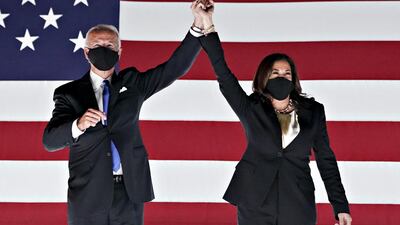
  • Former Vice President Joe Biden, Democratic presidential nominee, left, and Senator Kamala Harris, Democratic vice presidential nominee, wear protective masks while holding hands outside the Chase Center during the Democratic National Convention in Wilmington, Delaware, USA. Bloomberg
    Former Vice President Joe Biden, Democratic presidential nominee, left, and Senator Kamala Harris, Democratic vice presidential nominee, wear protective masks while holding hands outside the Chase Center during the Democratic National Convention in Wilmington, Delaware, USA. Bloomberg
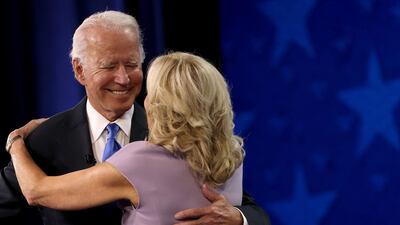
  • Joe Biden embraces his wife Dr. Jill Biden after delivering his acceptance speech. AFP
    Joe Biden embraces his wife Dr. Jill Biden after delivering his acceptance speech. AFP
  • Joe Biden hugs his wife Jill Biden during the fourth day of the Democratic National Convention. AP Photo
    Joe Biden hugs his wife Jill Biden during the fourth day of the Democratic National Convention. AP Photo
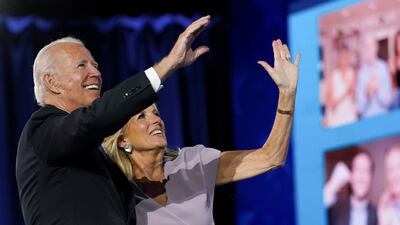
  • Joe Biden and his wife Jill are pictured after he accepted the 2020 Democratic presidential nomination. Reuters
    Joe Biden and his wife Jill are pictured after he accepted the 2020 Democratic presidential nomination. Reuters
  • Sen. Kamala Harris looks at her husband Doug Emhoff on an outdoor stage. AP Photo
    Sen. Kamala Harris looks at her husband Doug Emhoff on an outdoor stage. AP Photo
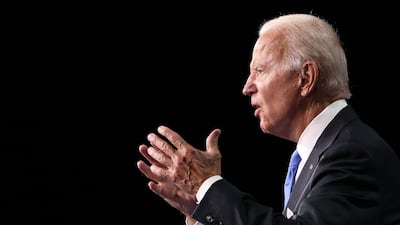
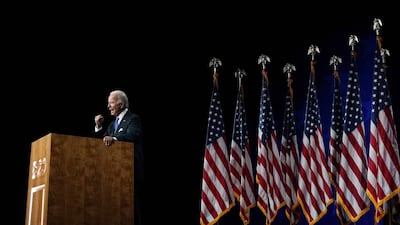
  • Joe Biden delivers his acceptance speech. AFP
    Joe Biden delivers his acceptance speech. AFP
  • Joe Biden accepts the Democratic Party nomination for US president. AFP
    Joe Biden accepts the Democratic Party nomination for US president. AFP
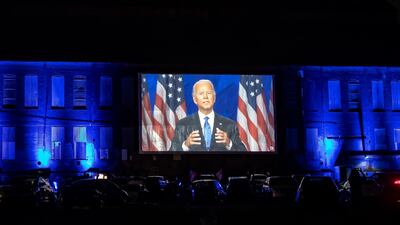
  • Attendees watch from their vehicles as Joe Biden speaks after accepting the nomination during a drive-in watch party for the Democratic National Convention. Pittsburgh Post-Gazette via AP
    Attendees watch from their vehicles as Joe Biden speaks after accepting the nomination during a drive-in watch party for the Democratic National Convention. Pittsburgh Post-Gazette via AP
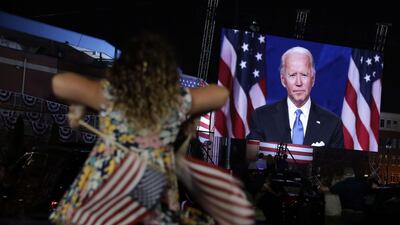
  • A supporter watches Joe Biden's acceptance speech from a parking lot outside Chase Center. AFP
    A supporter watches Joe Biden's acceptance speech from a parking lot outside Chase Center. AFP
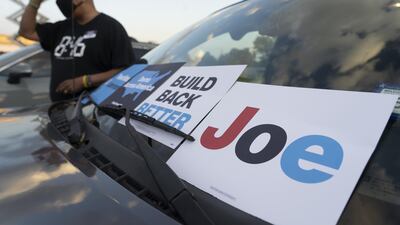
  • A Joe Biden supporter places signs on his car during a drive-in DNC watch event in Houston, Texas. AFP
    A Joe Biden supporter places signs on his car during a drive-in DNC watch event in Houston, Texas. AFP
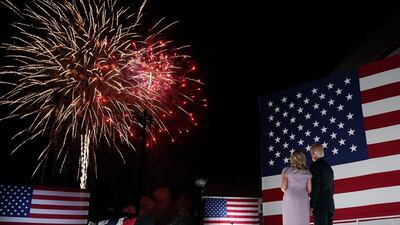
  • Joe Biden and Jill watch fireworks outside the Chase Center. AFP
    Joe Biden and Jill watch fireworks outside the Chase Center. AFP
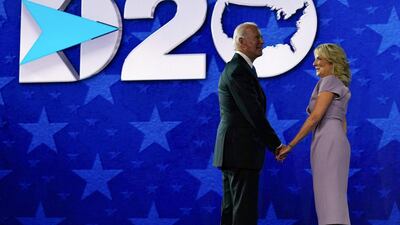
  • Joe Biden and Jill Biden stand on stage after he accepted the Democratic Party nomination for US president. AFP
    Joe Biden and Jill Biden stand on stage after he accepted the Democratic Party nomination for US president. AFP

Some overt display of piety is almost compulsory for politicians in the US. But this was different. This was not just ticking the box for public consumption. As Senator Chris Coons put it, “For Joe, faith isn’t a prop or a political tool. Joe knows the power of prayer, and I’ve seen him in moments of joy and triumph, of loss and despair, turn to God for strength.”

The convention, and Mr Biden’s campaign, are putting religion in the public square in an unabashed way that has become rare in many Western countries. This reticence stems from various factors, ranging from a sense that faith is a personal matter best not addressed at length in public, to an overdeveloped notion of separation of church and state that has – in the case of France, for example – led to outright hostility to religion and the state-sponsored persecution of schoolchildren who want to wear headscarves or crucifixes.

The overall attitude was most famously summed up by Alastair Campbell, spin doctor to then UK prime minister Tony Blair, when he told an interviewer, “We don’t do God.” Years later, in 2008, Mr Blair explained his reasoning for not doing so: that others may assume that people of faith are trying to impose their beliefs on others, and that those who talk openly about their religious convictions “may be considered weird”.

Mr Blair was, sad to say, not wrong to warn about that. Over the last 20 years, the small but highly influential band of “New Atheists”, such as Richard Dawkins, Sam Harris and the late Christopher Hitchens, have openly sneered at the religious. Mr Dawkins, for instance, once tweeted that “30 per cent of Australians say they have no religion. It’s what any intelligent person would say". That was a mild example, but the dismissal of vast swathes of humanity as “unintelligent” is typical of this group.

The reality, unless you believe most people are stupid, is quite different. In the latest survey by the Pew-Templeton Global Religious Futures Project, the worldwide percentage who identified as “unaffiliated” with any religion or belief system was a mere 16.4 percent – a proportion that is predicted to go down to just over 13 per cent by 2050. The numbers of Christians and Muslims, meanwhile, are expected to soar, with the two religions coming close to parity in terms of their adherents by mid-century. Mr Dawkins’s characterisation also sits oddly with most of human history, for until the 20th century it was difficult to think of any society in which religion did not enjoy a prominent position.

Polling shows that the world is likely to become a more religious place by 2050. AFP
A reticence to allow religion in the public square has led to outright hostility to it in places like France

Those who wish to banish religion to the margins have focused on extremist, and frequently deviant, versions of faiths. They ignore the history of great traditions of tolerance among believers, such as the glorious and intellectually enriching multireligious diversity of the great Islamic empires. They also ignore the modern heroes who continue this struggle, from Imam Feisal Abdul Rauf, organiser of the Cordoba Initiative in New York, to the Muslim World League Secretary-General Mohammed bin Abdul Karim Al Issa, who was recently awarded the first-ever Combat Anti-Semitism Award in the US.

In his address at the award ceremony, which was attended by the US Ambassador-at-Large for International Religious Freedom Sam Brownback, Dr Al Issa stated the need for “outreach to all of Allah’s children — Christians, Jews, Hindus, Buddhists, and others. For our battle against intolerance and division is the same".

We need to hear more about this, and about the huge amount of work that religious charities are doing around the world – often in the fields of health care and education – that receives next to no coverage in international media.

When Martin Luther King, Jr and Jesse Jackson are discussed in American discourse, it often seems as though they have been shorn of their priesthoods; they were “just” civil rights leaders. But as Mr Blair said in his 2008 speech, "If you are someone 'of faith', it is the focal point of belief in your life. There is no conceivable way that it wouldn't affect your politics." So their status as ordained ministers was not incidental. They were inspirational leaders because of their belief.

This brings us back to Mr Biden, who without the sustenance offered by his faith may have been incapacitated by grief after the deaths of his first wife and daughter in 1972 and his son Beau in 2015. In his view, it was his trust in God that saved him, and it is through that faith that he has enlarged that capacity for empathy that so many admire in him.

The emphasis on his religion brings no harshness to Mr Biden's campaign, excludes no one and declares no one under any obligation to live according to highly prescriptive or proscriptive rules. Instead, it is inclusive, compassionate, loving and forgiving. Religion can bring a moral centre to a campaign whose candidate promises healing. For that, America, and the rest of the world, should be grateful.

Sholto Byrnes is a commentator and consultant in Kuala Lumpur and a corresponding fellow of the Erasmus Forum

The five pillars of Islam

1. Fasting 

2. Prayer 

3. Hajj 

4. Shahada 

5. Zakat 

10 tips for entry-level job seekers
  • Have an up-to-date, professional LinkedIn profile. If you don’t have a LinkedIn account, set one up today. Avoid poor-quality profile pictures with distracting backgrounds. Include a professional summary and begin to grow your network.
  • Keep track of the job trends in your sector through the news. Apply for job alerts at your dream organisations and the types of jobs you want – LinkedIn uses AI to share similar relevant jobs based on your selections.
  • Double check that you’ve highlighted relevant skills on your resume and LinkedIn profile.
  • For most entry-level jobs, your resume will first be filtered by an applicant tracking system for keywords. Look closely at the description of the job you are applying for and mirror the language as much as possible (while being honest and accurate about your skills and experience).
  • Keep your CV professional and in a simple format – make sure you tailor your cover letter and application to the company and role.
  • Go online and look for details on job specifications for your target position. Make a list of skills required and set yourself some learning goals to tick off all the necessary skills one by one.
  • Don’t be afraid to reach outside your immediate friends and family to other acquaintances and let them know you are looking for new opportunities.
  • Make sure you’ve set your LinkedIn profile to signal that you are “open to opportunities”. Also be sure to use LinkedIn to search for people who are still actively hiring by searching for those that have the headline “I’m hiring” or “We’re hiring” in their profile.
  • Prepare for online interviews using mock interview tools. Even before landing interviews, it can be useful to start practising.
  • Be professional and patient. Always be professional with whoever you are interacting with throughout your search process, this will be remembered. You need to be patient, dedicated and not give up on your search. Candidates need to make sure they are following up appropriately for roles they have applied.

Arda Atalay, head of Mena private sector at LinkedIn Talent Solutions, Rudy Bier, managing partner of Kinetic Business Solutions and Ben Kinerman Daltrey, co-founder of KinFitz

UAE currency: the story behind the money in your pockets

Mercer, the investment consulting arm of US services company Marsh & McLennan, expects its wealth division to at least double its assets under management (AUM) in the Middle East as wealth in the region continues to grow despite economic headwinds, a company official said.

Mercer Wealth, which globally has $160 billion in AUM, plans to boost its AUM in the region to $2-$3bn in the next 2-3 years from the present $1bn, said Yasir AbuShaban, a Dubai-based principal with Mercer Wealth.

Within the next two to three years, we are looking at reaching $2 to $3 billion as a conservative estimate and we do see an opportunity to do so,” said Mr AbuShaban.

Mercer does not directly make investments, but allocates clients’ money they have discretion to, to professional asset managers. They also provide advice to clients.

“We have buying power. We can negotiate on their (client’s) behalf with asset managers to provide them lower fees than they otherwise would have to get on their own,” he added.

Mercer Wealth’s clients include sovereign wealth funds, family offices, and insurance companies among others.

From its office in Dubai, Mercer also looks after Africa, India and Turkey, where they also see opportunity for growth.

Wealth creation in Middle East and Africa (MEA) grew 8.5 per cent to $8.1 trillion last year from $7.5tn in 2015, higher than last year’s global average of 6 per cent and the second-highest growth in a region after Asia-Pacific which grew 9.9 per cent, according to consultancy Boston Consulting Group (BCG). In the region, where wealth grew just 1.9 per cent in 2015 compared with 2014, a pickup in oil prices has helped in wealth generation.

BCG is forecasting MEA wealth will rise to $12tn by 2021, growing at an annual average of 8 per cent.

Drivers of wealth generation in the region will be split evenly between new wealth creation and growth of performance of existing assets, according to BCG.

Another general trend in the region is clients’ looking for a comprehensive approach to investing, according to Mr AbuShaban.

“Institutional investors or some of the families are seeing a slowdown in the available capital they have to invest and in that sense they are looking at optimizing the way they manage their portfolios and making sure they are not investing haphazardly and different parts of their investment are working together,” said Mr AbuShaban.

Some clients also have a higher appetite for risk, given the low interest-rate environment that does not provide enough yield for some institutional investors. These clients are keen to invest in illiquid assets, such as private equity and infrastructure.

“What we have seen is a desire for higher returns in what has been a low-return environment specifically in various fixed income or bonds,” he said.

“In this environment, we have seen a de facto increase in the risk that clients are taking in things like illiquid investments, private equity investments, infrastructure and private debt, those kind of investments were higher illiquidity results in incrementally higher returns.”

The Abu Dhabi Investment Authority, one of the largest sovereign wealth funds, said in its 2016 report that has gradually increased its exposure in direct private equity and private credit transactions, mainly in Asian markets and especially in China and India. The authority’s private equity department focused on structured equities owing to “their defensive characteristics.”

THE BIO

Favourite holiday destination: Whenever I have any free time I always go back to see my family in Caltra, Galway, it’s the only place I can properly relax.

Favourite film: The Way, starring Martin Sheen. It’s about the Camino de Santiago walk from France to Spain.

Personal motto: If something’s meant for you it won’t pass you by.

Sri Lanka-India Test series schedule
  • 1st Test India won by 304 runs at Galle
  • 2nd Test Thursday-Monday at Colombo
  • 3rd Test August 12-16 at Pallekele
The%20specs%20
%3Cp%3E%3Cstrong%3EEngine%3A%20%3C%2Fstrong%3E2.0-litre%204cyl%20turbo%0D%3Cbr%3E%3Cstrong%3EPower%3A%20%3C%2Fstrong%3E261hp%20at%205%2C500rpm%0D%3Cbr%3E%3Cstrong%3ETorque%3A%20%3C%2Fstrong%3E400Nm%20at%201%2C750-4%2C000rpm%0D%3Cbr%3E%3Cstrong%3ETransmission%3A%20%3C%2Fstrong%3E7-speed%20dual-clutch%20auto%0D%3Cbr%3E%3Cstrong%3EFuel%20consumption%3A%20%3C%2Fstrong%3E10.5L%2F100km%0D%3Cbr%3E%3Cstrong%3EOn%20sale%3A%20%3C%2Fstrong%3ENow%0D%3Cbr%3E%3Cstrong%3EPrice%3A%20%3C%2Fstrong%3EFrom%20Dh129%2C999%20(VX%20Luxury)%3B%20from%20Dh149%2C999%20(VX%20Black%20Gold)%3C%2Fp%3E%0A
The burning issue

The internal combustion engine is facing a watershed moment – major manufacturer Volvo is to stop producing petroleum-powered vehicles by 2021 and countries in Europe, including the UK, have vowed to ban their sale before 2040. The National takes a look at the story of one of the most successful technologies of the last 100 years and how it has impacted life in the UAE. 

Read part four: an affection for classic cars lives on

Read part three: the age of the electric vehicle begins

Read part two: how climate change drove the race for an alternative 

The Rub of Time: Bellow, Nabokov, Hitchens, Travolta, Trump and Other Pieces 1986-2016
Martin Amis,
Jonathan Cape