An aerial view taken on July 24, 2020, shows Palestinians sunbathing on a beach in Gaza City on a hot summer day. AFP

Why is the world unable to see Gaza's true potential?


  • English
  • Arabic

Last July,  I was in Gaza. The heat was unbearable, as it usually is at this time of the year. It only adds to the general misery stemming from power cuts, a lack of clean water and sanitation and, of course, the now 13-year Israeli blockade. The unemployment rate among youth – many of whom would normally graduate from university during this time – stands at nearly 70 per cent.

Throw into the mix the coronavirus pandemic and the looming annexation of 30 per cent of the West Bank, as threatened by Israeli Prime Minister Benjamin Netanyahu, and things begin to look dire. There is a feeling of claustrophobia and of never being able to leave, added to the hopelessness of the 1.9 million people living in the 40-kilometre strip.

It is little wonder then that psychologists and economists in Gaza are deeply concerned about the rising suicide rates, especially among the young.

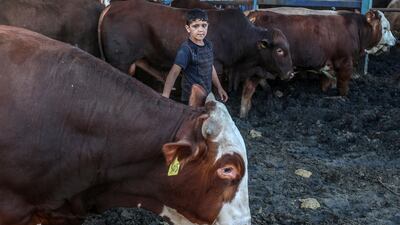
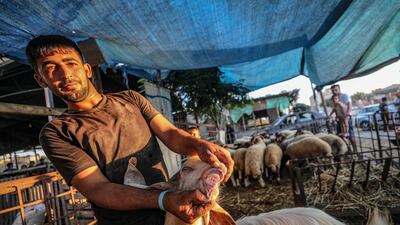
  • A Palestinian boy walks between a sacrificial animals at a livestock market in the southern Gaza Strip. Gazans are buying more sheep and cattle in preparation for the upcoming Sacrifice Feast. Eid al-Adha is the holiest of the two Muslims holidays celebrated each year, it marks the yearly Muslim pilgrimage (Hajj) to visit Mecca, the holiest place in Islam. Muslims slaughter a sacrificial animal and split the meat into three parts, one for the family, one for friends and relatives, and one for the poor and needy. EPA
    A Palestinian boy walks between a sacrificial animals at a livestock market in the southern Gaza Strip. Gazans are buying more sheep and cattle in preparation for the upcoming Sacrifice Feast. Eid al-Adha is the holiest of the two Muslims holidays celebrated each year, it marks the yearly Muslim pilgrimage (Hajj) to visit Mecca, the holiest place in Islam. Muslims slaughter a sacrificial animal and split the meat into three parts, one for the family, one for friends and relatives, and one for the poor and needy. EPA
  • Palestinian vendors display their sheep at a livestock market in the southern Gaza Strip. Gazans are buying more sheep and cattle in preparation for the upcoming Sacrifice Feast. Eid al-Adha is the holiest of the two Muslims holidays celebrated each year, it marks the yearly Muslim pilgrimage (Hajj) to visit Mecca, the holiest place in Islam. Muslims slaughter a sacrificial animal and split the meat into three parts, one for the family, one for friends and relatives, and one for the poor and needy. EPA
    Palestinian vendors display their sheep at a livestock market in the southern Gaza Strip. Gazans are buying more sheep and cattle in preparation for the upcoming Sacrifice Feast. Eid al-Adha is the holiest of the two Muslims holidays celebrated each year, it marks the yearly Muslim pilgrimage (Hajj) to visit Mecca, the holiest place in Islam. Muslims slaughter a sacrificial animal and split the meat into three parts, one for the family, one for friends and relatives, and one for the poor and needy. EPA
  • Palestinian vendors display their sacrificial animals at a livestock market in the southern Gaza Strip. Gazans are buying more sheep and cattle in preparation for the upcoming Sacrifice Feast. Eid al-Adha is the holiest of the two Muslims holidays celebrated each year, it marks the yearly Muslim pilgrimage (Hajj) to visit Mecca, the holiest place in Islam. Muslims slaughter a sacrificial animal and split the meat into three parts, one for the family, one for friends and relatives, and one for the poor and needy. EPA
    Palestinian vendors display their sacrificial animals at a livestock market in the southern Gaza Strip. Gazans are buying more sheep and cattle in preparation for the upcoming Sacrifice Feast. Eid al-Adha is the holiest of the two Muslims holidays celebrated each year, it marks the yearly Muslim pilgrimage (Hajj) to visit Mecca, the holiest place in Islam. Muslims slaughter a sacrificial animal and split the meat into three parts, one for the family, one for friends and relatives, and one for the poor and needy. EPA
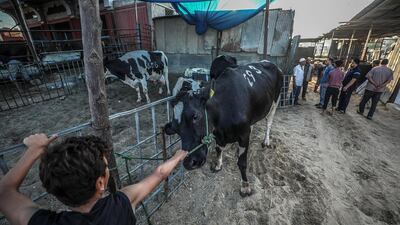
  • Palestinian vendors display their sacrificial animals at a livestock market in the southern Gaza Strip. Gazans are buying more sheep and cattle in preparation for the upcoming Sacrifice Feast. Eid al-Adha is the holiest of the two Muslims holidays celebrated each year, it marks the yearly Muslim pilgrimage (Hajj) to visit Mecca, the holiest place in Islam. Muslims slaughter a sacrificial animal and split the meat into three parts, one for the family, one for friends and relatives, and one for the poor and needy. EPA
    Palestinian vendors display their sacrificial animals at a livestock market in the southern Gaza Strip. Gazans are buying more sheep and cattle in preparation for the upcoming Sacrifice Feast. Eid al-Adha is the holiest of the two Muslims holidays celebrated each year, it marks the yearly Muslim pilgrimage (Hajj) to visit Mecca, the holiest place in Islam. Muslims slaughter a sacrificial animal and split the meat into three parts, one for the family, one for friends and relatives, and one for the poor and needy. EPA
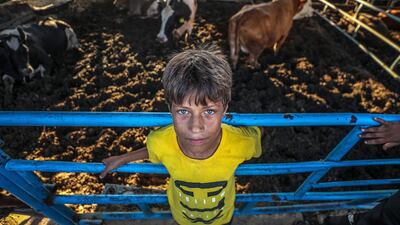
  • A Palestinian vendor display his sheep at a livestock market in the southern Gaza Strip. Gazans are buying more sheep and cattle in preparation for the upcoming Sacrifice Feast. Eid al-Adha is the holiest of the two Muslims holidays celebrated each year, it marks the yearly Muslim pilgrimage (Hajj) to visit Mecca, the holiest place in Islam. Muslims slaughter a sacrificial animal and split the meat into three parts, one for the family, one for friends and relatives, and one for the poor and needy. EPA
    A Palestinian vendor display his sheep at a livestock market in the southern Gaza Strip. Gazans are buying more sheep and cattle in preparation for the upcoming Sacrifice Feast. Eid al-Adha is the holiest of the two Muslims holidays celebrated each year, it marks the yearly Muslim pilgrimage (Hajj) to visit Mecca, the holiest place in Islam. Muslims slaughter a sacrificial animal and split the meat into three parts, one for the family, one for friends and relatives, and one for the poor and needy. EPA
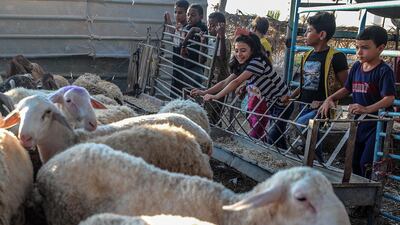
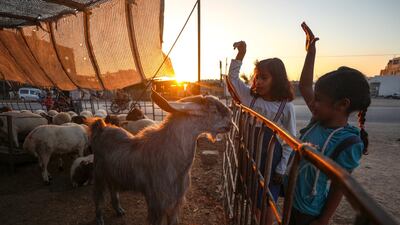
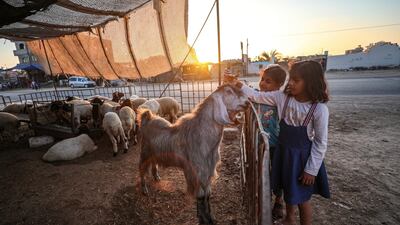
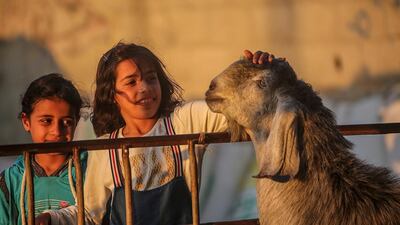
  • Palestinian girls play with sheep at a livestock market in the southern Gaza Strip. Gazans are buying more sheep and cattle in preparation for the upcoming Sacrifice Feast. Eid al-Adha is the holiest of the two Muslims holidays celebrated each year, it marks the yearly Muslim pilgrimage (Hajj) to visit Mecca, the holiest place in Islam. Muslims slaughter a sacrificial animal and split the meat into three parts, one for the family, one for friends and relatives, and one for the poor and needy. EPA
    Palestinian girls play with sheep at a livestock market in the southern Gaza Strip. Gazans are buying more sheep and cattle in preparation for the upcoming Sacrifice Feast. Eid al-Adha is the holiest of the two Muslims holidays celebrated each year, it marks the yearly Muslim pilgrimage (Hajj) to visit Mecca, the holiest place in Islam. Muslims slaughter a sacrificial animal and split the meat into three parts, one for the family, one for friends and relatives, and one for the poor and needy. EPA
  • Palestinian vendors display their sheep at a livestock market in the southern Gaza Strip. Gazans are buying more sheep and cattle in preparation for the upcoming Sacrifice Feast. Eid al-Adha is the holiest of the two Muslims holidays celebrated each year, it marks the yearly Muslim pilgrimage (Hajj) to visit Mecca, the holiest place in Islam. Muslims slaughter a sacrificial animal and split the meat into three parts, one for the family, one for friends and relatives, and one for the poor and needy. EPA
    Palestinian vendors display their sheep at a livestock market in the southern Gaza Strip. Gazans are buying more sheep and cattle in preparation for the upcoming Sacrifice Feast. Eid al-Adha is the holiest of the two Muslims holidays celebrated each year, it marks the yearly Muslim pilgrimage (Hajj) to visit Mecca, the holiest place in Islam. Muslims slaughter a sacrificial animal and split the meat into three parts, one for the family, one for friends and relatives, and one for the poor and needy. EPA
  • Palestinian girls play with sheep at a livestock market in the southern Gaza Strip. Gazans are buying more sheep and cattle in preparation for the upcoming Sacrifice Feast. Eid al-Adha is the holiest of the two Muslims holidays celebrated each year, it marks the yearly Muslim pilgrimage (Hajj) to visit Mecca, the holiest place in Islam. Muslims slaughter a sacrificial animal and split the meat into three parts, one for the family, one for friends and relatives, and one for the poor and needy. EPA
    Palestinian girls play with sheep at a livestock market in the southern Gaza Strip. Gazans are buying more sheep and cattle in preparation for the upcoming Sacrifice Feast. Eid al-Adha is the holiest of the two Muslims holidays celebrated each year, it marks the yearly Muslim pilgrimage (Hajj) to visit Mecca, the holiest place in Islam. Muslims slaughter a sacrificial animal and split the meat into three parts, one for the family, one for friends and relatives, and one for the poor and needy. EPA

I been travelling to the Gaza Strip since the end of the first intifada – the Palestinian uprising – in the early 1990s. Every time I have made my way past the Erez border crossing, I have had a sense of being locked in, despite holding a passport that gives me the option to leave whenever I want. For Gazans, who are seldom able to cross the barrier to find work or even to meet relatives and friends in the West Bank or Jerusalem, the feeling is permanent.

Imagine being thwarted at every level, undergoing three miserable wars and being caught in the crosshairs of the political feud between Hamas, the organisation that controls Gaza, and the Palestinian Authority, which runs the West Bank in Ramallah.

I have never found so much resilience in one place as I have in Gaza, especially among its youth. One project I encountered there last year was a tech hub called Gaza Sky Geeks, which hosts a coding academy. The people working there have come to speak perfect English, learnt from watching movies and videos.

I wandered around Gaza for several weeks, talking to friends, professors, housewives, fishermen, poets, farmers and priests. I also received an anguished briefing from Matthias Schmale, who heads the Gaza unit of the United Nations Relief and Works Agency for Palestine Refugees.

UNRWA has been destabilised by punishing financial cuts from the US. In his recently published book, John Bolton, the former national security adviser in the Trump administration, reveals how he was proud to cut funding to desperate Palestinians simply to appease pro-Israel lobbyists in Washington. But the politics that play out in the American capital, and in Tel Aviv, Jerusalem and elsewhere, matter little to those living in Gaza's Beach Camp or Rafah. They are just trying to get through the day.

Every visit to Gaza has left me haunted. On my last, when I met Gaza Sky Geeks, I had a particular train of thought: could the major banks and corporations around the world that require customer service not consider outsourcing their work to ordinary Gazans?

Could Gaza not become the next Bangalore (regarded as the Silicon Valley of India), given its people's growing technological expertise and linguistic skills? Could companies such as Apple, Google and Twitter not do more to make Gaza liveable, so that youngsters do not take their own lives – as Suleiman Al Ajouri, a man in his 30s, recently did when he shot himself out of frustration over his future?

An aerial view taken on July 24, 2020, shows a general view of Gaza City. AFP
Could Gaza not become the next Bangalore, with its growing technological expertise and linguistic skills?

It annoys me to hear some say that Covid-19 has been a good thing for human beings because it has allowed them to slow down and take stock of their lives. After all, half a million of their fellow human beings have died with Covid-19. There also seems to be little understanding of the conditions in which people like many of those in Gaza continue to live – stuck inside homes so small that they can hardly hold an entire family.

One of the saddest stories I have encountered is that of a friend, whom I will call Mohammed.

Last year, after much struggle and string-pulling, he left Gaza upon winning a fellowship to one of the most prestigious universities in Europe. Months later, however, he was unable to return to see his mother when she was infected by coronavirus. She whispered into the phone asking Mohammed to come home, but he was unable to. Even if the UK, where he lives, had not been in lockdown and he had made his way into Gaza to meet his mother, he would have risked being trapped there again.

Six years after his brother was killed in the Gaza-Israel conflict, Mohammed lost his mother. “I thought I was so happy when I arrived here in the UK to study,” he told me. “And now I realise it is not the fate of a Palestinian to be happy.”

Here in France, as I watch people board trains and planes to go on vacation, I think of a group of young Gazan writers called We Are Not Numbers who tell me that they don't want to be treated as mere statistics but normal human beings who are  born, fall in love, study and have real emotions.

It is difficult for me to imagine a place that evokes as many feelings of desperation and anger as Gaza. Even in Syria, if the war eventually ends, there is cause for some optimism that the country will be rebuilt. Gaza, however, is trapped in limbo, with a long march into the future that can seem like it is devoid of any hope at all.

Janine di Giovanni is a Senior Fellow at Yale Jackson Institute for Global Affairs and the author of the upcoming “The Vanishing” about Christians in the Middle East

The specs

Engine: 2.0-litre 4-cylinder turbo

Power: 240hp at 5,500rpm

Torque: 390Nm at 3,000rpm

Transmission: eight-speed auto

Price: from Dh122,745

On sale: now

Brave CF 27 fight card

Welterweight:
Abdoul Abdouraguimov (champion, FRA) v Jarrah Al Selawe (JOR)

Lightweight:
Anas Siraj Mounir (TUN) v Alex Martinez (CAN)

Welterweight:
Mzwandile Hlongwa (RSA) v Khamzat Chimaev (SWE)

Middleweight:
Tarek Suleiman (SYR) v Rustam Chsiev (RUS)
Mohammad Fakhreddine (LEB) v Christofer Silva (BRA)

Super lightweight:
Alex Nacfur (BRA) v Dwight Brooks (USA)

Bantamweight:
Jalal Al Daaja (JOR) v Tariq Ismail (CAN)
Chris Corton (PHI) v Zia Mashwani (PAK)

Featherweight:
Sulaiman (KUW) v Abdullatip (RUS)

Super lightweight:
Flavio Serafin (BRA) v Mohammad Al Katib (JOR)

The specs

Engine: Dual 180kW and 300kW front and rear motors

Power: 480kW

Torque: 850Nm

Transmission: Single-speed automatic

Price: From Dh359,900 ($98,000)

On sale: Now

If you go:
The flights: Etihad, Emirates, British Airways and Virgin all fly from the UAE to London from Dh2,700 return, including taxes
The tours: The Tour for Muggles usually runs several times a day, lasts about two-and-a-half hours and costs £14 (Dh67)
Harry Potter and the Cursed Child is on now at the Palace Theatre. Tickets need booking significantly in advance
Entrance to the Harry Potter exhibition at the House of MinaLima is free
The hotel: The grand, 1909-built Strand Palace Hotel is in a handy location near the Theatre District and several of the key Harry Potter filming and inspiration sites. The family rooms are spacious, with sofa beds that can accommodate children, and wooden shutters that keep out the light at night. Rooms cost from £170 (Dh808).

Mercer, the investment consulting arm of US services company Marsh & McLennan, expects its wealth division to at least double its assets under management (AUM) in the Middle East as wealth in the region continues to grow despite economic headwinds, a company official said.

Mercer Wealth, which globally has $160 billion in AUM, plans to boost its AUM in the region to $2-$3bn in the next 2-3 years from the present $1bn, said Yasir AbuShaban, a Dubai-based principal with Mercer Wealth.

Within the next two to three years, we are looking at reaching $2 to $3 billion as a conservative estimate and we do see an opportunity to do so,” said Mr AbuShaban.

Mercer does not directly make investments, but allocates clients’ money they have discretion to, to professional asset managers. They also provide advice to clients.

“We have buying power. We can negotiate on their (client’s) behalf with asset managers to provide them lower fees than they otherwise would have to get on their own,” he added.

Mercer Wealth’s clients include sovereign wealth funds, family offices, and insurance companies among others.

From its office in Dubai, Mercer also looks after Africa, India and Turkey, where they also see opportunity for growth.

Wealth creation in Middle East and Africa (MEA) grew 8.5 per cent to $8.1 trillion last year from $7.5tn in 2015, higher than last year’s global average of 6 per cent and the second-highest growth in a region after Asia-Pacific which grew 9.9 per cent, according to consultancy Boston Consulting Group (BCG). In the region, where wealth grew just 1.9 per cent in 2015 compared with 2014, a pickup in oil prices has helped in wealth generation.

BCG is forecasting MEA wealth will rise to $12tn by 2021, growing at an annual average of 8 per cent.

Drivers of wealth generation in the region will be split evenly between new wealth creation and growth of performance of existing assets, according to BCG.

Another general trend in the region is clients’ looking for a comprehensive approach to investing, according to Mr AbuShaban.

“Institutional investors or some of the families are seeing a slowdown in the available capital they have to invest and in that sense they are looking at optimizing the way they manage their portfolios and making sure they are not investing haphazardly and different parts of their investment are working together,” said Mr AbuShaban.

Some clients also have a higher appetite for risk, given the low interest-rate environment that does not provide enough yield for some institutional investors. These clients are keen to invest in illiquid assets, such as private equity and infrastructure.

“What we have seen is a desire for higher returns in what has been a low-return environment specifically in various fixed income or bonds,” he said.

“In this environment, we have seen a de facto increase in the risk that clients are taking in things like illiquid investments, private equity investments, infrastructure and private debt, those kind of investments were higher illiquidity results in incrementally higher returns.”

The Abu Dhabi Investment Authority, one of the largest sovereign wealth funds, said in its 2016 report that has gradually increased its exposure in direct private equity and private credit transactions, mainly in Asian markets and especially in China and India. The authority’s private equity department focused on structured equities owing to “their defensive characteristics.”


THE BIO

Age: 30

Favourite book: The Power of Habit

Favourite quote: "The world is full of good people, if you cannot find one, be one"

Favourite exercise: The snatch

Favourite colour: Blue

Ten tax points to be aware of in 2026

1. Domestic VAT refund amendments: request your refund within five years

If a business does not apply for the refund on time, they lose their credit.

2. E-invoicing in the UAE

Businesses should continue preparing for the implementation of e-invoicing in the UAE, with 2026 a preparation and transition period ahead of phased mandatory adoption. 

3. More tax audits

Tax authorities are increasingly using data already available across multiple filings to identify audit risks. 

4. More beneficial VAT and excise tax penalty regime

Tax disputes are expected to become more frequent and more structured, with clearer administrative objection and appeal processes. The UAE has adopted a new penalty regime for VAT and excise disputes, which now mirrors the penalty regime for corporate tax.

5. Greater emphasis on statutory audit

There is a greater need for the accuracy of financial statements. The International Financial Reporting Standards standards need to be strictly adhered to and, as a result, the quality of the audits will need to increase.

6. Further transfer pricing enforcement

Transfer pricing enforcement, which refers to the practice of establishing prices for internal transactions between related entities, is expected to broaden in scope. The UAE will shortly open the possibility to negotiate advance pricing agreements, or essentially rulings for transfer pricing purposes. 

7. Limited time periods for audits

Recent amendments also introduce a default five-year limitation period for tax audits and assessments, subject to specific statutory exceptions. While the standard audit and assessment period is five years, this may be extended to up to 15 years in cases involving fraud or tax evasion. 

8. Pillar 2 implementation 

Many multinational groups will begin to feel the practical effect of the Domestic Minimum Top-Up Tax (DMTT), the UAE's implementation of the OECD’s global minimum tax under Pillar 2. While the rules apply for financial years starting on or after January 1, 2025, it is 2026 that marks the transition to an operational phase.

9. Reduced compliance obligations for imported goods and services

Businesses that apply the reverse-charge mechanism for VAT purposes in the UAE may benefit from reduced compliance obligations. 

10. Substance and CbC reporting focus

Tax authorities are expected to continue strengthening the enforcement of economic substance and Country-by-Country (CbC) reporting frameworks. In the UAE, these regimes are increasingly being used as risk-assessment tools, providing tax authorities with a comprehensive view of multinational groups’ global footprints and enabling them to assess whether profits are aligned with real economic activity. 

Contributed by Thomas Vanhee and Hend Rashwan, Aurifer

The biog

Favourite pet: cats. She has two: Eva and Bito

Favourite city: Cape Town, South Africa

Hobby: Running. "I like to think I’m artsy but I’m not".

Favourite move: Romantic comedies, specifically Return to me. "I cry every time".

Favourite spot in Abu Dhabi: Saadiyat beach

Real estate tokenisation project

Dubai launched the pilot phase of its real estate tokenisation project last month.

The initiative focuses on converting real estate assets into digital tokens recorded on blockchain technology and helps in streamlining the process of buying, selling and investing, the Dubai Land Department said.

Dubai’s real estate tokenisation market is projected to reach Dh60 billion ($16.33 billion) by 2033, representing 7 per cent of the emirate’s total property transactions, according to the DLD.

Essentials
The flights: You can fly from the UAE to Iceland with one stop in Europe with a variety of airlines. Return flights with Emirates from Dubai to Stockholm, then Icelandair to Reykjavik, cost from Dh4,153 return. The whole trip takes 11 hours. British Airways flies from Abu Dhabi and Dubai to Reykjavik, via London, with return flights taking 12 hours and costing from Dh2,490 return, including taxes. 
The activities: A half-day Silfra snorkelling trip costs 14,990 Icelandic kronur (Dh544) with Dive.is. Inside the Volcano also takes half a day and costs 42,000 kronur (Dh1,524). The Jokulsarlon small-boat cruise lasts about an hour and costs 9,800 kronur (Dh356). Into the Glacier costs 19,500 kronur (Dh708). It lasts three to four hours.
The tours: It’s often better to book a tailor-made trip through a specialist operator. UK-based Discover the World offers seven nights, self-driving, across the island from £892 (Dh4,505) per person. This includes three nights’ accommodation at Hotel Husafell near Into the Glacier, two nights at Hotel Ranga and two nights at the Icelandair Hotel Klaustur. It includes car rental, plus an iPad with itinerary and tourist information pre-loaded onto it, while activities can be booked as optional extras. More information inspiredbyiceland.com

How to donate

Send “thenational” to the following numbers or call the hotline on: 0502955999
2289 – Dh10
2252 – Dh 50
6025 – Dh20
6027 – Dh 100
6026 – Dh 200