Once seen as a pathway to end a decade of conflict in Syria, the "Astana process" has since become little more than a wretched notion. The peace process that began in 2017 and involved Russia, Turkey and Iran subsequently collapsed for a number of reasons, including Russian-Turkish clashes over the Syrian city of Idlib and a showdown between Moscow and Ankara in nearby Libya.
Meanwhile Iran is preoccupied, as its media claims, with championing the Palestinian cause as a way to retaliate against US sanctions in the wake of the Israel's Washington-approved plan to annex parts of the West Bank.
In all this, Arab nations have once again become theatres of the proxy wars of others. Unfortunately, things are about to get worse.
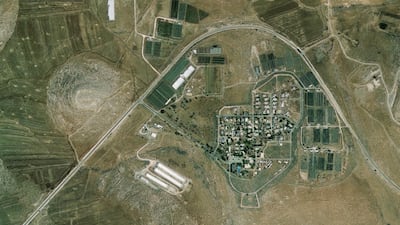
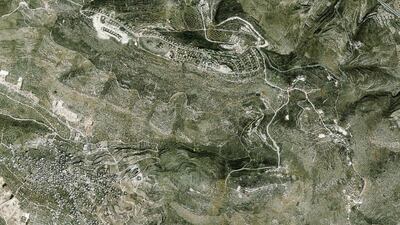
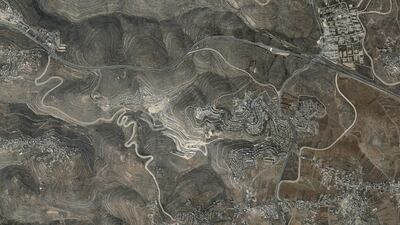
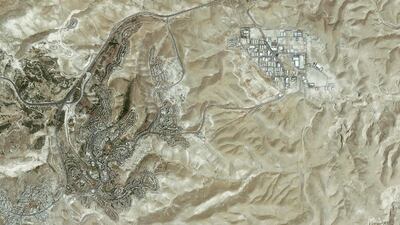
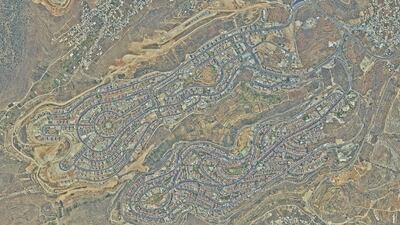
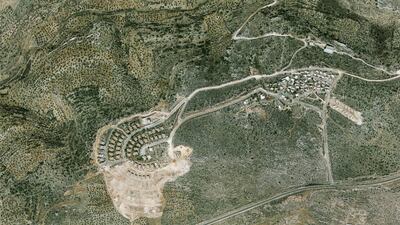
A handout photo made available by the Peace Now organization showing an aerial view of the Israeli settlement of Gitit in the West Bank. EPA
A handout photo made available by the Peace Now organization showing an aerial view of the Israeli settlement of Yizhar in the West Bank. EPA
A handout photo made available by the Peace Now organization showing an aerial view of the Israeli settlement of Givat Zeev in the West Bank. EPA
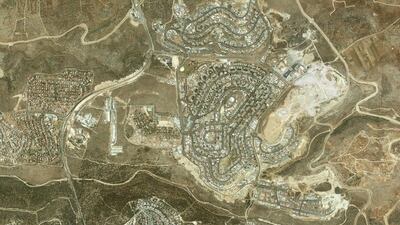
A handout photo made available by the Peace Now organization showing an aerial view of the Israeli settlement of Maale Adumim in the West Bank. EPA
A handout photo made available by the Peace Now organization showing an aerial view of the Israeli settlement of Modiin Ellit in the West Bank. EPA
A handout photo made available by the Peace Now organization showing an aerial view of the Israeli settlement of Ariel in the West Bank. EPA
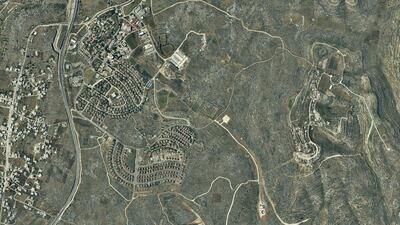
A handout photo made available by the Peace Now organization showing an aerial view of the Israeli settlement of Ofra in the West Bank. EPA
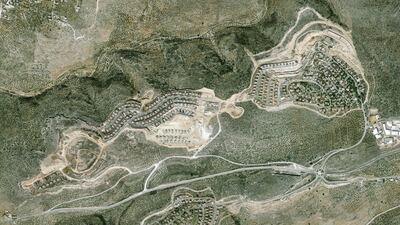
A handout photo made available by the Peace Now organization showing an aerial view of the Israeli settlement of Leshem-Alei Zahavm in the West Bank. EPA
A handout photo made available by the Peace Now organization showing an aerial view of the Israeli settlement of Har Homa in the West Bank. EPA
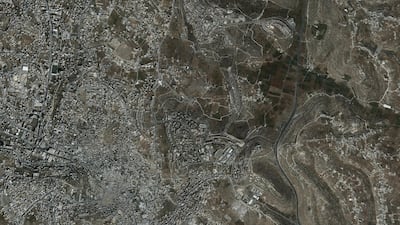
A handout photo made available by the Peace Now organization showing an aerial view of the Israeli settlement of Kiryat Arba in the West Bank. EPA
A handout photo made available by the Peace Now organization showing an aerial view of the Israeli settlement of Beitar Illit.
A handout photo made available by the Peace Now organization showing an aerial view of the Israeli settlement of Eli in the West Bank.
A handout photo made available by the Peace Now organization showing an aerial view of the Israeli settlement of Bruchin in the West Bank. EPA
Beginning with Iran, I have been reliably informed that following a meeting last Tuesday, the Islamic Revolutionary Guard Corps will mobilise pro-regime forces such as Hezbollah and Hamas in June and July in conjunction with the expected Israeli announcement of annexing Palestinian territories. "There will be one hundred per cent military mobilisation, and these preparations are not for military exercises,” I have been told. At the meeting, the possibility of clashes were discussed.
Tehran assesses that a popular mobilisation could help deflect the restive public's attention away from domestic troubles, resulting from the crippling US-led economic sanctions.
Meanwhile, the war in Libya has turned into a horror show involving multinational mercenaries and international terrorists waging battles on behalf of various groups jostling for power. There are many moving parts in the conflict, significant among them the Muslim Brotherhood project backed by Turkish President Recep Tayyip Erdogan, who insists on imposing its ideology on the rest of the Arab world as well.
Throw into the mix oil politics, human trafficking and a migrant crisis, and the conflict there has become decidedly more complex.
Forces loyal to the Government of National Accord parade a Pantsir air defence system truck in the Libyan capital of Tripoli. AFP
I have been informed that Moscow is determined to teach Ankara a lesson in North Africa. "The idea is if we achieve what we want against Turkey in Libya, this will give us the ability to act decisively against Turkey in Syria," I was told. Relations between the two countries have been greatly strained by the battle for Idlib, a city in Syria's north-west that continues to be held by rebels backed by Turkey in their fight against the Assad regime, supported by Russia.
This week, French Foreign Minister Jean-Yves Le Drian warned against the "Syrianisation" of Libya, with foreign parties supporting local proxies there, saying that the Turkish-backed Government of National Accord was bringing many thousands of Syrian fighters into Libya.
Vladimir Putin's Russia and Recep Tayyip Erdogan's Turkey are on opposite sides in both Syria and Libya. AP Photo
Indeed, it is Turkey’s involvement in Libya – following an agreement with the Fayez Al Sarraj-led GNA – that has brought the curse of Syrianisation upon Libya. Ankara has publicly threatened retired Field Marshal Khalifa Haftar, leader of the Libyan National Army, which is fighting to wrest control of Tripoli from GNA. Russia has for some time lent Field Marshal Haftar its backing, but what is new is the qualitative shift in its logistical and military support.
I have been informed of Moscow's determination to help Field Marshal Haftar win Tripoli and take control of the country "by September 30" that "requires Moscow to give Haftar everything he needs to achieve victory, which is only possible by allowing Haftar's forces inflict maximal losses on the Turkish military in Libya" – in other words, with the help of Russian fighter jets and mercenaries.
Turkey has publicly threatened Khalifa Haftar, whose forces are fighting to wrest control of Tripoli from the Government of National Accord. Reuters
While the short-term objectives are to thwart Turkish plans in Libya and transform the LNA into a more effective force, the long-term objective could be to deliver Saif Gaddafi, the son of former ruler Muammar, to the presidency.
This has raised alarms in Washington, which this week publicly criticised Moscow. It sent out implicit messages suggesting a willingness to tolerate Ankara's adventure in Libya and raised concern about Russia's strategic ambitions in the country. The US military also accused Russia of sending fighter jets to provide air cover to mercenaries operating in Libya.
Meanwhile David Schenker, the US Assistant Secretary of State for Near Eastern Affairs, protested against the characterisation of Turkey’s role in Libya as "wreaking havoc". Speaking at the fourth e-policy circle of the Beirut Institute Summit in Abu Dhabi, he said: “Why do you think it’s Turkey that’s creating havoc by backing the internationally recognised government while Russia is sending in mercenaries and advanced fighter aircraft?”
With reference to Turkey’s mercenaries, Mr Schenker said “everybody has mercenaries in Libya”.
Meanwhile Philipp Ackermann, Director-General for the Near and Middle East and the Maghreb in the German Federal Foreign Office, which led the Berlin Conference for reconciliation in Libya, said in the same panel that what is under way in Libya is now a proxy war involving different parties with different objectives. Adding that Europe is concerned by the conflict – given its proximity to Libya – Mr Ackermann said the Berlin Conference needed to be persisted with for any hope of securing peace in the region.
Unfortunately though, the reality in Libya does not raise hopes of national reconciliation, or a Russian-Turkish truce, or a check on the Muslim Brotherhood's ambitions there any time soon. Worse, it is military confrontation that is likely to dominate the headlines.
Raghida Dergham is the founder and executive chairwoman of the Beirut Institute
Baftas 2020 winners
BEST FILM
1917 - Pippa Harris, Callum McDougall, Sam Mendes, Jayne-Ann Tenggren
THE IRISHMAN - Robert De Niro, Jane Rosenthal, Martin Scorsese, Emma Tillinger Koskoff
JOKER - Bradley Cooper, Todd Phillips, Emma Tillinger Koskoff
ONCE UPON A TIME… IN HOLLYWOOD - David Heyman, Shannon McIntosh, Quentin Tarantino
PARASITE - Bong Joon-ho, Kwak Sin-ae
DIRECTOR
1917 - Sam Mendes
THE IRISHMAN - Martin Scorsese
JOKER - Todd Phillips
ONCE UPON A TIME… IN HOLLYWOOD - Quentin Tarantino
British aristocrat Lord Carnarvon, who funded the expedition to find the Tutankhamun tomb, died in a Cairo hotel four months after the crypt was opened. He had been in poor health for many years after a car crash, and a mosquito bite made worse by a shaving cut led to blood poisoning and pneumonia. Reports at the time said Lord Carnarvon suffered from “pain as the inflammation affected the nasal passages and eyes”. Decades later, scientists contended he had died of aspergillosis after inhaling spores of the fungus aspergillus in the tomb, which can lie dormant for months. The fact several others who entered were also found dead withiin a short time led to the myth of the curse.
Starring: Sam Worthington, Sigourney Weaver, Zoe Saldana
Rating: 4.5/5
Key facilities
Olympic-size swimming pool with a split bulkhead for multi-use configurations, including water polo and 50m/25m training lanes
Premier League-standard football pitch
400m Olympic running track
NBA-spec basketball court with auditorium
600-seat auditorium
Spaces for historical and cultural exploration
An elevated football field that doubles as a helipad
Specialist robotics and science laboratories
AR and VR-enabled learning centres
Disruption Lab and Research Centre for developing entrepreneurial skills
MATCH INFO
Champions League quarter-final, first leg
Manchester United v Barcelona, Wednesday, 11pm (UAE)
Match on BeIN Sports
Super Bowl LIII schedule
What Super Bowl LIII
Who is playing New England Patriots v Los Angeles Rams
Where Mercedes-Benz Stadium in Atlanta, United States
When Sunday (start time is 3.30am on Monday UAE time)
Petrarch: Everywhere a Wanderer
Christopher Celenza,
Reaktion Books
Tips to stay safe during hot weather
Stay hydrated: Drink plenty of fluids, especially water. Avoid alcohol and caffeine, which can increase dehydration.
Seek cool environments: Use air conditioning, fans, or visit community spaces with climate control.
Limit outdoor activities: Avoid strenuous activity during peak heat. If outside, seek shade and wear a wide-brimmed hat.
Dress appropriately: Wear lightweight, loose and light-coloured clothing to facilitate heat loss.
Check on vulnerable people: Regularly check in on elderly neighbours, young children and those with health conditions.
Home adaptations: Use blinds or curtains to block sunlight, avoid using ovens or stoves, and ventilate living spaces during cooler hours.
Recognise heat illness: Learn the signs of heat exhaustion and heat stroke (dizziness, confusion, rapid pulse, nausea), and seek medical attention if symptoms occur.
Gothia Cup 2025
4,872 matches
1,942 teams
116 pitches
76 nations
26 UAE teams
15 Lebanese teams
2 Kuwaiti teams
Islamophobia definition
A widely accepted definition was made by the All Party Parliamentary Group on British Muslims in 2019: “Islamophobia is rooted in racism and is a type of racism that targets expressions of Muslimness or perceived Muslimness.” It further defines it as “inciting hatred or violence against Muslims”.
UAE currency: the story behind the money in your pockets
Unlike other mobile wallets and payment apps, a unique feature of eWallet is that there is no need to have a bank account, credit or debit card to do digital payments.
Customers only need a valid Emirates ID and a working UAE mobile number to register for eWallet account.
Sector: Additive manufacturing, 3D printing technologies
Size: 15 full-time employees
Stage: Seed stage and seeking Series A round of financing
Investors: Oman Technology Fund from 2017 to 2019, exited through an agreement with a new investor to secure new funding that it under negotiation right now.
David Haye record
Total fights: 32 Wins: 28 Wins by KO: 26 Losses: 4