

Key developments across the Middle East in recent days have helped to renew a sense of optimism among some about a turnaround in US-Iran relations. But this could yet amount to wishful thinking on their part, as both Washington and Tehran prepare to host meetings over the coming week to decide how to more effectively deal with their adversary.
Decision-makers in Washington will discuss various options to contain the Iranian regime, including perhaps the launch of pre-emptive military strikes. Meanwhile, commanders of the Islamic Revolutionary Guard Corps – Tehran's influential paramilitary volunteer militia – will focus on their existing strategies in Lebanon and Iraq, where the regime wields considerable influence and is determined to keep within its orbit at any cost and by any means.
Con Coughlin: Iran's economy will face more turbulence over airline

In short, far from rapprochement, the coming days and weeks could well witness a further escalation in tensions between the two regional powers.
To be sure there are justifiable reasons for optimism, with Iraq emerging as the primary source of it: Mustafa Al Kadhimi was chosen by a parliamentary majority to become prime minister; he received the metaphorical thumbs-up from regional powers, as well as the Americans, Europeans and Russians.
In a phone call with Mr Al Kadhimi, US President Donald Trump said Iraq was important to regional and international stability, adding that America would continue to provide economic aid. In turn, Mr Kadhimi said Baghdad was keen to have the best possible relations with Washington.
Yet, none of this need necessarily translate to a radical shift in Iran’s policy of control in Iraq – or vis-a-vis American presence in the country – because the regime would simply not give up its influence in Iraq to the US. What's more, I have been told by those in the know that Tehran views Mr Al Kadhimi's government to be a transitional one – a “temporary solution”.
Iraq is therefore no less vulnerable to destabilisation. It remains fragile so long as the US-Iran conflict is not settled.
Mina Al-Oraibi: What lies ahead for the Prime Minister of Iraq?
Lebanon is a different matter. In the Iranian regime's calculus, that country is essentially a liquid asset so long as Hezbollah dominates its politics and society. Tehran is therefore not as willing to back down there, and is ready to carry out whatever measures possible to guarantee its continued hold.
Of course, this does not mean that Lebanon is more important to the regime than Iraq is. Lebanon is just less complicated for Iran, even though it shares a border with Israel – one of the regime's biggest adversaries. There is a known margin of agreements, red lines, security zones and buffer strips manned by the United Nations Interim Force on the border. There is also now a buffer zone in the Golan Heights guaranteed by Russia, created with the implicit consent of the Assad regime, in neighbouring Syria.
A view from The National: Germany is right to see Hezbollah for what it really is
-
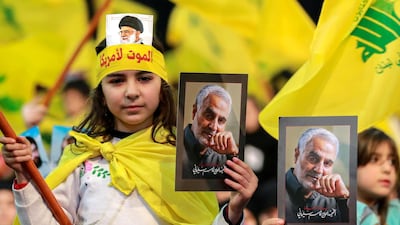
Supporters of Hezbollah hold photos of slain Iranian general Qassem Suleimani as they listen to a televised speech by Hezbollah leader Hassan Nasrallah in a southern suburb of the Lebanese capital Beirut. EPA -
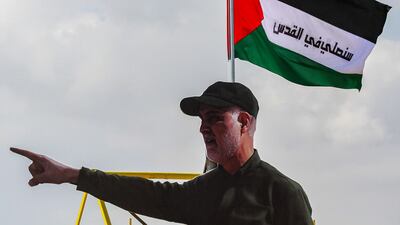
A giant cutout of Qassem Suleimani set up in the Garden of Iran park built by the Iranian government in the southern Lebanese village of Maroun Al Ras near the border with Israel. AFP -
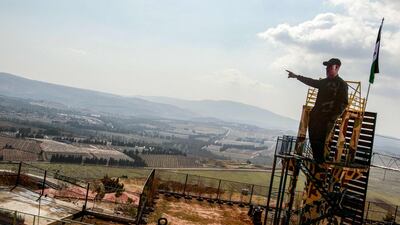
A view of a giant cutout depicting Iran's late top general Qasem Soleimani, who was killed in a US drone strike near Baghdad airport on January 3, 2020. AFP -
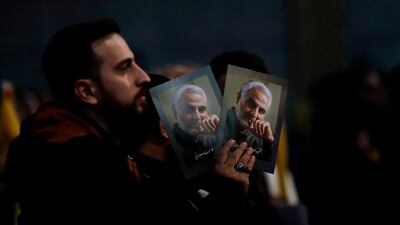
A Hezbollah supporter holds pictures of Qassem Suleimani during a ceremony marking the the end of a 40-day Muslim mourning period for the Iranian general and the anniversary of the assassination of Hezbollah leaders Abbas Al Moussawi, Ragheb Harb and Imad Mughniyeh. AP Photo -

Hezbollah supporters hold pictures of Qassem Suleimani in the southern suburb of Beirut. AP Photo -
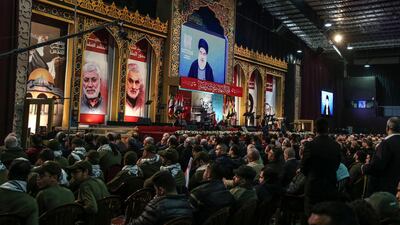
Hezbollah leader Hassan Nasrallah addresses supporters via a video link. EPA -
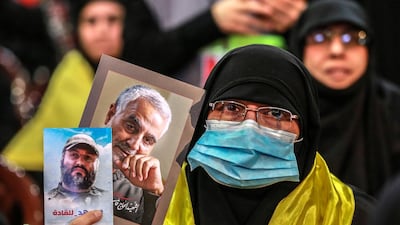
A Hezbollah supporter holds a photo of Qassem Suleimani during a rally to mark the group's Martyrs Day. EPA -
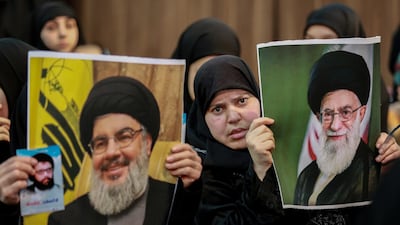
Supporters of Hezbollah hold photos of Hassan Nasrallah and Iran's supreme leader Ali Khamenei in southern Beirut. EPA -
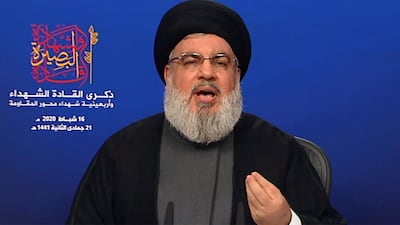
An screen grab from Hezbollah's Al Manar TV shows Hassan Nasrallah delivering a televised address from an undisclosed location in Lebanon. AFP -
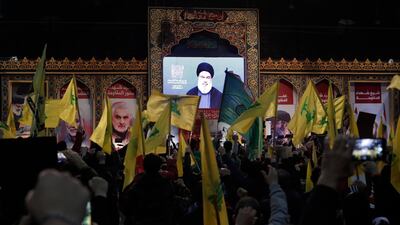
Hezbollah supporters wave the group's flag as they listen to Hassan Nasrallah speak. AP Photo -
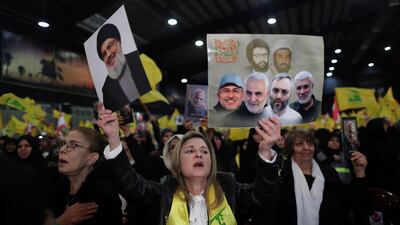
Hezbollah supporters sing the Lebanese and Hezbollah anthems during a ceremony marking the deaths of slain commanders and the Iranian general Qassem Suleimani in the southern suburb of Beirut. AP Photo


Washington's position regarding Beirut's fate is not entirely clear. In fact, the only bit of clarity we have is that Washington views its situation exclusively through the prism of fighting Hezbollah.
Hezbollah was recently deemed a terrorist entity by Germany, which according to the US is an effective approach to dealing with its growing influence in the region. Washington continues to crack down on its global operations and networks, even as it applies pressure on European countries to refrain from providing economic aid to Beirut as long as its government fails to adopt radical reforms – including the ending of Hezbollah's domination over the airport, ports and border crossings with Syria.
Michael Young: Lebanon's two primary pillars are quivering
-
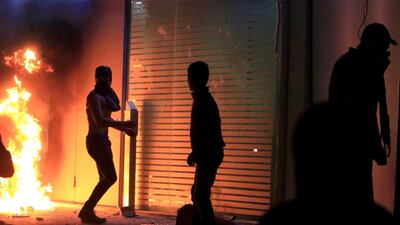
A demonstrator is seen next to a burning fire in front of a bank during a protest against growing economic hardship in Sidon, Lebanon. Reuters -
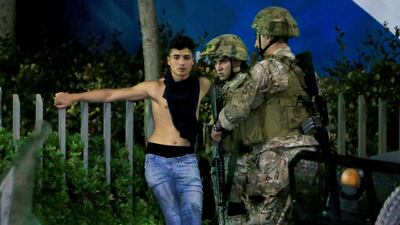
A detained demonstrator stands near Lebanese army soldiers during a protest against growing economic hardship in Sidon, Lebanon. Reuters -
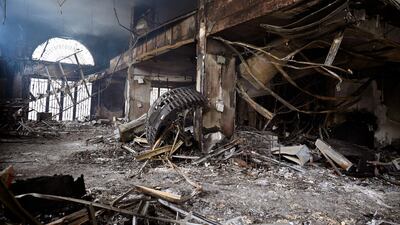
Interior view of a damaged bank that was set ablaze by protesters in Tripoli, northern Lebanon. EPA -
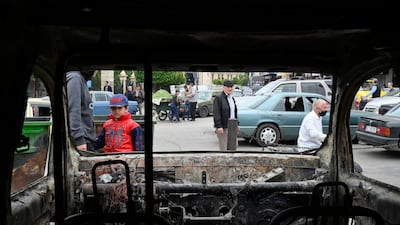
Lebanese people inspect a burnt out car of the Lebanese Internal Security Forces which was set ablaze by protesters in Tripoli, northern Lebanon. EPA -
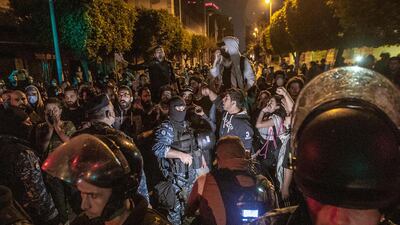
Anti-government protesters shout slogans during a protest against the collapsing Lebanese currency and the price hikes of goods, in front the central bank in Beirut, Lebanon. EPA -
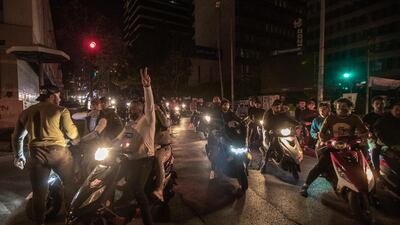
Anti-government protesters ride their motorcycles during a protest against the collapsing Lebanese currency and the price hikes of goods, in front the central bank in Beirut, Lebanon. EPA -

Lebanese men inspect a burnt out car of the Lebanese Internal Security Forces which was set ablaze by protesters in Tripoli, northern Lebanon. EPA -

Workers install metallic barriers on the facade of a bank as a protective measure against vandalism in Tripoli, northern Lebanon. EPA -
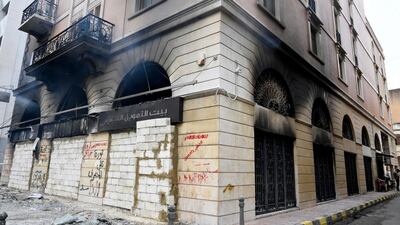
Exterior view of a damaged bank that was set ablaze by protesters in Tripoli, northern Lebanon. EPA -
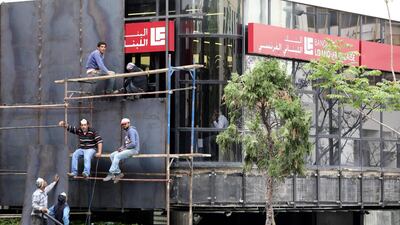
Workers install metallic barriers along the facade of a bank as a protective measure against vandalism in the Lebanese capital Beirut. AFP -

Anti-government protesters shout slogans during a protest against the collapsing Lebanese currency and the price hikes of goods, in front the central bank in Beirut, Lebanon. EPA -
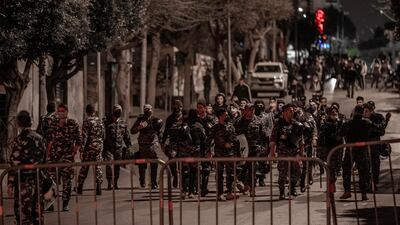
Lebanese riot control police watch as annti-government protesters gather during a demonstration against the collapsing Lebanese currency and the price hikes of goods, in Beirut, Lebanon. EPA -
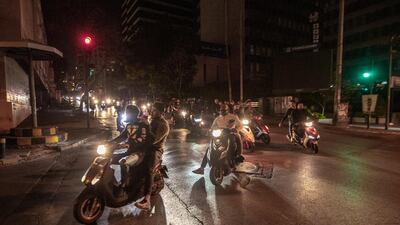
Anti-government protesters ride their motorcycles during a protest against the collapsing Lebanese currency and the price hikes of goods, in front the central bank in Beirut, Lebanon. EPA -
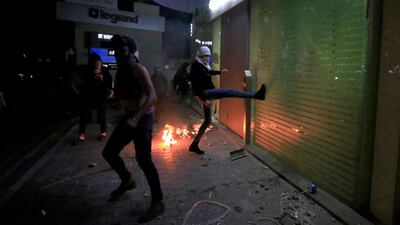
A demonstrator smashes a window of a bank during a protest against growing economic hardship in Sidon, Lebanon. Reuters


The complacency of Lebanon’s leaders, political parties, and its financial and banking institutions, vis-a-vis corruption and nepotism even as Beirut appeals to the world for aid has prompted Alistair Burt, a former UK minister, to call for the Lebanese to reform their system.
“Sort out the corruption and get your economy sorted and stop running to other people," he said at a summit organised by the Beirut Institute last week. "The solutions have got to be in the hands of those who are governing in Lebanon. Ultimately the issue of Hezbollah can't be ducked and that's got to be tackled.”
In this context, UN Secretary-General Antonio Guterres's report to the Security Council on the implementation of Resolution 1559 – which supports free and fair presidential elections in Lebanon and calls upon remaining foreign forces to withdraw from the country – has interesting implications. Mr Guterres said: "I continue to urge the government and the armed forces of Lebanon to take all measures necessary to prohibit Hezbollah and other armed groups from acquiring weapons and building paramilitary capacity outside the authority of the state."
Circling back to US-Iran relations, the whispers about pragmatism are seemingly coming out of some corridors in Washington, because of the desire to avert a confrontation, and from Tehran, as part of a process of reconfiguration ahead of the US presidential election but also as a result of the domestic difficulties in Iran.
Some have also noted that silence on the part of Tehran and Hezbollah about Israel's brazen determination to annex West Bank and the Jordan Valley could be a sign of their willingness to allow the so-called Deal of the Century concerning the fate of Palestine to pass. But the question is: what are they looking for in return? This is a deeper and more important question that may be at the heart of the choice between escalation and de-escalation in US-Iranian relations.
A view from The National: Israel's new government is a sign of further disasters to come

Reports suggesting that the US move to withdraw patriot missiles from Saudi Arabia could signal a new assessment that it does not consider Iran to be a major threat are inaccurate. They have also been dismissed by US Secretary of State Mike Pompeo.
Be that as it may, the meeting in Tehran will shed further light on the fate of Lebanon. Meanwhile, the one in Washington will give us an idea about whether the mood there is for confrontation, or for a pragmatic truce.
Raghida Dergham is the founder and executive chairwoman of the Beirut Institute

