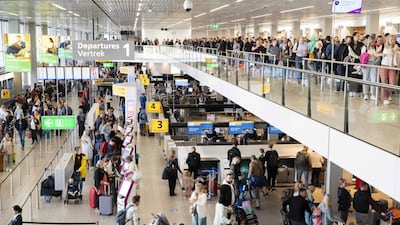
Recently there has been huge disruption at airports across the world. AFP


Aviation must keep pace with sky-high demand


  • English
  • Arabic

June 02, 2022

Quick thinking is an important quality in a pilot. When the pandemic hit, Etihad Airways Senior First Officer Maurits Robert van Gelder had to demonstrate it outside the cockpit.

Due to plummeting demand during Covid-19, airlines around the world had to adopt significant cost-saving measures, including redundancies. Etihad was no different. After finding out that he was among those being laid off, Mr van Gelder, a Dutch national, looked for ways to keep himself in Abu Dhabi, because he still had “full faith” in being re-employed when the sector recovered. But a stint in real estate and personal training left him unsatisfied. Eighteen months later, Mr van Gelder was able to return to the job he loved, after Etihad began rehiring staff due to rebounding demand. After a tough year and a half it was a remarkably quick return to the skies, indicative of what the airlines' chief executive, Tony Douglas, expects to be "impressive" results in the first half of 2022.

That increase in activity is being mirrored across the global aviation sector. The International Air Transport Association reported in March that total demand for air travel in January 2022 was up by more than 80 per cent from January 2021.

  • Passengers queue at England's Manchester airport on Monday, after Tui announced a 'small number' of flight cancellations and delays. PA
    Passengers queue at England's Manchester airport on Monday, after Tui announced a 'small number' of flight cancellations and delays. PA
  • There were also long queues at Bristol airport. Photo: Paul Trueman/Twitter
    There were also long queues at Bristol airport. Photo: Paul Trueman/Twitter
  • Hundreds of passengers at Brussels airport were forced to join lengthy queues for border control. Photo: Twitter
    Hundreds of passengers at Brussels airport were forced to join lengthy queues for border control. Photo: Twitter
  • Passengers wait at Schiphol airport in Amsterdam. Photo: Twitter
    Passengers wait at Schiphol airport in Amsterdam. Photo: Twitter
  • Long queues at Dublin airport caused more than 1,000 passengers to miss their flights on Sunday. Photo: Twitter
    Long queues at Dublin airport caused more than 1,000 passengers to miss their flights on Sunday. Photo: Twitter
  • Queues at Dublin airport snaked all the way outside. Photo: Twitter
    Queues at Dublin airport snaked all the way outside. Photo: Twitter
  • Luggage piles up on the floor at Bristol airport after a flight to Naples with Easy Jet was cancelled on Saturday. PA
    Luggage piles up on the floor at Bristol airport after a flight to Naples with Easy Jet was cancelled on Saturday. PA
  • Travellers wait at Schiphol airport. EPA
    Travellers wait at Schiphol airport. EPA
  • A very busy Schiphol airport. EPA
    A very busy Schiphol airport. EPA

But for many companies it is proving too much too soon. Yesterday, key UK carriers British Airways and EasyJet cancelled at least 150 flights from two of the country's biggest airports, a major threat to the upcoming holiday season. Hours-long queues are common as high demand and a lack of airport staff put a strain on operations. Similar scenes are taking place in Brussels, Dublin and Amsterdam.

And even for those who do manage to go on holiday this year, around the globe employers in the hospitality sector are warning of crippling shortages. In April, the US Travel Association has said that out of 1.6 million jobs yet to recover in the country's economy, a "staggering" 1.5 million were in hospitality and leisure.

There are many reasons for global labour shortages, few with a simple fix. It is quicker to lay off a worker than hire one, and many people working in the sectors worst affected by the pandemic have switched careers. There is even talk of a "Great Resignation", the trend of US workers leaving jobs in record numbers since spring 2021. This is in large part thought to be caused by people realising the viability of more enjoyable flexible working arrangements.

There are still many clamouring to get back to their old jobs. Mr van Gelder told The National: “When I got back in the cockpit, I felt this instant comfort. It’s like putting on your favourite suit." In time, more workers across the economy will be donning their old suits and uniforms once again, but it might take longer than expected, and if companies do not give them incentive as Etihad is doing, they might be coming back in far smaller numbers.

Real estate tokenisation project

Dubai launched the pilot phase of its real estate tokenisation project last month.

The initiative focuses on converting real estate assets into digital tokens recorded on blockchain technology and helps in streamlining the process of buying, selling and investing, the Dubai Land Department said.

Dubai’s real estate tokenisation market is projected to reach Dh60 billion ($16.33 billion) by 2033, representing 7 per cent of the emirate’s total property transactions, according to the DLD.

Email sent to Uber team from chief executive Dara Khosrowshahi

From: Dara

To: Team@

Date: March 25, 2019 at 11:45pm PT

Subj: Accelerating in the Middle East

Five years ago, Uber launched in the Middle East. It was the start of an incredible journey, with millions of riders and drivers finding new ways to move and work in a dynamic region that’s become so important to Uber. Now Pakistan is one of our fastest-growing markets in the world, women are driving with Uber across Saudi Arabia, and we chose Cairo to launch our first Uber Bus product late last year.

Today we are taking the next step in this journey—well, it’s more like a leap, and a big one: in a few minutes, we’ll announce that we’ve agreed to acquire Careem. Importantly, we intend to operate Careem independently, under the leadership of co-founder and current CEO Mudassir Sheikha. I’ve gotten to know both co-founders, Mudassir and Magnus Olsson, and what they have built is truly extraordinary. They are first-class entrepreneurs who share our platform vision and, like us, have launched a wide range of products—from digital payments to food delivery—to serve consumers.

I expect many of you will ask how we arrived at this structure, meaning allowing Careem to maintain an independent brand and operate separately. After careful consideration, we decided that this framework has the advantage of letting us build new products and try new ideas across not one, but two, strong brands, with strong operators within each. Over time, by integrating parts of our networks, we can operate more efficiently, achieve even lower wait times, expand new products like high-capacity vehicles and payments, and quicken the already remarkable pace of innovation in the region.

This acquisition is subject to regulatory approval in various countries, which we don’t expect before Q1 2020. Until then, nothing changes. And since both companies will continue to largely operate separately after the acquisition, very little will change in either teams’ day-to-day operations post-close. Today’s news is a testament to the incredible business our team has worked so hard to build.

It’s a great day for the Middle East, for the region’s thriving tech sector, for Careem, and for Uber.

Uber on,

Dara

Business Insights
  • Canada and Mexico are significant energy suppliers to the US, providing the majority of oil and natural gas imports
  • The introduction of tariffs could hinder the US's clean energy initiatives by raising input costs for materials like nickel
  • US domestic suppliers might benefit from higher prices, but overall oil consumption is expected to decrease due to elevated costs
Scoreline

Australia 2-1 Thailand

Australia: Juric 69', Leckie 86'
Thailand: Pokklaw 82'

Yahya Al Ghassani's bio

Date of birth: April 18, 1998

Playing position: Winger

Clubs: 2015-2017 – Al Ahli Dubai; March-June 2018 – Paris FC; August – Al Wahda

Mercer, the investment consulting arm of US services company Marsh & McLennan, expects its wealth division to at least double its assets under management (AUM) in the Middle East as wealth in the region continues to grow despite economic headwinds, a company official said.

Mercer Wealth, which globally has $160 billion in AUM, plans to boost its AUM in the region to $2-$3bn in the next 2-3 years from the present $1bn, said Yasir AbuShaban, a Dubai-based principal with Mercer Wealth.

Within the next two to three years, we are looking at reaching $2 to $3 billion as a conservative estimate and we do see an opportunity to do so,” said Mr AbuShaban.

Mercer does not directly make investments, but allocates clients’ money they have discretion to, to professional asset managers. They also provide advice to clients.

“We have buying power. We can negotiate on their (client’s) behalf with asset managers to provide them lower fees than they otherwise would have to get on their own,” he added.

Mercer Wealth’s clients include sovereign wealth funds, family offices, and insurance companies among others.

From its office in Dubai, Mercer also looks after Africa, India and Turkey, where they also see opportunity for growth.

Wealth creation in Middle East and Africa (MEA) grew 8.5 per cent to $8.1 trillion last year from $7.5tn in 2015, higher than last year’s global average of 6 per cent and the second-highest growth in a region after Asia-Pacific which grew 9.9 per cent, according to consultancy Boston Consulting Group (BCG). In the region, where wealth grew just 1.9 per cent in 2015 compared with 2014, a pickup in oil prices has helped in wealth generation.

BCG is forecasting MEA wealth will rise to $12tn by 2021, growing at an annual average of 8 per cent.

Drivers of wealth generation in the region will be split evenly between new wealth creation and growth of performance of existing assets, according to BCG.

Another general trend in the region is clients’ looking for a comprehensive approach to investing, according to Mr AbuShaban.

“Institutional investors or some of the families are seeing a slowdown in the available capital they have to invest and in that sense they are looking at optimizing the way they manage their portfolios and making sure they are not investing haphazardly and different parts of their investment are working together,” said Mr AbuShaban.

Some clients also have a higher appetite for risk, given the low interest-rate environment that does not provide enough yield for some institutional investors. These clients are keen to invest in illiquid assets, such as private equity and infrastructure.

“What we have seen is a desire for higher returns in what has been a low-return environment specifically in various fixed income or bonds,” he said.

“In this environment, we have seen a de facto increase in the risk that clients are taking in things like illiquid investments, private equity investments, infrastructure and private debt, those kind of investments were higher illiquidity results in incrementally higher returns.”

The Abu Dhabi Investment Authority, one of the largest sovereign wealth funds, said in its 2016 report that has gradually increased its exposure in direct private equity and private credit transactions, mainly in Asian markets and especially in China and India. The authority’s private equity department focused on structured equities owing to “their defensive characteristics.”

The%20specs
%3Cp%3E%3Cstrong%3EEngine%3A%3C%2Fstrong%3E%20Twin%20electric%20motors%20and%20105kWh%20battery%20pack%0D%3Cbr%3E%3Cstrong%3EPower%3A%20%3C%2Fstrong%3E619hp%0D%3Cbr%3E%3Cstrong%3ETorque%3A%20%3C%2Fstrong%3E1%2C015Nm%0D%3Cbr%3E%3Cstrong%3ETransmission%3A%20%3C%2Fstrong%3ESingle-speed%20auto%0D%3Cbr%3E%3Cstrong%3ETouring%20range%3A%20%3C%2Fstrong%3EUp%20to%20561km%0D%3Cbr%3E%3Cstrong%3EOn%20sale%3A%20%3C%2Fstrong%3EQ3%20or%20Q4%202022%0D%3Cbr%3E%3Cstrong%3EPrice%3A%20%3C%2Fstrong%3EFrom%20Dh635%2C000%3C%2Fp%3E%0A
UAE players with central contracts

Rohan Mustafa, Ashfaq Ahmed, Chirag Suri, Rameez Shahzad, Shaiman Anwar, Adnan Mufti, Mohammed Usman, Ghulam Shabbir, Ahmed Raza, Qadeer Ahmed, Amir Hayat, Mohammed Naveed and Imran Haider.

Manchester City (0) v Liverpool (3)

Uefa Champions League, quarter-final, second leg

Where: Etihad Stadium
When: Tuesday, 10.45pm
Live on beIN Sports HD

THE%20HOLDOVERS
%3Cp%3E%3Cstrong%3EDirector%3A%20%3C%2Fstrong%3EAlexander%20Payne%3C%2Fp%3E%0A%3Cp%3E%3Cstrong%3EStarring%3A%3C%2Fstrong%3E%20Paul%20Giamatti%2C%20Da'Vine%20Joy%20Randolph%2C%20Dominic%20Sessa%3C%2Fp%3E%0A%3Cp%3E%3Cstrong%3ERating%3A%3C%2Fstrong%3E%204.5%2F5%3C%2Fp%3E%0A
Gulf Under 19s final

Dubai College A 50-12 Dubai College B

If%20you%20go
%3Cp%3EThere%20are%20regular%20flights%20from%20Dubai%20to%20Kathmandu.%20Fares%20with%20Air%20Arabia%20and%20flydubai%20start%20at%20Dh1%2C265.%3Cbr%3EIn%20Kathmandu%2C%20rooms%20at%20the%20Oasis%20Kathmandu%20Hotel%20start%20at%20Dh195%20and%20Dh120%20at%20Hotel%20Ganesh%20Himal.%3Cbr%3EThird%20Rock%20Adventures%20offers%20professionally%20run%20group%20and%20individual%20treks%20and%20tours%20using%20highly%20experienced%20guides%20throughout%20Nepal%2C%20Bhutan%20and%20other%20parts%20of%20the%20Himalayas.%3C%2Fp%3E%0A
Citadel: Honey Bunny first episode

Directors: Raj & DK

Stars: Varun Dhawan, Samantha Ruth Prabhu, Kashvi Majmundar, Kay Kay Menon

Rating: 4/5

Updated: June 06, 2023, 10:33 AM