Iraq's health system is battling a cholera outbreak in parts of the country. EPA


Why are old deadly diseases coming back?


  • English
  • Arabic

June 24, 2022

In 1953, scientists Francis Crick and James Watson discovered how DNA carries genetic information, easily one of the most important scientific achievements in history. Announcing it to his colleagues at Cambridge University, Crick famously walked into The Eagle pub and declared that they had “found the secret of life”.

Now, as it has done many times already, the science that the pair enabled is bringing life and hope to some of the most ill in society. This week, researchers at the UAE-backed Zayed Centre for Research into Rare Disease in Children in London made breakthroughs in gene editing that pave the way for more effective, targeted treatment of leukaemia. The centre is also using genetic research to help sufferers of early onset epilepsy. Prompt diagnosis means patients can be moved into tailored treatment more quickly, giving children the best chance to deal with the illness.

Also this week, The National has written about the work of Dante Labs’ work in Dubai’s Silicon Oasis. The company offers customers Dh999 saliva testing kits, which create a genetic profile that can identify vulnerabilities to illnesses, such as diabetes and cancer.

These are examples of the many scientific and medical frontiers being explored in 2022. But they do not mask a number of deeply troubling setbacks.

Parts of the Middle East are buckling under the pressure of lethal diseases. In Iraq, the World Health Organisation has just shipped urgent medical supplies to the city of Sulaymaniyah, as it battles a troubling outbreak of cholera. The disease is highly contagious and more cases would pile pressure on the country’s already struggling health system. Iraq’s fragile water supply is a likely cause of the outbreak. Instability has led to poorly maintained and unhygienic infrastructure, and dwindling water sources due to climate change and mismanagement are driving people to more polluted sources. Many hoped that cholera was largely confined to the past. The WHO recorded a 60 per cent decrease in global incidence of the disease in 2018. The fact it is now resurgent in parts of the world is a cause for serious concern.

  • A group of mothers with their children wait outside Middlesex County Council Clinic for the first polio vaccinations in May 1956. All photos: Getty Images
    A group of mothers with their children wait outside Middlesex County Council Clinic for the first polio vaccinations in May 1956. All photos: Getty Images
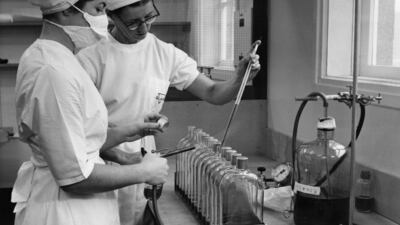
  • A polio vaccine being tested at the Glaxo Laboratories in Sefton Park, Buckinghamshire, in 1956.
    A polio vaccine being tested at the Glaxo Laboratories in Sefton Park, Buckinghamshire, in 1956.
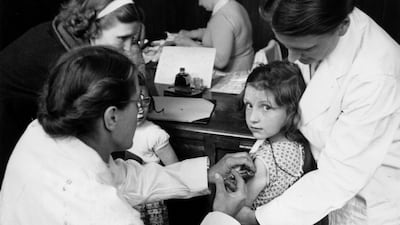
  • A child is injected with a vaccine against polio in 1956, the first stage of the biggest vaccination programme ever undertaken in Britain at the time.
    A child is injected with a vaccine against polio in 1956, the first stage of the biggest vaccination programme ever undertaken in Britain at the time.
  • Four young children wait for injections against polio at the Fairfield Welfare Clinic in Wandsworth, south London, in 1956.
    Four young children wait for injections against polio at the Fairfield Welfare Clinic in Wandsworth, south London, in 1956.
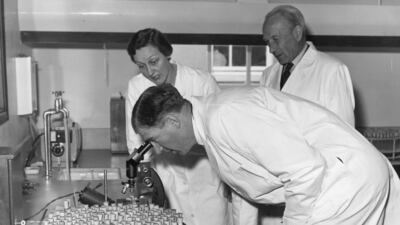
  • Health minister Dennis Vosper examining the polio virus in 1957, during the production of Polivirin, Britain's anti-poliomyletis vaccine, at Glaxo's Virus Research Laboratories in Stoke Poges.
    Health minister Dennis Vosper examining the polio virus in 1957, during the production of Polivirin, Britain's anti-poliomyletis vaccine, at Glaxo's Virus Research Laboratories in Stoke Poges.
  • A queue of factory workers waiting to receive polio vaccinations in one of the new London Mobile Immunisation Clinics at Highbury Grove in 1959.
    A queue of factory workers waiting to receive polio vaccinations in one of the new London Mobile Immunisation Clinics at Highbury Grove in 1959.
  • Junior members of staff at the Ministry of Health on Saville Row, London, line up to receive their inoculation against polio in 1959.
    Junior members of staff at the Ministry of Health on Saville Row, London, line up to receive their inoculation against polio in 1959.
  • Nurses in one of the many emergency polio vaccination clinics in Hull read the latest reports on the health scare in 1961.
    Nurses in one of the many emergency polio vaccination clinics in Hull read the latest reports on the health scare in 1961.

And it is not the only historically devastating disease making a comeback. This week, the UK detected a possible polio outbreak in London. It has not been found in the country for almost 40 years. The risk to public health is low – most people in the UK have been vaccinated against it – but authorities are urgently calling people who have not been inoculated to do so.

Such setbacks in a year when scientists are making major breakthroughs show that achieving better overall global health is neither straightforward nor inevitable with the passage of time. Work done in cutting-edge labs does not compensate for the need for basic education around the importance of vaccination, hygiene, healthy lifestyles and awareness of where food and drink come from.

Indeed, doctors in the UAE are stressing the importance of continued testing and taking of precautions to battle Covid-19. The scientific realities of new variants and waning immunity from vaccinations are also playing a part, and they are impossible for the individual to control. But Covid-19 reminded the world that personal action is pivotal, too. The advanced work of scientists might make headlines, but individual responsibility could be even more consequential for managing global health, especially in today’s complex epidemiological landscape.


WOMAN AND CHILD

Director: Saeed Roustaee

Starring: Parinaz Izadyar, Payman Maadi

Rating: 4/5

While you're here
England squad

Moeen Ali, James Anderson, Jofra Archer, Jonny Bairstow, Dominic Bess, James Bracey, Stuart Broad, Rory Burns, Jos Buttler, Zak Crawley, Sam Curran, Joe Denly, Ben Foakes, Lewis Gregory, Keaton Jennings, Dan Lawrence, Jack Leach, Saqib Mahmood, Craig Overton, Jamie Overton, Matthew Parkinson, Ollie Pope, Ollie Robinson, Joe Root, Dom Sibley, Ben Stokes, Olly Stone, Amar Virdi, Chris Woakes, Mark Wood

Day 4, Dubai Test: At a glance

Moment of the day Lahiru Gamage appeared to have been hard done by when he had his dismissal of Sami Aslam chalked off for a no-ball. Replays suggested he had not overstepped. No matter. Two balls later, the exact same combination – Gamage the bowler and Kusal Mendis at second slip – combined again to send Aslam back.

Stat of the day Haris Sohail took three wickets for one run in the only over he bowled, to end the Sri Lanka second innings in a hurry. That was as many as he had managed in total in his 10-year, 58-match first-class career to date. It was also the first time a bowler had taken three wickets having bowled just one over in an innings in Tests.

The verdict Just 119 more and with five wickets remaining seems like a perfectly attainable target for Pakistan. Factor in the fact the pitch is worn, is turning prodigiously, and that Sri Lanka’s seam bowlers have also been finding the strip to their liking, it is apparent the task is still a tough one. Still, though, thanks to Asad Shafiq and Sarfraz Ahmed, it is possible.

MWTC

Tickets start from Dh100 for adults and are now on sale at www.ticketmaster.ae and Virgin Megastores across the UAE. Three-day and travel packages are also available at 20 per cent discount.

The specs: 2018 Nissan 370Z Nismo

The specs: 2018 Nissan 370Z Nismo
Price, base / as tested: Dh182,178
Engine: 3.7-litre V6
Power: 350hp @ 7,400rpm
Torque: 374Nm @ 5,200rpm
Transmission: Seven-speed automatic
​​​​​​​Fuel consumption, combined: 10.5L / 100km

COMPANY%20PROFILE
%3Cp%3E%3Cstrong%3ECompany%20name%3A%3C%2Fstrong%3E%20Bedu%3C%2Fp%3E%0A%3Cp%3E%3Cstrong%3EStarted%3A%3C%2Fstrong%3E%202021%3C%2Fp%3E%0A%3Cp%3E%3Cstrong%3EFounders%3A%3C%2Fstrong%3E%20Khaled%20Al%20Huraimel%2C%20Matti%20Zinder%2C%20Amin%20Al%20Zarouni%3C%2Fp%3E%0A%3Cp%3E%3Cstrong%3EBased%3A%3C%2Fstrong%3E%20Dubai%2C%20UAE%3C%2Fp%3E%0A%3Cp%3E%3Cstrong%3EIndustry%3A%3C%2Fstrong%3E%20AI%2C%20metaverse%2C%20Web3%20and%20blockchain%3C%2Fp%3E%0A%3Cp%3E%3Cstrong%3EFunding%3A%3C%2Fstrong%3E%20Currently%20in%20pre-seed%20round%20to%20raise%20%245%20million%20to%20%247%20million%3C%2Fp%3E%0A%3Cp%3E%3Cstrong%3EInvestors%3A%3C%2Fstrong%3E%20Privately%20funded%3C%2Fp%3E%0A
MATCH INFO

Uefa Champions League final:

Who: Real Madrid v Liverpool
Where: NSC Olimpiyskiy Stadium, Kiev, Ukraine
When: Saturday, May 26, 10.45pm (UAE)
TV: Match on BeIN Sports

TOURNAMENT INFO

Women’s World Twenty20 Qualifier

Jul 3- 14, in the Netherlands
The top two teams will qualify to play at the World T20 in the West Indies in November

UAE squad
Humaira Tasneem (captain), Chamani Seneviratne, Subha Srinivasan, Neha Sharma, Kavisha Kumari, Judit Cleetus, Chaya Mughal, Roopa Nagraj, Heena Hotchandani, Namita D’Souza, Ishani Senevirathne, Esha Oza, Nisha Ali, Udeni Kuruppuarachchi

Expo details

Expo 2020 Dubai will be the first World Expo to be held in the Middle East, Africa and South Asia

The world fair will run for six months from October 20, 2020 to April 10, 2021.

It is expected to attract 25 million visits

Some 70 per cent visitors are projected to come from outside the UAE, the largest proportion of international visitors in the 167-year history of World Expos.

More than 30,000 volunteers are required for Expo 2020

The site covers a total of 4.38 sqkm, including a 2 sqkm gated area

It is located adjacent to Al Maktoum International Airport in Dubai South

Ticket prices
  • Golden circle - Dh995
  • Floor Standing - Dh495
  • Lower Bowl Platinum - Dh95
  • Lower Bowl premium - Dh795
  • Lower Bowl Plus - Dh695
  • Lower Bowl Standard- Dh595
  • Upper Bowl Premium - Dh395
  • Upper Bowl standard - Dh295
Mrs%20Chatterjee%20Vs%20Norway
%3Cp%3E%3Cstrong%3EDirector%3A%3C%2Fstrong%3E%20Ashima%20Chibber%C2%A0%3C%2Fp%3E%0A%3Cp%3E%3Cstrong%3EStars%3A%3C%2Fstrong%3E%20Rani%20Mukerji%2C%20Anirban%20Bhattacharya%20and%20Jim%20Sarbh%C2%A0%3C%2Fp%3E%0A%3Cp%3E%3Cstrong%3ERating%3A%3C%2Fstrong%3E%202%2F5%3C%2Fp%3E%0A

Mercer, the investment consulting arm of US services company Marsh & McLennan, expects its wealth division to at least double its assets under management (AUM) in the Middle East as wealth in the region continues to grow despite economic headwinds, a company official said.

Mercer Wealth, which globally has $160 billion in AUM, plans to boost its AUM in the region to $2-$3bn in the next 2-3 years from the present $1bn, said Yasir AbuShaban, a Dubai-based principal with Mercer Wealth.

Within the next two to three years, we are looking at reaching $2 to $3 billion as a conservative estimate and we do see an opportunity to do so,” said Mr AbuShaban.

Mercer does not directly make investments, but allocates clients’ money they have discretion to, to professional asset managers. They also provide advice to clients.

“We have buying power. We can negotiate on their (client’s) behalf with asset managers to provide them lower fees than they otherwise would have to get on their own,” he added.

Mercer Wealth’s clients include sovereign wealth funds, family offices, and insurance companies among others.

From its office in Dubai, Mercer also looks after Africa, India and Turkey, where they also see opportunity for growth.

Wealth creation in Middle East and Africa (MEA) grew 8.5 per cent to $8.1 trillion last year from $7.5tn in 2015, higher than last year’s global average of 6 per cent and the second-highest growth in a region after Asia-Pacific which grew 9.9 per cent, according to consultancy Boston Consulting Group (BCG). In the region, where wealth grew just 1.9 per cent in 2015 compared with 2014, a pickup in oil prices has helped in wealth generation.

BCG is forecasting MEA wealth will rise to $12tn by 2021, growing at an annual average of 8 per cent.

Drivers of wealth generation in the region will be split evenly between new wealth creation and growth of performance of existing assets, according to BCG.

Another general trend in the region is clients’ looking for a comprehensive approach to investing, according to Mr AbuShaban.

“Institutional investors or some of the families are seeing a slowdown in the available capital they have to invest and in that sense they are looking at optimizing the way they manage their portfolios and making sure they are not investing haphazardly and different parts of their investment are working together,” said Mr AbuShaban.

Some clients also have a higher appetite for risk, given the low interest-rate environment that does not provide enough yield for some institutional investors. These clients are keen to invest in illiquid assets, such as private equity and infrastructure.

“What we have seen is a desire for higher returns in what has been a low-return environment specifically in various fixed income or bonds,” he said.

“In this environment, we have seen a de facto increase in the risk that clients are taking in things like illiquid investments, private equity investments, infrastructure and private debt, those kind of investments were higher illiquidity results in incrementally higher returns.”

The Abu Dhabi Investment Authority, one of the largest sovereign wealth funds, said in its 2016 report that has gradually increased its exposure in direct private equity and private credit transactions, mainly in Asian markets and especially in China and India. The authority’s private equity department focused on structured equities owing to “their defensive characteristics.”

Updated: June 07, 2023, 9:41 AM