

Looking at the UAE's healthcare system is a good way to get a grasp of the country's rapid development since its founding just over 51 years ago.
During the mid-20th century, medical services were extremely basic. An article by the UAE's National Library and Archives describes the work of the British Government's "Dr McCaully", who in the 1940s helped set up and run a simple health service in the territories that now comprise the Emirates, to serve oil companies and locals.
By the 1960s, a more sophisticated health system was emerging, with one British document from 1960 praising Dubai's Al Maktoum Hospital as reflecting "no little credit on those responsible for its development". Many staff came from India and Pakistan.
Today, the UAE's healthcare sector is completely transformed, and there are many thousands who deserve credit. The country has some of the best healthcare in the Middle East, if not the world, with brands such as the Cleveland Clinic and Mayo Clinic operating.
This also helps diversify the country's economy. The option of advanced care in the country reduces the need for residents to travel abroad for treatment.
An important milestone in the sector took place this week when Abu Dhabi opened a clinical trials centre at Sheikh Shakhbout Medical City, in partnership with the Mayo Clinic. It will contribute to medical research and help establish the capital as a global hub for medicine by researching vaccines, innovative drugs, devices, procedures and tests, among other products in the fields of oncology, cardiology, neurology, rheumatology, haematology, ophthalmology, gastroenterology and paediatrics.
Speaking about the new centre, Dr Naser Ammash, chief executive of Sheikh Shakhbout Medical City, said that it will "elevate our institution to higher levels because we're not only taking care of patients but also looking for different kinds of solutions for their needs...This is how you develop the life sciences hub in Abu Dhabi and take it to that next level".
He is right. A truly sophisticated healthcare sector is made up of more than simply hospitals and clinics. It is also about embracing the science that advances understanding.
The UAE has already created projects in this regard. In 2020, the Emirate Genome Programme was launched. By collecting more regional DNA data, it is hoped that insight can be gained into genetic disorders that disproportionately affect people in the region, and therefore help doctors provide more personalised care.
-
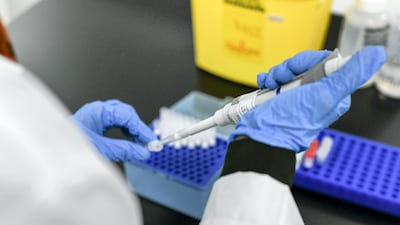
Emiratis in the UAE have been urged to voluntarily give an anonymous blood sample to help expand the data collection for the Emirati Genome Project. All photos by Khushnum Bhandari / The National -

The programme, which officially launched two years ago, has so far collected blood samples and buccal swabs from tens of thousands of people. -
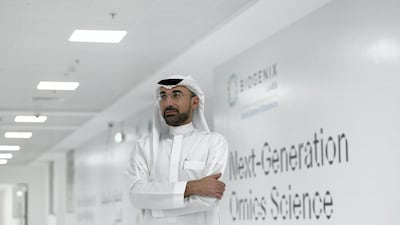
Dr Walid Zaher is the chief research officer for G42 Healthcare and one of the lead researchers for the Emirati Genome Programme -
Using the data, experts say they can predict, and in some cases prevent, diseases before they happen -
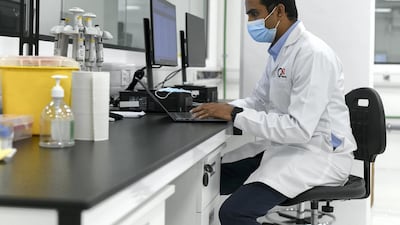
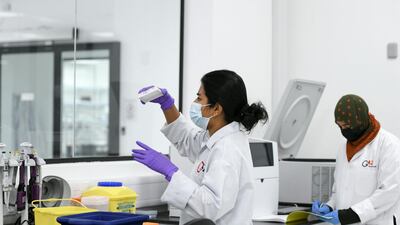
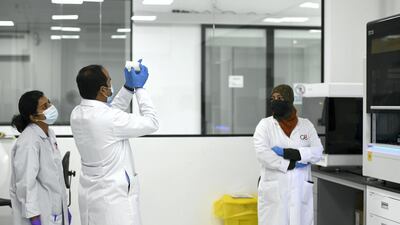
Researchers for the Emirati Genome Programme analyse sample data in the Omics laboratory -
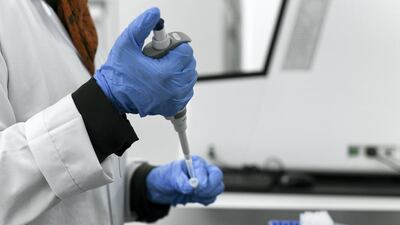
Researchers said the end goal is to collect samples from 100 per cent of the population -
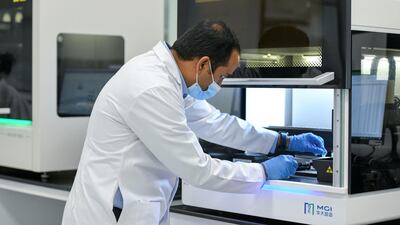
The risk of inheriting a gene mutation increases sharply when closely related individuals marry -
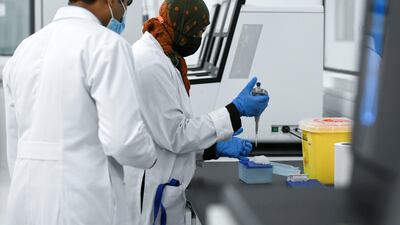
Teams working as part of the programme have already created the first reference genome from more than 1,000 volunteers -
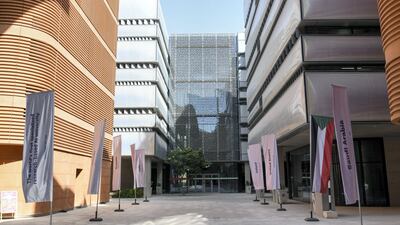
The Omics Centre of Excellence run by G42 Healthcare in Masdar City, Abu Dhabi -
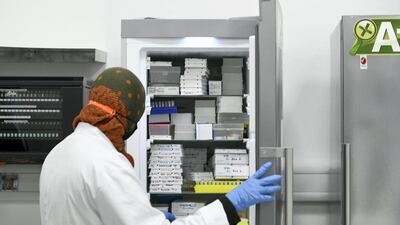
Using biotechnology and Artificial Intelligence, researchers can characterise things like genetic variation and understand how they relate to different diseases -
Volunteers can now submit DNA samples at a number of centres across Abu Dhabi including NMC Royal Hospital in Khalifa City, Bareen International Hospital, and NMC Specialty Hospital, Al Ain


That project might be geared towards Emiratis, but one of the reasons Abu Dhabi makes so much sense as a centre of medical trials is its diverse society. With more than 200 nationalities in the UAE, a genetically wide range of potential volunteers is within easy reach.
But this week's news is about more than economics and science. It is also about giving hope, especially to those that are most ill. Dr Shahrukh Hashmi, acting medical director of research at the hospital, told The National: “One of the top areas is cancer and we want to do individualised personalised medicine ... This will provide hope to patients who have gone through all their cancer therapies without success.”
Sixty years ago, physicians such as Dr McCaully were setting up facilities that looked like little more than field hospitals. He would most likely have been surprised that in such a short space of time, a new country in the territory he worked in would join the ranks of the most scientifically advanced nations that can support such health infrastructure. It is a credit to him, and the many thousands that have followed since, who have contributed to medicine in the Emirates.

