

Tomorrow is Nakba Day and amid some of the worst violence experienced by Palestinians in living memory, a special event will take place – a joint ceremony involving Palestinians and Israelis that will hear testimonies from 1948 and focus on what one organiser called “collective liberation”.
It comes shortly after a similar commemoration was staged on Sunday – Israel’s Memorial Day. Held in Arabic and Hebrew, it brought together bereaved Palestinian and Israeli families and demanded a different future for children in the region. Among those who spoke was Ahmed Al Helou, who has had 60 family members killed in Gaza, and Yonatan Zeigen, the son of peace activist Vivian Silver, who was killed in Kibbutz Be'eri on October 7.
This recognition of common humanity and the demand for collective liberation from the dead ends of war and occupation are important responses to frequent dehumanisation or indifference to the suffering felt by the “other side”. Palestinian and Israeli societies are locked in a devastating, decades-long conflict that requires another way forward – one that must be based on rights and justice if it has any chance of succeeding.
-
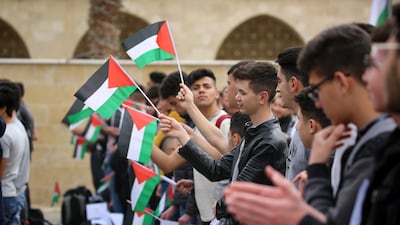
Palestinians in the West Bank city of Hebron participate in a rally marking the 74th anniversary of the Palestinian Nakba (catastrophe), referring to their uprooting in the war over Israel's 1948 creation. EPA -
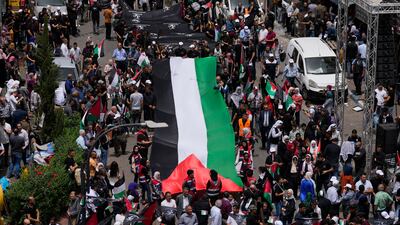
Palestinians carry a large national flag during a Nakba Day rally to mark the displacement of thousands of Palestinians after the founding of the Israeli state in the aftermath of the Second World War. AP -
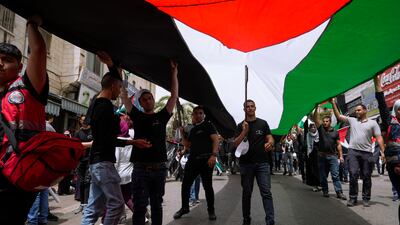
Nakba Day, marked here in the West Bank city of Ramallah, commemorates the 700,000 Palestinians who were forced to flee and seek refuge in neighbouring Jordan, Lebanon, Syria, the West Bank and the Gaza Strip. AP -
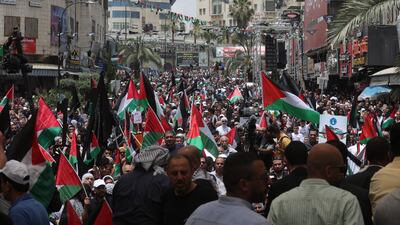
Israeli security forces were on high alert on Sunday after warnings by Hamas as Palestinians marked Nakba Day in places such as the West Bank city of Ramallah. EPA -
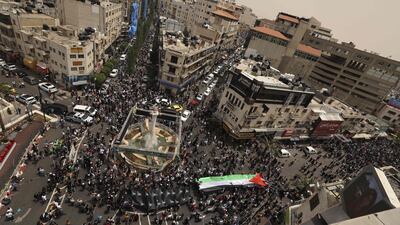
Palestinians marching in the occupied West Bank town of Ramallah in a Nakba Day rally to mark the biggest tragedy in Palestine’s history. AFP -
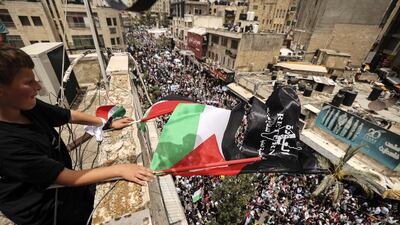
A young Palestinian waves national flags from a rooftop as people march in a rally marking the 74th anniversary of the Nakba (catastrophe) in the occupied West Bank town of Ramallah. AFP -
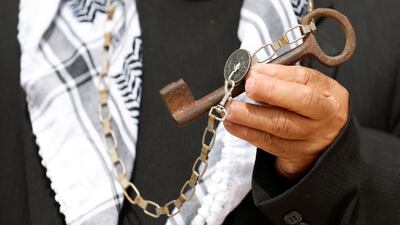
A Palestinian man at a Nakba rally in Ramallah holds a key to symbolise property lost during the forced removal of Palestinians from their homes after the formation of Israel. Reuters -
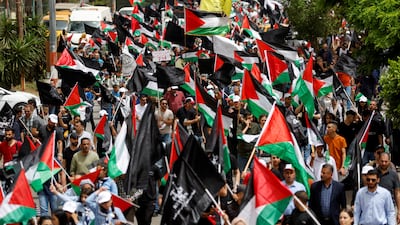
Palestinians mark the 74th anniversary of the Nakba in Ramallah. Reuters -
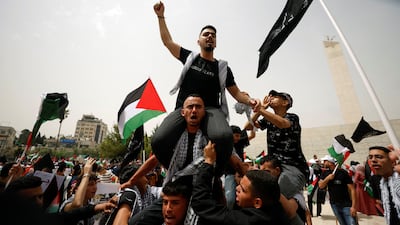
Demonstrators remembering the Nakba, the forced removal of Palestinians from their homes after the formation of Israel. Reuters -
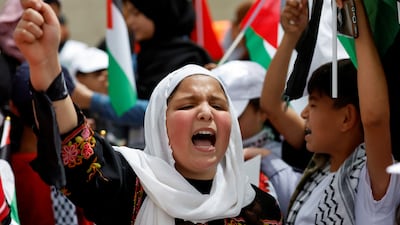
A Palestinian girl takes part in a Ramallah rally marking the 74th anniversary of the Nakba. Reuters


Although suffering and bereavement are personal and subjective experiences – no one can truly feel the pain of another – Palestinians as a society have been displaced, occupied and subjected to foreign military law, and now more than 35,000 of them have been killed in this latest war. These families, who seek justice and liberation in addition to peace, are arguably displaying more courage and better, wiser leadership than that shown so far by Israel’s government or the militarists of Hamas.
These families’ voices complement other examples of people who have braved criticism from their own society by putting peace first. On Saturday, The National reported on one of the Israeli hostages being held in Gaza, 84-year-old journalist Oded Lifshitz. Mr Lifshitz spent decades campaigning for Palestinian rights and, until he was taken prisoner, travelled regularly to the Erez checkpoint connecting Israel with Gaza to collect a number of Palestinian cancer patients for treatment in Israeli hospitals.
The integrity and courage of individuals like Mr Lifshitz or the hundreds of bereaved families willing to stand together and recognise one another’s pain will be critical examples for the years ahead. The trauma of the Gaza war will profoundly and negatively affect an entire generation. As far back as November, the Save the Children charity was reporting that Israel’s bombardment of Gaza was exacerbating a mental health crisis for the enclave’s children that would have far-reaching consequences. Similarly, a study published in February outlined the “broad and significant impact” of the October 7 attacks on the mental health of the Israeli population, underscoring the need for “interventions to address the mental health needs of Jewish and Arab citizens”.
It may often seem that voices calling for peace with justice are in the minority. However, the fact that the families organising joint commemorations, Israelis speaking out against the atrocities being committed in Gaza or Palestinians criticising violence against civilians can be outliers in their societies is more reason for the world to listen to them above the din of war.
Other conflicts have proved that families coming together in common humanity is not just a humane thing to do. It is an essential part of creating the atmosphere necessary to break the cycle of violence and lead to political progress. Such a scenario seems very remote in Palestine and Israel right now, but one day it will be necessary to have examples to point to of people who suffered greatly but retained their dignity and refused to give in to revenge and extremism. That is the hope that is needed today in Palestine, Israel and the whole world.

