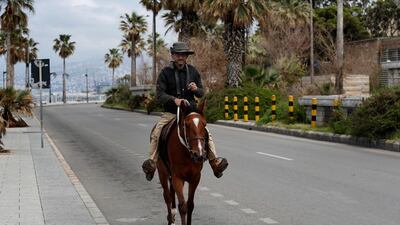
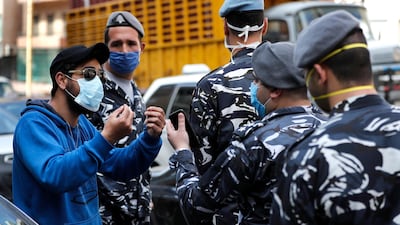
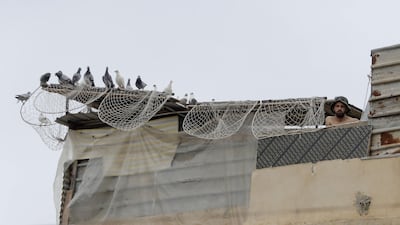
In Lebanon, there has been a belief recently that the confinement due to the novel coronavirus pandemic has benefited corrupt politicians in the country. Because people have not been allowed into the streets, this view goes, the protest movement that began last October has been deflated.
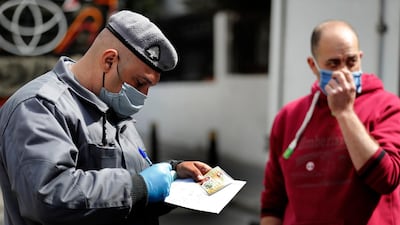
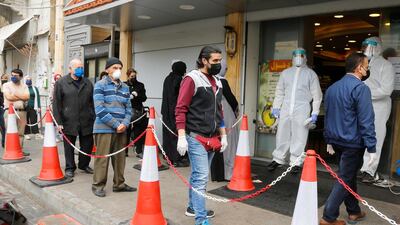
There is a major problem with such a judgment. As the Lebanese economy continues to collapse, with the pound having lost more than half of its value since the protests began, the idea that people will remain passive is wholly unrealistic. Indeed, in the past two weeks protests have taken place in poorer areas of Lebanon, albeit with people wearing masks. And protests in which people remain in their cars are continuing this week.
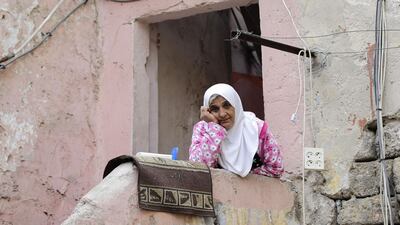
Many Lebanese earn daily wages and the enforced confinement has meant that large numbers of people have been without any income for weeks. It has become a common refrain to hear the poor say they would prefer to die from the coronavirus than from hunger. A social explosion is inevitable unless the economic situation in the country starts showing the possibility of amelioration.
A stronger case could be made that Lebanon’s political class is far more worried by what the consequences of coronavirus are for its lock on the political and economic system than it is reassured by the resulting containment measures on a disgruntled population.
The reason is that most politicians are now trapped.
The pandemic has imposed economic burdens on societies all over the world, in the form of the opportunity costs of lost or delayed business and the heightened direct costs of dealing with the disease. In Lebanon, the situation is even more dire, which means that the Lebanese authorities now have no realistic alternative but to go to the International Monetary Fund for a bailout.
This is a step many politicians would have liked to avoid. If Lebanon is dependent on outside financial assistance, this can be leveraged in return for genuine economic reforms. That could mean the political class would have less control over Lebanon’s economy, which has served as its cash cow and instrument of patronage. Hezbollah, Lebanon's most powerful party, expressed its uneasiness many weeks ago, warning that the IMF would not be allowed to “manage” Lebanon’s financial crisis.
Today, such protests sound absurd. With Lebanon in vital need of foreign currency to import food, medicine, and fuel, there is no latitude to avoid going to the IMF, unless the political class wants to face a social backlash, with no prospect that the situation will improve in the coming years. The implications for the ability of the political elite to maintain its control could be catastrophic.
One individual who may be more vulnerable than most is the speaker of parliament, Nabih Berri. When the protests began, Mr Berri was accused by protestors in the south of embodying the worst features of the political elite, and a rest house in the city of Tyre owned by his wife was burned down. Since then, the speaker has gone overboard in portraying himself as a defender of the people.
Mr Berri, unlike his communal partner (and sometimes rival) Hezbollah, does not have the means to absorb popular discontent. His principal method of patronage was to place people in state institutions. Yet the state today is bankrupt and the salaries of most of his political clients have shrunk. Mr Berri would likely have much more trouble dealing with popular displeasure than Hezbollah.
As Lebanon's economy continues to collapse, the idea that people will remain passive is wildly unrealistic
Nor is Mr Berri alone. The reaction against the political class for having plundered the country and impoverished much of the population has spared very few leaders. They are aware of this, which is why if the situation deteriorates further, their hold on the levers of the state will slip. An IMF bailout could at least inject needed liquidity into the economy, improving matters somewhat.
Yet to say that the politicians are cornered fails to tell the whole story. With many countries in urgent need of IMF assistance due to the coronavirus, Lebanon is one among a long list requiring aid. Unless it can formulate a reform programme that can convince the fund's board, the Lebanese will be on their own. If that happens, Beirut's politicians may have to approve of serious reform measures that eat into their networks of corruption.
This is not necessarily a cause for optimism. What is likely to transpire is that each politician will try to protect his own slice of the national pie, to the detriment of the others. That means that reform will proceed chaotically. The ultimate result may be an improvement in the economy, but the absence of a consensus around a reform programme will mean that the Lebanese will suffer needlessly.
Lebanon’s protests have not ended. As dark times settle in, they may not even have truly begun. By forcing the politicians to make tough choices, the coronavirus has created a dilemma from which they may not escape. They will be squeezed by the IMF, but without it their power will erode amid burgeoning distress.
Michael Young is editor of Diwan, the blog of the Carnegie Middle East programme, in Beirut

KILLING OF QASSEM SULEIMANI
RESULTS
Catchweight 82kg
Piotr Kuberski (POL) beat Ahmed Saeb (IRQ) by decision.
Women’s bantamweight
Corinne Laframboise (CAN) beat Cornelia Holm (SWE) by unanimous decision.
Welterweight
Omar Hussein (PAL) beat Vitalii Stoian (UKR) by unanimous decision.
Welterweight
Josh Togo (LEB) beat Ali Dyusenov (UZB) by unanimous decision.
Flyweight
Isaac Pimentel (BRA) beat Delfin Nawen (PHI) TKO round-3.
Catchweight 80kg
Seb Eubank (GBR) beat Emad Hanbali (SYR) KO round 1.
Lightweight
Mohammad Yahya (UAE) beat Ramadan Noaman (EGY) TKO round 2.
Lightweight
Alan Omer (GER) beat Reydon Romero (PHI) submission 1.
Welterweight
Juho Valamaa (FIN) beat Ahmed Labban (LEB) by unanimous decision.
Featherweight
Elias Boudegzdame (ALG) beat Austin Arnett (USA) by unanimous decision.
Super heavyweight
Maciej Sosnowski (POL) beat Ibrahim El Sawi (EGY) by submission round 1.
Electoral College Victory
Trump has so far secured 295 Electoral College votes, according to the Associated Press, exceeding the 270 needed to win. Only Nevada and Arizona remain to be called, and both swing states are leaning Republican. Trump swept all five remaining swing states, North Carolina, Georgia, Pennsylvania, Michigan and Wisconsin, sealing his path to victory and giving him a strong mandate.
Popular Vote Tally
The count is ongoing, but Trump currently leads with nearly 51 per cent of the popular vote to Harris’s 47.6 per cent. Trump has over 72.2 million votes, while Harris trails with approximately 67.4 million.
Mercer, the investment consulting arm of US services company Marsh & McLennan, expects its wealth division to at least double its assets under management (AUM) in the Middle East as wealth in the region continues to grow despite economic headwinds, a company official said.
Mercer Wealth, which globally has $160 billion in AUM, plans to boost its AUM in the region to $2-$3bn in the next 2-3 years from the present $1bn, said Yasir AbuShaban, a Dubai-based principal with Mercer Wealth.
“Within the next two to three years, we are looking at reaching $2 to $3 billion as a conservative estimate and we do see an opportunity to do so,” said Mr AbuShaban.
Mercer does not directly make investments, but allocates clients’ money they have discretion to, to professional asset managers. They also provide advice to clients.
“We have buying power. We can negotiate on their (client’s) behalf with asset managers to provide them lower fees than they otherwise would have to get on their own,” he added.
Mercer Wealth’s clients include sovereign wealth funds, family offices, and insurance companies among others.
From its office in Dubai, Mercer also looks after Africa, India and Turkey, where they also see opportunity for growth.
Wealth creation in Middle East and Africa (MEA) grew 8.5 per cent to $8.1 trillion last year from $7.5tn in 2015, higher than last year’s global average of 6 per cent and the second-highest growth in a region after Asia-Pacific which grew 9.9 per cent, according to consultancy Boston Consulting Group (BCG). In the region, where wealth grew just 1.9 per cent in 2015 compared with 2014, a pickup in oil prices has helped in wealth generation.
BCG is forecasting MEA wealth will rise to $12tn by 2021, growing at an annual average of 8 per cent.
Drivers of wealth generation in the region will be split evenly between new wealth creation and growth of performance of existing assets, according to BCG.
Another general trend in the region is clients’ looking for a comprehensive approach to investing, according to Mr AbuShaban.
“Institutional investors or some of the families are seeing a slowdown in the available capital they have to invest and in that sense they are looking at optimizing the way they manage their portfolios and making sure they are not investing haphazardly and different parts of their investment are working together,” said Mr AbuShaban.
Some clients also have a higher appetite for risk, given the low interest-rate environment that does not provide enough yield for some institutional investors. These clients are keen to invest in illiquid assets, such as private equity and infrastructure.
“What we have seen is a desire for higher returns in what has been a low-return environment specifically in various fixed income or bonds,” he said.
“In this environment, we have seen a de facto increase in the risk that clients are taking in things like illiquid investments, private equity investments, infrastructure and private debt, those kind of investments were higher illiquidity results in incrementally higher returns.”
The Abu Dhabi Investment Authority, one of the largest sovereign wealth funds, said in its 2016 report that has gradually increased its exposure in direct private equity and private credit transactions, mainly in Asian markets and especially in China and India. The authority’s private equity department focused on structured equities owing to “their defensive characteristics.”
10 tips for entry-level job seekers
- Have an up-to-date, professional LinkedIn profile. If you don’t have a LinkedIn account, set one up today. Avoid poor-quality profile pictures with distracting backgrounds. Include a professional summary and begin to grow your network.
- Keep track of the job trends in your sector through the news. Apply for job alerts at your dream organisations and the types of jobs you want – LinkedIn uses AI to share similar relevant jobs based on your selections.
- Double check that you’ve highlighted relevant skills on your resume and LinkedIn profile.
- For most entry-level jobs, your resume will first be filtered by an applicant tracking system for keywords. Look closely at the description of the job you are applying for and mirror the language as much as possible (while being honest and accurate about your skills and experience).
- Keep your CV professional and in a simple format – make sure you tailor your cover letter and application to the company and role.
- Go online and look for details on job specifications for your target position. Make a list of skills required and set yourself some learning goals to tick off all the necessary skills one by one.
- Don’t be afraid to reach outside your immediate friends and family to other acquaintances and let them know you are looking for new opportunities.
- Make sure you’ve set your LinkedIn profile to signal that you are “open to opportunities”. Also be sure to use LinkedIn to search for people who are still actively hiring by searching for those that have the headline “I’m hiring” or “We’re hiring” in their profile.
- Prepare for online interviews using mock interview tools. Even before landing interviews, it can be useful to start practising.
- Be professional and patient. Always be professional with whoever you are interacting with throughout your search process, this will be remembered. You need to be patient, dedicated and not give up on your search. Candidates need to make sure they are following up appropriately for roles they have applied.
Arda Atalay, head of Mena private sector at LinkedIn Talent Solutions, Rudy Bier, managing partner of Kinetic Business Solutions and Ben Kinerman Daltrey, co-founder of KinFitz
Ten tax points to be aware of in 2026
1. Domestic VAT refund amendments: request your refund within five years
If a business does not apply for the refund on time, they lose their credit.
2. E-invoicing in the UAE
Businesses should continue preparing for the implementation of e-invoicing in the UAE, with 2026 a preparation and transition period ahead of phased mandatory adoption.
3. More tax audits
Tax authorities are increasingly using data already available across multiple filings to identify audit risks.
4. More beneficial VAT and excise tax penalty regime
Tax disputes are expected to become more frequent and more structured, with clearer administrative objection and appeal processes. The UAE has adopted a new penalty regime for VAT and excise disputes, which now mirrors the penalty regime for corporate tax.
5. Greater emphasis on statutory audit
There is a greater need for the accuracy of financial statements. The International Financial Reporting Standards standards need to be strictly adhered to and, as a result, the quality of the audits will need to increase.
6. Further transfer pricing enforcement
Transfer pricing enforcement, which refers to the practice of establishing prices for internal transactions between related entities, is expected to broaden in scope. The UAE will shortly open the possibility to negotiate advance pricing agreements, or essentially rulings for transfer pricing purposes.
7. Limited time periods for audits
Recent amendments also introduce a default five-year limitation period for tax audits and assessments, subject to specific statutory exceptions. While the standard audit and assessment period is five years, this may be extended to up to 15 years in cases involving fraud or tax evasion.
8. Pillar 2 implementation
Many multinational groups will begin to feel the practical effect of the Domestic Minimum Top-Up Tax (DMTT), the UAE's implementation of the OECD’s global minimum tax under Pillar 2. While the rules apply for financial years starting on or after January 1, 2025, it is 2026 that marks the transition to an operational phase.
9. Reduced compliance obligations for imported goods and services
Businesses that apply the reverse-charge mechanism for VAT purposes in the UAE may benefit from reduced compliance obligations.
10. Substance and CbC reporting focus
Tax authorities are expected to continue strengthening the enforcement of economic substance and Country-by-Country (CbC) reporting frameworks. In the UAE, these regimes are increasingly being used as risk-assessment tools, providing tax authorities with a comprehensive view of multinational groups’ global footprints and enabling them to assess whether profits are aligned with real economic activity.
Contributed by Thomas Vanhee and Hend Rashwan, Aurifer
Sarfira
Director: Sudha Kongara Prasad
Starring: Akshay Kumar, Radhika Madan, Paresh Rawal
Rating: 2/5
Dhadak 2
Director: Shazia Iqbal
Starring: Siddhant Chaturvedi, Triptii Dimri
Rating: 1/5
BIGGEST CYBER SECURITY INCIDENTS IN RECENT TIMES
SolarWinds supply chain attack: Came to light in December 2020 but had taken root for several months, compromising major tech companies, governments and its entities
Microsoft Exchange server exploitation: March 2021; attackers used a vulnerability to steal emails
Kaseya attack: July 2021; ransomware hit perpetrated REvil, resulting in severe downtime for more than 1,000 companies
Log4j breach: December 2021; attackers exploited the Java-written code to inflitrate businesses and governments
Zayed Sustainability Prize
NEW%20UTILITY%20POLICY%3A%20WHAT%20DOES%20IT%20REGULATE%3F
%3Cp%3E%E2%80%A2%20Agreements%20on%20energy%20and%20water%20supply%3C%2Fp%3E%0A%3Cp%3E%E2%80%A2%20Applied%20service%20fees%3C%2Fp%3E%0A%3Cp%3E%E2%80%A2%20Customer%20data%20and%20information%20privacy%3C%2Fp%3E%0A%3Cp%3E%E2%80%A2%20Prohibition%20of%20service%20disconnections%3C%2Fp%3E%0A%3Cp%3E%E2%80%A2%20Customer%20complaint%20process%3C%2Fp%3E%0A%3Cp%3E%E2%80%A2%20Management%20of%20debts%20and%20customers%20in%20default%3C%2Fp%3E%0A%3Cp%3E%E2%80%A2%20Services%20provided%20to%20people%20of%20determination%20and%20home%20care%20customers%3C%2Fp%3E%0A
The Sand Castle
Director: Matty Brown
Stars: Nadine Labaki, Ziad Bakri, Zain Al Rafeea, Riman Al Rafeea
Rating: 2.5/5