I never look at the Moon without being reminded of Neil Armstrong and Buzz Aldrin – and of the day, July 20, 1969, when they left their first footprints on its dusty surface. The exploit seems even more heroic in retrospect, when we realise how "primitive" the technology was: Nasa's entire suite of computers was less powerful than a single smartphone today.
Apollo 11 was only 12 years after the USSR's first Sputnik satellite launched into orbit around the Earth. Had the pace of missions been sustained in the subsequent half-century, there would surely have been footprints on Mars long before today.
But this has not happened.
The reason, of course, is that Apollo was motivated by the US strategic imperative to "beat the Russians"; it consumed up to four per cent of the US federal budget. Once US primacy was achieved, continuing gargantuan levels of funding was not justifiable, and the Apollo Programme ended in 1972 with the safe return of Apollo 17.
Hundreds more people have ventured into space in the ensuing decades, but – anti-climactically – they have done no more than circle the Earth in low orbit, mostly in the International Space Station.
Space technology has nonetheless burgeoned. There is participation from more than 70 nations, as well as the commercial sector. We routinely depend on orbiting satellites for communication, navigation, environmental monitoring, surveillance and weather forecasting. And space technology offers a huge boost to astronomers, lifting telescopes into orbits far above the blurring and absorptive effects of Earth's atmosphere.
The sector has been energised by private companies, such as Elon Musk's SpaceX and Jeff Bezos's Blue Origin. These ventures bring a can-do Silicon Valley culture into a domain long dominated by Nasa and a few aerospace conglomerates. They have developed the techniques to recover and reuse the main launch rocket, presaging real cost savings.
Machine learning is advancing quickly, as is sensor technology. In coming decades, the entire solar system – planets, moons, and asteroids – will be explored by fleets of tiny, automated probes interacting with one another like a flock of birds.
Giant robotic fabricators will construct, in space, solar energy collectors, telescopes and other giant structures. Indeed, much industrial production could eventually happen away from Earth.
Ever more capable instruments have been sent to Mars to orbit around the red planet or land on its surface. They will be joined next year by the UAE's Hope spacecraft to study the Martian climate – hopefully a pathfinder for other projects, both inspirational and practical, from the Middle East.
But the extra cost of sending humans – and returning them safely – remains significant. So will humans once again venture into what we call “deep space”, rather than simply orbiting the Earth?
-
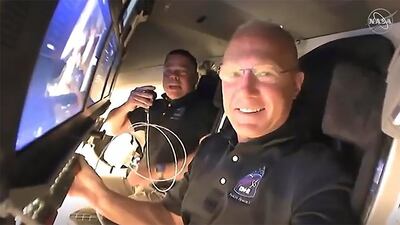
Nasa astronauts Doug Hurley, foreground, and Bob Behnken call down to mission controllers for a report on their second flight day onboard the SpaceX Crew Dragon spacecraft on Nasa's SpaceX Demo-2 mission approaching to dock to the International Space Station (ISS). Nasa TV / EPA -
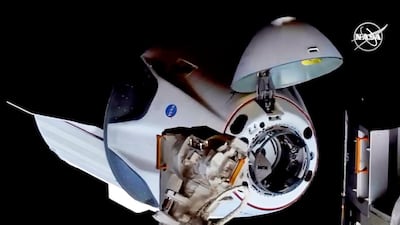
SpaceX's Crew Dragon spacecraft approaches to dock to ISS. Nasa TV / EPA -
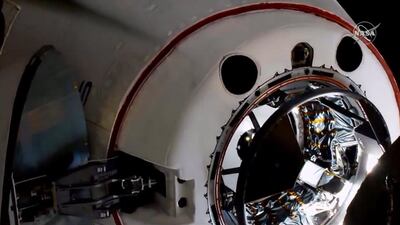
SpaceX's Crew Dragon spacecraft approaches to dock to ISS. Nasa TV / EPA -

SpaceX's Crew Dragon spacecraft approaches to dock to ISS. Nasa TV / EPA -

The SpaceX Dragon crew capsule, with Nasa astronauts Doug Hurley and Robert Behnken aboard, docks with the International Space Station. Nasa TV / AP -
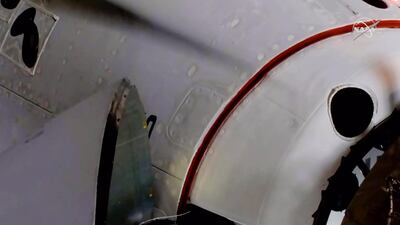
The SpaceX Dragon crew capsule, with Nasa astronauts Doug Hurley and Robert Behnken aboard, docks with the International Space Station. Nasa TV / AP -
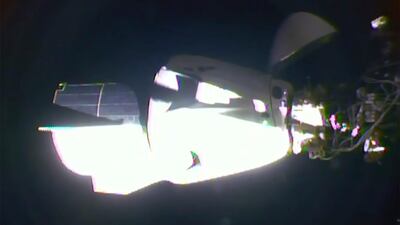
The SpaceX Dragon crew capsule, with Nasa astronauts Doug Hurley and Robert Behnken aboard, docks with the International Space Station. Nasa TV / AP -
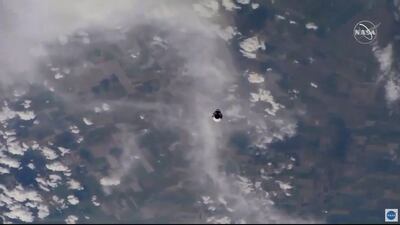
SpaceX Crew Dragon is seen from the International Space Station during the spacecraft's approach to the orbiting laboratory. Nasa TV / EPA -
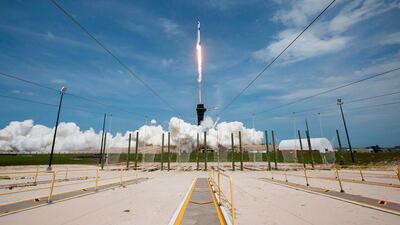
SpaceX Falcon 9 rocket carrying the company's Crew Dragon spacecraft launched from Launch Complex 39A on Nasa’s SpaceX Demo-2 mission to the International Space Station with Nasa astronauts Robert Behnken and Douglas Hurley onboard, at Nasa's Kennedy Space Centre in Florida. Nasa / AFP


To today’s young people, the Apollo programme is ancient history. It was all over long before they were ever born. Of the 12 men who walked on the moon, only three are still living. We could be nearing a time when no human has a first-hand memory of standing on another world.
Along with millions of others, I would be saddened if human exploration of deep space faded into history.
Mars is a more alluring target than the Moon, albeit more remote. I hope that some people alive today will walk on the red planet’s surface – as an adventure, and as a step towards the stars.
Nasa’s Space Shuttle, when it was operational, was launched more than 130 times. Its two crashes were national traumas because it had been promoted unwisely as a safe vehicle for civilians (and because a schoolteacher, Christa McAuliffe, was one of the casualties). Test pilots and adventurers would readily accept much more risk than the two per cent implicit in the experience of the Space Shuttle programme.
China has the resources, the dirigisme and maybe even the willingness to undertake an Apollo-style programme. It already achieved a "first" by landing on the far side of the Moon, and will surely follow this up with a manned Lunar base. But a clearer-cut "great leap forward" in Chinese space exploration would involve footprints on Mars, not just on the Moon.
Looking further ahead, the UAE envisages that, by 2117, there could be a real "city" on Mars, and it is welcome to have this inspirational goal to inspire interest among the next generation and inspire innovation in the region.
I think the future of manned spaceflight also lies with privately funded adventurers who are prepared to participate in a cut-price programme far riskier than the kind Nasa has been able to impose upon its astronauts thus far.
The phrase “space tourism” should be avoided. It lulls people into believing that such ventures are genuinely safe. And if that is the perception, the inevitable accidents will be as traumatic as those of the Shuttle. These exploits must be sold, so to speak, as dangerous sports, or intrepid exploration.
So I hope that adventurers and thrill-seekers later this century might establish a fragile base on Mars. But do not ever expect mass emigration from Earth. And here I disagree with Mr Musk and with my late Cambridge colleague Stephen Hawking, who enthuse about a rapid build-up of large-scale Martian communities.
Space does not offer an escape from all of Earth’s problems. We have got to solve these here. Coping with climate change may seem daunting, but it is simple compared to terraforming Mars. No place in our solar system offers an environment as clement as even the Antarctic, or the top of Everest. There is no “Planet B” for ordinary, risk-averse people. We must cherish our Earthly home and our global heritage – but continue to seek inspiration from the stars.
Martin Rees is the UK’s Astronomer Royal and the author of On the Future: Prospects for Humanity