What happens to the Middle East if Tehran falls?


Nada AlTaher
  • English
  • Arabic

Up until last week, it seemed unthinkable for a UN member state to strike a nuclear site. But Israel did just that when it launched its attack on Iran, hitting military and atomic sites, and killing key figures of the Islamic Revolutionary Guard Corps.

It also seemed unthinkable for missiles to penetrate Israel’s Iron Dome and destroy infrastructure in cities such as Haifa and Tel Aviv.

Yet again, civilians are paying the heaviest price. More than 240 people have been killed in Iran so far. In Israel, at least 24 people have been killed in retaliatory strikes. One week on, the war shows no signs of abating, with the US hinting it might get involved, too.

A sense of unease has gripped the region, with neighbouring states fearing further escalation. A group of 20 countries including Gulf states, Jordan and Egypt has called for an end to hostilities. In a worst-case scenario, the repercussions could be catastrophic for them, too.

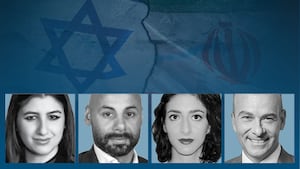
In this episode of Beyond the Headlines, host Nada AlTaher looks at the consequences of the war on the Middle East and asks what will happen to the region if Tehran were to fall? She speaks to Hasan AlHasan, senior fellow for Middle East policy at the International Institute for Strategic Studies, and Thomas Juneau, associate fellow with the MENA Programme at Chatham House and a professor at University of Ottawa, Canada.

Editor’s Note: We want to hear from you! Help us improve our podcasts by taking our 2-minute listener survey. Click here.

Who's who in Yemen conflict

Houthis: Iran-backed rebels who occupy Sanaa and run unrecognised government

Yemeni government: Exiled government in Aden led by eight-member Presidential Leadership Council

Southern Transitional Council: Faction in Yemeni government that seeks autonomy for the south

Habrish 'rebels': Tribal-backed forces feuding with STC over control of oil in government territory

DIVINE%20INTERVENTOIN
%3Cp%3EStarring%3A%20Elia%20Suleiman%2C%20Manal%20Khader%2C%20Amer%20Daher%3C%2Fp%3E%0A%3Cp%3EDirector%3A%20Elia%20Suleiman%3C%2Fp%3E%0A%3Cp%3ERating%3A%204.5%2F5%3C%2Fp%3E%0A

Mercer, the investment consulting arm of US services company Marsh & McLennan, expects its wealth division to at least double its assets under management (AUM) in the Middle East as wealth in the region continues to grow despite economic headwinds, a company official said.

Mercer Wealth, which globally has $160 billion in AUM, plans to boost its AUM in the region to $2-$3bn in the next 2-3 years from the present $1bn, said Yasir AbuShaban, a Dubai-based principal with Mercer Wealth.

Within the next two to three years, we are looking at reaching $2 to $3 billion as a conservative estimate and we do see an opportunity to do so,” said Mr AbuShaban.

Mercer does not directly make investments, but allocates clients’ money they have discretion to, to professional asset managers. They also provide advice to clients.

“We have buying power. We can negotiate on their (client’s) behalf with asset managers to provide them lower fees than they otherwise would have to get on their own,” he added.

Mercer Wealth’s clients include sovereign wealth funds, family offices, and insurance companies among others.

From its office in Dubai, Mercer also looks after Africa, India and Turkey, where they also see opportunity for growth.

Wealth creation in Middle East and Africa (MEA) grew 8.5 per cent to $8.1 trillion last year from $7.5tn in 2015, higher than last year’s global average of 6 per cent and the second-highest growth in a region after Asia-Pacific which grew 9.9 per cent, according to consultancy Boston Consulting Group (BCG). In the region, where wealth grew just 1.9 per cent in 2015 compared with 2014, a pickup in oil prices has helped in wealth generation.

BCG is forecasting MEA wealth will rise to $12tn by 2021, growing at an annual average of 8 per cent.

Drivers of wealth generation in the region will be split evenly between new wealth creation and growth of performance of existing assets, according to BCG.

Another general trend in the region is clients’ looking for a comprehensive approach to investing, according to Mr AbuShaban.

“Institutional investors or some of the families are seeing a slowdown in the available capital they have to invest and in that sense they are looking at optimizing the way they manage their portfolios and making sure they are not investing haphazardly and different parts of their investment are working together,” said Mr AbuShaban.

Some clients also have a higher appetite for risk, given the low interest-rate environment that does not provide enough yield for some institutional investors. These clients are keen to invest in illiquid assets, such as private equity and infrastructure.

“What we have seen is a desire for higher returns in what has been a low-return environment specifically in various fixed income or bonds,” he said.

“In this environment, we have seen a de facto increase in the risk that clients are taking in things like illiquid investments, private equity investments, infrastructure and private debt, those kind of investments were higher illiquidity results in incrementally higher returns.”

The Abu Dhabi Investment Authority, one of the largest sovereign wealth funds, said in its 2016 report that has gradually increased its exposure in direct private equity and private credit transactions, mainly in Asian markets and especially in China and India. The authority’s private equity department focused on structured equities owing to “their defensive characteristics.”

MOUNTAINHEAD REVIEW

Starring: Ramy Youssef, Steve Carell, Jason Schwartzman

Director: Jesse Armstrong

Rating: 3.5/5

Five%20calorie-packed%20Ramadan%20drinks
%3Cp%3E%3Cstrong%3ERooh%20Afza%3C%2Fstrong%3E%0D%3Cbr%3E100ml%20contains%20414%20calories%0D%3Cbr%3E%3Cstrong%3ETang%20orange%20drink%3C%2Fstrong%3E%0D%3Cbr%3E100ml%20serving%20contains%20300%20calories%0D%3Cbr%3E%3Cstrong%3ECarob%20beverage%20mix%3C%2Fstrong%3E%0D%3Cbr%3E100ml%20serving%20contains%20about%20300%20calories%0D%3Cbr%3E%3Cstrong%3EQamar%20Al%20Din%20apricot%20drink%3C%2Fstrong%3E%0D%3Cbr%3E100ml%20saving%20contains%2061%20calories%0D%3Cbr%3E%3Cstrong%3EVimto%20fruit%20squash%3C%2Fstrong%3E%0D%3Cbr%3E100ml%20serving%20contains%2030%20calories%3C%2Fp%3E%0A
The specs

Engine: 2.0-litre 4cyl turbo

Power: 261hp at 5,500rpm

Torque: 405Nm at 1,750-3,500rpm

Transmission: 9-speed auto

Fuel consumption: 6.9L/100km

On sale: Now

Price: From Dh117,059

The President's Cake

Director: Hasan Hadi

Starring: Baneen Ahmad Nayyef, Waheed Thabet Khreibat, Sajad Mohamad Qasem 

Rating: 4/5

Our family matters legal consultant

Name: Hassan Mohsen Elhais

Position: legal consultant with Al Rowaad Advocates and Legal Consultants.

In-demand jobs and monthly salaries
  • Technology expert in robotics and automation: Dh20,000 to Dh40,000 
  • Energy engineer: Dh25,000 to Dh30,000 
  • Production engineer: Dh30,000 to Dh40,000 
  • Data-driven supply chain management professional: Dh30,000 to Dh50,000 
  • HR leader: Dh40,000 to Dh60,000 
  • Engineering leader: Dh30,000 to Dh55,000 
  • Project manager: Dh55,000 to Dh65,000 
  • Senior reservoir engineer: Dh40,000 to Dh55,000 
  • Senior drilling engineer: Dh38,000 to Dh46,000 
  • Senior process engineer: Dh28,000 to Dh38,000 
  • Senior maintenance engineer: Dh22,000 to Dh34,000 
  • Field engineer: Dh6,500 to Dh7,500
  • Field supervisor: Dh9,000 to Dh12,000
  • Field operator: Dh5,000 to Dh7,000
Specs

Engine: Dual-motor all-wheel-drive electric

Range: Up to 610km

Power: 905hp

Torque: 985Nm

Price: From Dh439,000

Available: Now

Ammar 808:
Maghreb United

Sofyann Ben Youssef
Glitterbeat 

Updated: November 19, 2025, 11:38 AM
More podcasts
