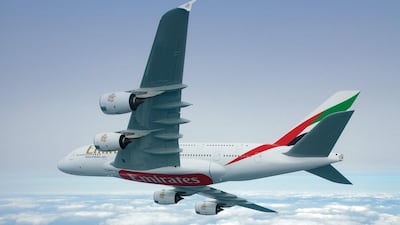
Emirates has 116 superjumbos in its fleet and is currently upgrading 67. Photo: Emirates

Emirates says Airbus A380s could still be in the skies in 20 years


  • English
  • Arabic

This year, Emirates celebrated 15 years since it took delivery of its first Airbus A380.

It happened in July 2008, when an aircraft with the registration A6-EDA arrived from Hamburg. It then took its inaugural flight for the carrier on August 1, flying between Dubai and New York.

That specific jet is no longer in operation, but about 90 are in service, with a total of 116 in Emirates' fleet.

Passenger capacity on the jets ranges from 484 to 615 with room for up to 24 crew. They fly to 50 destinations globally.

No A380s operated during the pandemic for the airline. However, despite Airbus announcing it has ceased production of the model, they are enjoying a recent resurgence. The last A380 was delivered to Emirates in December 2021.

Emirates received its final A380 in December 2021. Photo: Emirates

Emirates isn't the only airline that favours this model. Etihad Airways reintroduced its superjumbo fleet this summer and Qatar Airways also flies the aircraft in the region. International carriers such as British Airways and Singapore Airlines also have them.

“It's an iconic aircraft. Customers absolutely love it. They go out of their way to fly on it," Richard Jewsbury, an Emirates executive, told industry publication Simple Flying this week. "People enjoy the experience, but also enjoy seeing it in the sky as well. It's just wonderful to see it fly and prosper."

From the perspective of the UK market, it's an important aircraft, he said, with about 120,000 passengers a week travelling with Emirates in and out of the UK – 80 per cent of those on A380s.

There are no plans to discontinue this aircraft from the company's portfolio any time soon. "We took delivery of our last A380 in December 2021," Jewsbury added. "That's just around 18 months old. So, the more recently delivered aircraft are going to be around for a while.

"It's going to be the late 2030s, maybe early 2040s, before we wave goodbye to the last A380. They're going to be here for the foreseeable future.”

The airline is also in the process of upgrading 67 A380s, along with 53 Boeing 777s, as part of a multi-billion-dollar plan to introduce premium economy class, new seats, finishes and flooring, with work set to finish in 2025.

The A380 is the largest passenger aircraft in history and its floor space spans about 550 square metres over its two decks.

The first test flight took place in 2005 and the aircraft entered service with Singapore Airlines in October 2007. The model has flown more than 800,000 flights and carried more than 300 million passengers since, according to Airbus.

  • Emirates' newest superjumbo is fitted with the Dubai airline's first Premium Economy cabin. All photos: Emirates
    Emirates' newest superjumbo is fitted with the Dubai airline's first Premium Economy cabin. All photos: Emirates
  • The airline was offering complimentary upgrades to those flying Economy class to London.
    The airline was offering complimentary upgrades to those flying Economy class to London.
  • The stairway on the A380 main deck, around which Emirates' new Premium Economy cabin is located.
    The stairway on the A380 main deck, around which Emirates' new Premium Economy cabin is located.
  • Emirates' Premium Economy seats feature anti-stain leather and luxurious stitching details.
    Emirates' Premium Economy seats feature anti-stain leather and luxurious stitching details.
  • With a generous pitch of up to 40 inches, seat are 19.5 inches wide and recline eight inches into a cradle position with room to stretch out.
    With a generous pitch of up to 40 inches, seat are 19.5 inches wide and recline eight inches into a cradle position with room to stretch out.
  • Each traveller has an in-armrest dining table and cocktail table.
    Each traveller has an in-armrest dining table and cocktail table.
  • Passengers onboard EK2021 will be able to experience Emirates' new premium economy cabin.
    Passengers onboard EK2021 will be able to experience Emirates' new premium economy cabin.

Anghami
Started: December 2011
Co-founders: Elie Habib, Eddy Maroun
Based: Beirut and Dubai
Sector: Entertainment
Size: 85 employees
Stage: Series C
Investors: MEVP, du, Mobily, MBC, Samena Capital

LUKA CHUPPI

Director: Laxman Utekar

Producer: Maddock Films, Jio Cinema

Cast: Kartik Aaryan, Kriti Sanon​​​​​​​, Pankaj Tripathi, Vinay Pathak, Aparshakti Khurana

Rating: 3/5

Desert Warrior

Starring: Anthony Mackie, Aiysha Hart, Ben Kingsley

Director: Rupert Wyatt

Rating: 3/5

Ticket prices
  • Golden circle - Dh995
  • Floor Standing - Dh495
  • Lower Bowl Platinum - Dh95
  • Lower Bowl premium - Dh795
  • Lower Bowl Plus - Dh695
  • Lower Bowl Standard- Dh595
  • Upper Bowl Premium - Dh395
  • Upper Bowl standard - Dh295
PRISCILLA
%3Cp%3EDirector%3A%20Sofia%20Coppola%3C%2Fp%3E%0A%3Cp%3EStarring%3A%20Cailee%20Spaeny%2C%20Jacob%20Elordi%3C%2Fp%3E%0A%3Cp%3ERating%3A%203%2F5%3C%2Fp%3E%0A
Specs

Engine: 51.5kW electric motor

Range: 400km

Power: 134bhp

Torque: 175Nm

Price: From Dh98,800

Available: Now

Asia Cup 2018 Qualifier

Sunday's results:

  • UAE beat Malaysia by eight wickets
  • Nepal beat Singapore by four wickets
  • Oman v Hong Kong, no result

Tuesday fixtures:

  • Malaysia v Singapore
  • UAE v Oman
  • Nepal v Hong Kong
Ten tax points to be aware of in 2026

1. Domestic VAT refund amendments: request your refund within five years

If a business does not apply for the refund on time, they lose their credit.

2. E-invoicing in the UAE

Businesses should continue preparing for the implementation of e-invoicing in the UAE, with 2026 a preparation and transition period ahead of phased mandatory adoption. 

3. More tax audits

Tax authorities are increasingly using data already available across multiple filings to identify audit risks. 

4. More beneficial VAT and excise tax penalty regime

Tax disputes are expected to become more frequent and more structured, with clearer administrative objection and appeal processes. The UAE has adopted a new penalty regime for VAT and excise disputes, which now mirrors the penalty regime for corporate tax.

5. Greater emphasis on statutory audit

There is a greater need for the accuracy of financial statements. The International Financial Reporting Standards standards need to be strictly adhered to and, as a result, the quality of the audits will need to increase.

6. Further transfer pricing enforcement

Transfer pricing enforcement, which refers to the practice of establishing prices for internal transactions between related entities, is expected to broaden in scope. The UAE will shortly open the possibility to negotiate advance pricing agreements, or essentially rulings for transfer pricing purposes. 

7. Limited time periods for audits

Recent amendments also introduce a default five-year limitation period for tax audits and assessments, subject to specific statutory exceptions. While the standard audit and assessment period is five years, this may be extended to up to 15 years in cases involving fraud or tax evasion. 

8. Pillar 2 implementation 

Many multinational groups will begin to feel the practical effect of the Domestic Minimum Top-Up Tax (DMTT), the UAE's implementation of the OECD’s global minimum tax under Pillar 2. While the rules apply for financial years starting on or after January 1, 2025, it is 2026 that marks the transition to an operational phase.

9. Reduced compliance obligations for imported goods and services

Businesses that apply the reverse-charge mechanism for VAT purposes in the UAE may benefit from reduced compliance obligations. 

10. Substance and CbC reporting focus

Tax authorities are expected to continue strengthening the enforcement of economic substance and Country-by-Country (CbC) reporting frameworks. In the UAE, these regimes are increasingly being used as risk-assessment tools, providing tax authorities with a comprehensive view of multinational groups’ global footprints and enabling them to assess whether profits are aligned with real economic activity. 

Contributed by Thomas Vanhee and Hend Rashwan, Aurifer

Updated: September 05, 2023, 1:14 PM