• Student-built satellite DhabiSat successfully reached its target orbit.
    Student-built satellite DhabiSat successfully reached its target orbit.
  • DhabiSat arrived at the International Space Station on board the Cygnus NG-15 resupply spacecraft.
    DhabiSat arrived at the International Space Station on board the Cygnus NG-15 resupply spacecraft.
  • DhabiSat was carried to the International Space Station on Cygnus on February 20. The spacecraft left the station on June 29, releasing DhabiSat and four other CubeSat into their final orbit.
    DhabiSat was carried to the International Space Station on Cygnus on February 20. The spacecraft left the station on June 29, releasing DhabiSat and four other CubeSat into their final orbit.
  • DhabiSat, formerly called MYSat-2, is an initiative by Khalifa University to help students design, build and test software modules for attitude determination and control systems, which enables satellites to point accurately at specific locations.
    DhabiSat, formerly called MYSat-2, is an initiative by Khalifa University to help students design, build and test software modules for attitude determination and control systems, which enables satellites to point accurately at specific locations.
  • DhabiSat was built by 27 graduate students at Yahsat Space Lab in Abu Dhabi.
    DhabiSat was built by 27 graduate students at Yahsat Space Lab in Abu Dhabi.

UAE in space: Student-built satellite DhabiSat successfully reaches target orbit


Sarwat Nasir
  • English
  • Arabic

A UAE-built miniature satellite that can point in specific directions to take high-resolution images has successfully reached its target orbit in space.

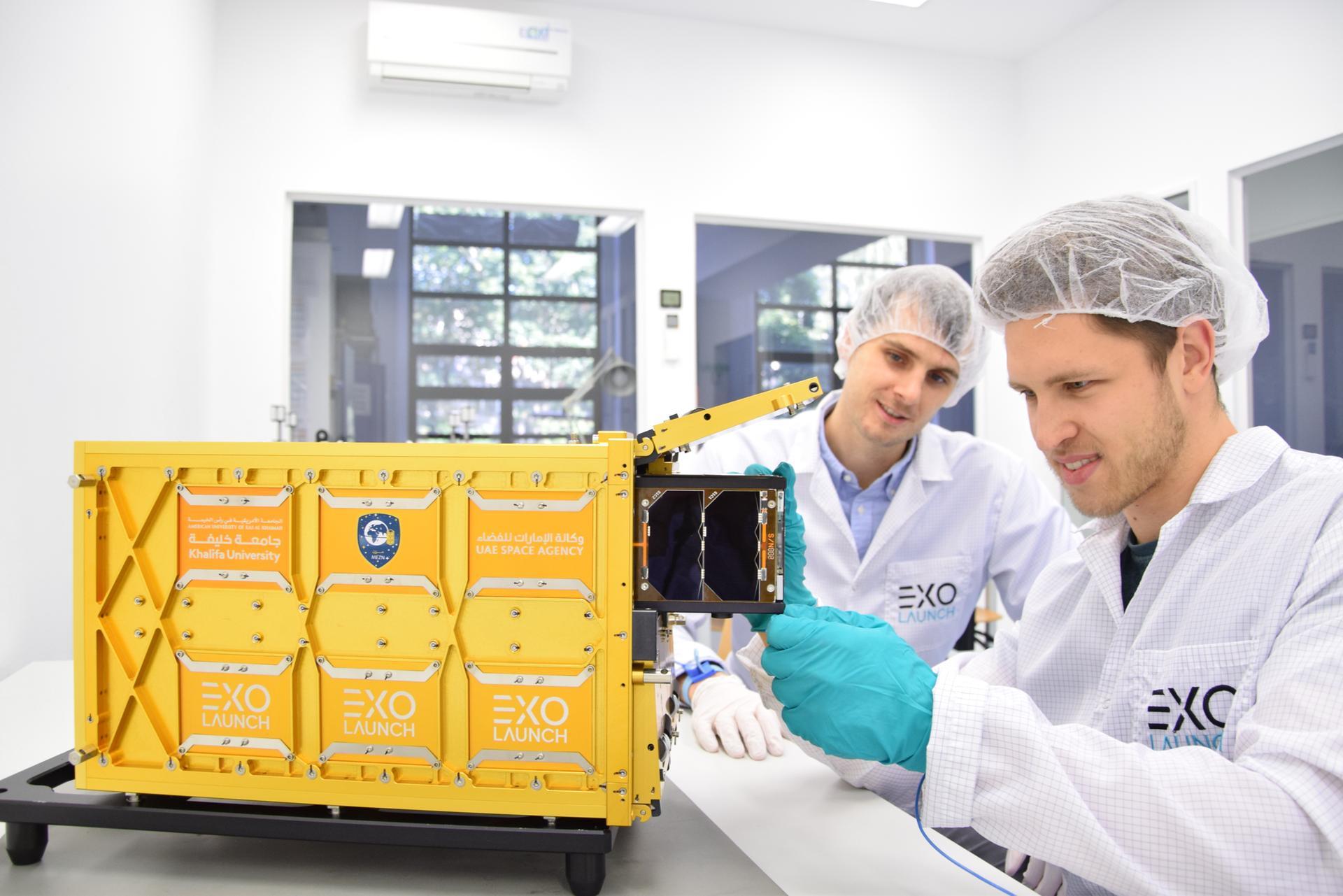
Students at Khalifa University built the advanced Cubesat, called DhabiSat, which was carried to the International Space Station on Cygnus resupply craft on February 20.

Cygnus, which was launched on an Antares rocket from the Wallops Flight Facility in Virginia, left the station on June 29, releasing DhabiSat and four other nanosats into their final orbit.

“With the deployment of DhabiSat into its orbital slot, our students and our partners have once again registered another key milestone for Khalifa University and the UAE,” said Dr Arif Sultan Al Hammadi, the university's executive vice-president.

“We thank our partners Yahsat and Northrop Grumman, who have supported our students throughout the process of designing, developing and launching DhabiSat, the third CubeSat built by Khalifa University students, as well as another CubeSat we are planning to build in the future.

“As the UAE begins to consolidate its status as a space power in the world, we look forward to creating more scientific talent and human capital, especially in the space science sector, along with our academic and industry partners.”

DhabiSat, formerly called MYSat-2, is an initiative by the university to help students design, build and test software modules for attitude determination and control systems, which enables satellites to point accurately at specific locations.

DhabiSat was carried to the International Space Station on Cygnus resupply ship on February 20. The spacecraft recently left the station, releasing DhabiSat and four other CubeSat into their final orbit. Courtesy: Khalifa University

The CubeSat has been designed to use less power while targeting its digital camera. If successful, the algorithms used in this mission will help in developing more advanced CubeSats.

Muna Almheiri, YahSat’s chief human capital officer, said DhabiSat was a significant step in the UAE’s mission to develop home-grown talent in the space field.

“We need future generations of Emirati space leaders and visionaries to fulfil the aspirations of our founding fathers, and the rich potential of our nation,” she said.

“DhabiSat’s successful deployment underscores the aptitude, skills and maturity of our youth to manage multi-pronged programmes and work with the leading lights in the global space industry."

KhalifaSat launched its first nanosat, an Earth observation satellite called MYSat-1, built entirely by its students, into space in 2018.

A growing number of universities in the UAE have introduced the development of CubeSat into their educational programmes. They are versatile satellites that allow students to design, build and create software.

Last year, the MeznSat satellite, which can measure greenhouse gases over the UAE, was launched into space.

It was built by students at the Khalifa University and American University of Ras Al Khaimah, and funded by the UAE Space Agency.

Students use the YahSat Space Lab in Khalifa University to build these nanosatellites.

UAE-built MeznSat miniature satellite launches into space - in pictures

  • UAE's third mini-satellite MeznSat.
    UAE's third mini-satellite MeznSat.
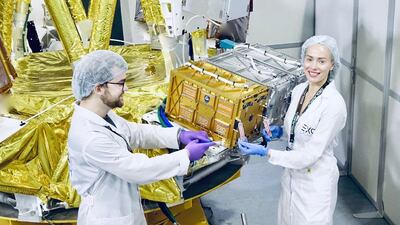
  • MeznSat was placed inside the Exolaunch container, which kept it is safe before its launch into space.
    MeznSat was placed inside the Exolaunch container, which kept it is safe before its launch into space.
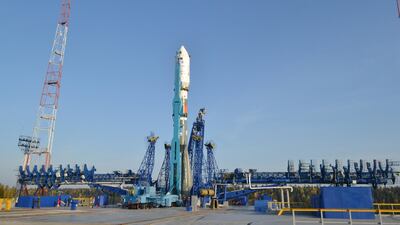
  • The Soyuz 2.1b rocket in position for lift-off at the Plesetsk Cosmodrome in Russia.
    The Soyuz 2.1b rocket in position for lift-off at the Plesetsk Cosmodrome in Russia.
  • MeznSat has 18 other nanosats on board.
    MeznSat has 18 other nanosats on board.
  • The 3-unit CubeSat will study greenhouse gas concentrations over the UAE, specifically carbon dioxide and methane
    The 3-unit CubeSat will study greenhouse gas concentrations over the UAE, specifically carbon dioxide and methane
  • From two ground stations, Khalifa University students will retrieve, process and analyse the data supplied by MeznSat.
    From two ground stations, Khalifa University students will retrieve, process and analyse the data supplied by MeznSat.
Avatar: Fire and Ash

Director: James Cameron

Starring: Sam Worthington, Sigourney Weaver, Zoe Saldana

Rating: 4.5/5

Cricket World Cup League 2 Fixtures

Saturday March 5, UAE v Oman, ICC Academy (all matches start at 9.30am)

Sunday March 6, Oman v Namibia, ICC Academy

Tuesday March 8, UAE v Namibia, ICC Academy

Wednesday March 9, UAE v Oman, ICC Academy

Friday March 11, Oman v Namibia, Sharjah Cricket Stadium

Saturday March 12, UAE v Namibia, Sharjah Cricket Stadium

UAE squad

Ahmed Raza (captain), Chirag Suri, Muhammad Waseem, CP Rizwan, Vriitya Aravind, Asif Khan, Basil Hameed, Rohan Mustafa, Kashif Daud, Zahoor Khan, Junaid Siddique, Karthik Meiyappan, Akif Raja, Rahul Bhatia

In the Restaurant: Society in Four Courses
Christoph Ribbat
Translated by Jamie Searle Romanelli
Pushkin Press 

Key features of new policy

Pupils to learn coding and other vocational skills from Grade 6

Exams to test critical thinking and application of knowledge

A new National Assessment Centre, PARAKH (Performance, Assessment, Review and Analysis for Holistic Development) will form the standard for schools

Schools to implement online system to encouraging transparency and accountability

Key findings of Jenkins report
  • Founder of the Muslim Brotherhood, Hassan al Banna, "accepted the political utility of violence"
  • Views of key Muslim Brotherhood ideologue, Sayyid Qutb, have “consistently been understood” as permitting “the use of extreme violence in the pursuit of the perfect Islamic society” and “never been institutionally disowned” by the movement.
  • Muslim Brotherhood at all levels has repeatedly defended Hamas attacks against Israel, including the use of suicide bombers and the killing of civilians.
  • Laying out the report in the House of Commons, David Cameron told MPs: "The main findings of the review support the conclusion that membership of, association with, or influence by the Muslim Brotherhood should be considered as a possible indicator of extremism."
Match info

Manchester United 4
(Pogba 5', 33', Rashford 45', Lukaku 72')

Bournemouth 1
(Ake 45 2')

Red card: Eric Bailly (Manchester United)

The specs: 2018 BMW R nineT Scrambler

Price, base / as tested Dh57,000

Engine 1,170cc air/oil-cooled flat twin four-stroke engine

Transmission Six-speed gearbox

Power 110hp) @ 7,750rpm

Torque 116Nm @ 6,000rpm

Fuel economy, combined 5.3L / 100km

Updated: July 13, 2021, 11:43 AM