The second stage of the UAE’s national railway network that will ultimately stretch more than 600 kilometres is on track.
The National took a 10km journey on board an Etihad Rail inspection train, from Saih Shuaib to Al Maha Forest in Abu Dhabi, to see how construction was progressing.
Etihad Rail
From Saih Shuaib, tracks are being laid north towards Dubai and south towards Abu Dhabi, creating a rail link for the first time between the two emirates.
“It’s all hands on deck to complete the rail network,” said Omar Al Sebeyi, acting executive director of the commercial sector at Etihad Rail, as he pointed at construction workers who were laying tracks and building bridges and tunnels on the route.
-
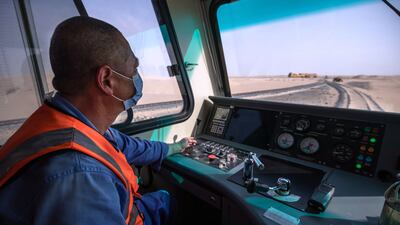
Etihad Rail's inspection train travels from Saih Shuaib to Al Maha Forest in Abu Dhabi, as officials monitor progress in the second stage of the national railway project. All photos: Victor Besa / The National -
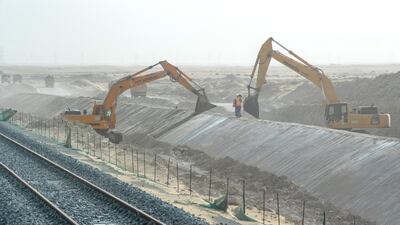
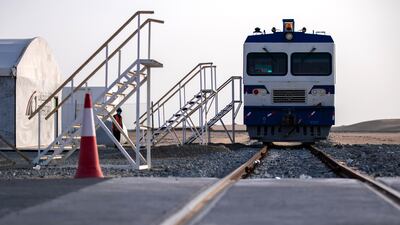
The inspection train is designated for the supervision and inspection of construction works. -
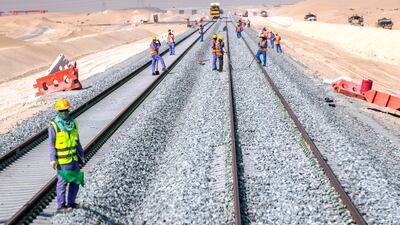
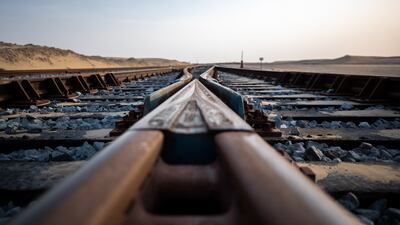
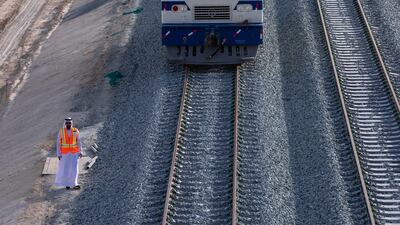
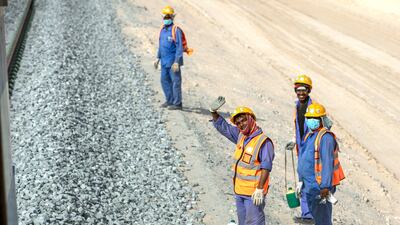
Railroad track workers along the Saih Shuaib line. -

From Saih Shuaib, tracks are being laid north toward Dubai and south toward Abu Dhabi, creating a rail link for the first time between the two emirates. -

Stage one of Etihad Rail, a 264-kilometre line, has been fully operational since January 2016. -
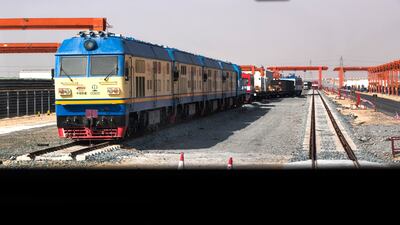
Two trains transport up to 22,000 tonnes of granulated sulphur each day from gas fields in Shah and Habshan to an export point in Ruwais. -
The second stage of the network will extend from Ghuwaifat on the border with Saudi Arabia and connect the emirates of Abu Dhabi, Dubai, Sharjah, Ras Al Khaimah and Fujairah on the east coast. -
The fleet will expand from seven to 45 locomotives, transporting 60 million tonnes of cargo a year. -
In March, Etihad Rail announced it had completed 34 per cent of the network. -
After the completion of stage two and other future expansion works, the rail network will stretch about 1,200km across the country. -
The rail service will carry both passengers and freight. -

Omar Al Sebeyi, acting executive director of the commercial sector at Etihad Rail said everyone was working hard to achieve their deadlines. -

Railroad cars about to be loaded with metal rails, rocks and other track-building materials for transporting down the line. -
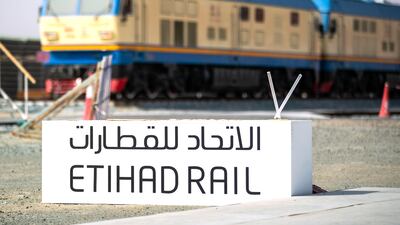
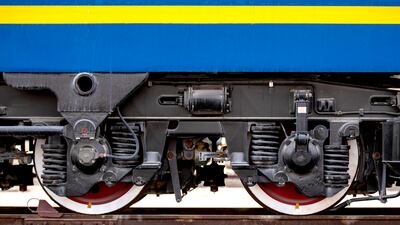
A locomotive at the railroad yard. -
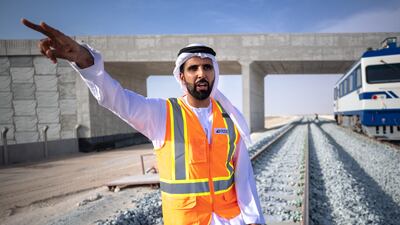
Omar Al Sebeyi, acting executive director of the commercial sector at Etihad Rail points out changes to the track.


Stage one of Etihad Rail, a 264km line, has been fully operational since January 2016.
Two trains transport up to 22,000 tonnes of granulated sulphur each day from gasfields in Shah and Habshan to an export point in Ruwais, about 240km west of Abu Dhabi city.
The second stage of the network will extend from Ghuwaifat on the border with Saudi Arabia and connect the emirates of Abu Dhabi, Dubai, Sharjah, Ras Al Khaimah and Fujairah on the east coast.
The fleet will expand from seven to 45 locomotives, and transport 60 million tonnes of cargo a year.
Teams began laying tracks on Package A of stage two, a slice of network stretching across Abu Dhabi, in January, while track-laying on Package B, which connects Dubai and Abu Dhabi, commenced in June.
Track-laying for Package C, running through Dubai and Sharjah to connect with the northern emirates, and Package D, which connects Sharjah with Fujairah Port, will begin in coming months.
Recently, excavation work was completed on the longest tunnel in the region. Measuring 1.8km, the tunnel connects the port of Fujairah on the emirate's eastern seaboard with the rest of the UAE and GCC rail network.
In addition, 160 bridges are being constructed across Dubai and the Northern Emirates.
After the completion of stage two and other future expansion works, the rail network will stretch about 1,200km across the country and carry both passengers and freight. Authorities said it would reduce road haulage in the UAE, taking 2.5 million lorry trips off the motorways each year.
In March, Etihad Rail announced it had completed 34 per cent the network.
-

Workers inside the Etihad Rail tunnel in Fujairah. At 1.8km, T1 is the largest of nine tunnels carved through the Hajar Mountains. -

Waterproofing work at the site. -

Workers inside the tunnel. It took construction crews more than 300,000 man hours to remove about 500,000 tonnes of rock - an amount similar in weight to all the materials used to build the Burj Khalifa. -
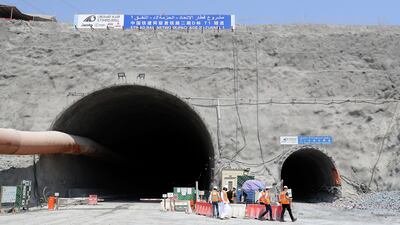
The mouth of the Etihad Rail tunnel in Fujairah. -

Workers inside the Etihad Rail tunnel in Fujairah. It has been one of the most challenging construction projects seen in the country to date. -

A circular scaffold frame painstakingly moves through the tunnel, allowing workers to operate safely through the walls of the snaking shaft of T1. -

Waterproofing work inside the tunnel. -

A concrete facade was fitted to the face of the tunnel before electric lines with water pipes and drainage channels were added. -

The tunnel is big enough to carry two-tier trains, for freight and passengers. -

View of the mouth of the tunnel. -

Construction work inside the Etihad Rail tunnel in Fujairah. -

There are several emergency escape tunnels bored out alongside each of the main passageways. -

Workers inside the Etihad Rail tunnel. -

Officials working inside the Etihad Rail tunnel in Fujairah. -

Workers inside the tunnel. -

Workers walk into the tunnel. -

The project seen from the outside.


A scenic route
The inspection train passed through the lush green area of the Al Maha Forest, where trees and shrubs line the route.
“Special care is taken to protect wildlife and natural habitats,” said Mr Al Sebeyi.
The rail operator has partnered with environmental agencies, including the Environment Agency – Abu Dhabi and Emirates Nature-WWF.
“We have built a series of animal crossings and culverts to ensure the UAE national railway network does not interrupt any natural animal migration. We have integrated over 95 animal crossings and culverts into the project,” he said.
On Package A of the network, Etihad Rail has built 22 gazelle underpasses, 10 camel underpasses and 78 reptile underpasses. On Package B, it is constructing 23 gazelle underpasses, six camel underpasses and 51 reptile underpasses.
As part of its environmental initiatives, Etihad Rail translocated 550 ghaf trees and replanted 590. The company also implemented strict measures to protect wildlife in the Al Wathba Wetland Reserve, including speed limitations and a ‘no-horn zone’ around the area.
In addition, it relocated more than 300 species of wildlife in the Misanad Nature Reserve in Sharjah, including snakes, Cheesman’s Gerbils, scorpions, and gecko, the endangered lizard.