An artist impression shows light bending behind a black hole.

A peek into the unknown: scientists detect light behind a black hole


Sarwat Nasir
  • English
  • Arabic

Scientists have detected a flash of light behind a black hole, proving Albert Einstein correct once again.

The bright X-ray flares were observed around a supermassive black hole that is 10 million bigger than the sun and inhabits a galaxy 800 million light years from Earth.

Scientists previously considered it impossible to capture the phenomenon because black holes devour everything around them. The space object’s gravity is so strong that not even light can escape.

“Any light that goes into that black hole doesn’t come out, so we shouldn’t be able to see anything that’s behind the black hole,” Dan Wilkins, the lead scientist of the study at Stanford University said.

“It is another strange characteristic of the black hole, however, that makes this observation possible. The reason we can see that is because that black hole is warping space, bending light and twisting magnetic fields around itself.”

The first photo of a black hole, taken using a global network of telescopes, conducted by the Event Horizon Telescope project.

The findings, published on July 28 in the Nature journal, were made possible using Nasa’s NuStar and the European Space Agency’s XXM-Newton X-ray observatories.

The light was so bright that the X-rays reflected on to the disc of gas falling into the black hole. Light reflected on the gas behind the black hole was bent around it, causing smaller flashes to be visible through telescopes.

Scientists say the observations have confirmed part of Einstein's Theory of Relativity, which states that gravity bends light around black holes.

“Fifty years ago, when astrophysicists starting speculating about how the magnetic field might behave close to a black hole, they had no idea that one day we might have the techniques to observe this directly and see Einstein’s general theory of relativity in action,” Roger Blandford, co-author of the study said.

The aim of the research was to study the black hole’s mysterious corona, a hot, ionised plasma which is the source of the light.

Current theories state that the corona is a result of gas that falls towards the black hole, where it forms a spinning disc around it. The gas then heats up intensely, generating strong magnetic fields that become twisted into knots, producing high-energy electrons that release the X-ray light.

Remarkable images of space - in pictures

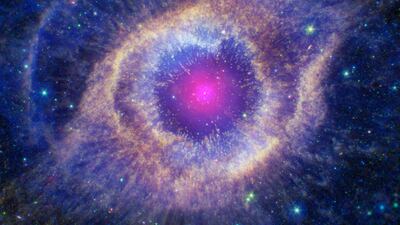
  • Helix Nebula is a phase when a star like the Sun runs out of fuel, it expands and its outer layers puff off, and then the core of the star shrinks. All photos: Nasa
    Helix Nebula is a phase when a star like the Sun runs out of fuel, it expands and its outer layers puff off, and then the core of the star shrinks. All photos: Nasa
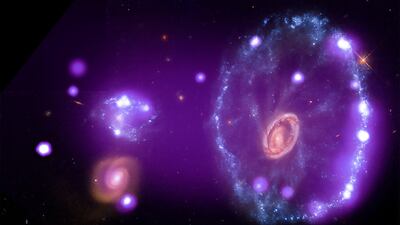
  • This Cartwheel Galaxy resembles a bull's eye, which is appropriate because its appearance is partly due to a smaller galaxy that passed through the middle of this object.
    This Cartwheel Galaxy resembles a bull's eye, which is appropriate because its appearance is partly due to a smaller galaxy that passed through the middle of this object.
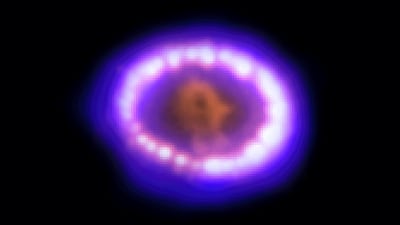
  • On February 24, 1987, observers in the southern hemisphere saw a new object in a nearby galaxy called the Large Magellanic Cloud. This was one of the brightest supernova explosions in centuries and soon became known as Supernova 1987A.
    On February 24, 1987, observers in the southern hemisphere saw a new object in a nearby galaxy called the Large Magellanic Cloud. This was one of the brightest supernova explosions in centuries and soon became known as Supernova 1987A.
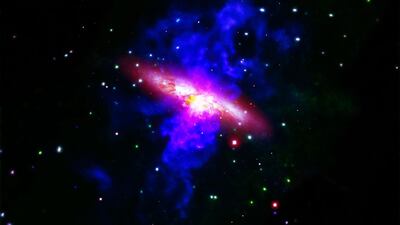
  • Messier 82, or M82, is a galaxy that is oriented edge-on to Earth. This gives astronomers an interesting view of what happens as this galaxy undergoes bursts of star formations.
    Messier 82, or M82, is a galaxy that is oriented edge-on to Earth. This gives astronomers an interesting view of what happens as this galaxy undergoes bursts of star formations.
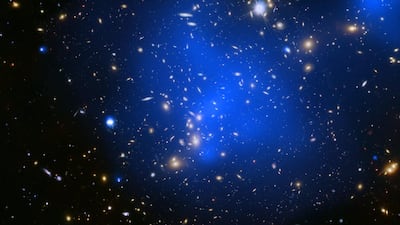
  • Galaxy clusters are the largest objects in the universe held together by gravity. They contain enormous amounts of superheated gas, with temperatures of tens of millions of degrees, which glow brightly in X-rays and can be observed across millions of light years between galaxies.
    Galaxy clusters are the largest objects in the universe held together by gravity. They contain enormous amounts of superheated gas, with temperatures of tens of millions of degrees, which glow brightly in X-rays and can be observed across millions of light years between galaxies.
  • What will be the next star in our Milky Way galaxy to explode as a supernova? Astronomers aren't certain, but one candidate is in Eta Carinae, a volatile system containing two massive stars that closely orbit each other.
    What will be the next star in our Milky Way galaxy to explode as a supernova? Astronomers aren't certain, but one candidate is in Eta Carinae, a volatile system containing two massive stars that closely orbit each other.
Company%20profile
%3Cp%3E%3Cstrong%3ECompany%20name%3A%20%3C%2Fstrong%3EHakbah%0D%3Cbr%3E%3Cstrong%3EStarted%3A%20%3C%2Fstrong%3E2018%0D%3Cbr%3E%3Cstrong%3EFounder%3A%20%3C%2Fstrong%3ENaif%20AbuSaida%0D%3Cbr%3E%3Cstrong%3EBased%3A%20%3C%2Fstrong%3ESaudi%20Arabia%0D%3Cbr%3E%3Cstrong%3ESector%3A%20%3C%2Fstrong%3EFinTech%0D%3Cbr%3E%3Cstrong%3ECurrent%20number%20of%20staff%3A%20%3C%2Fstrong%3E22%20%0D%3Cbr%3E%3Cstrong%3EInitial%20investment%3A%20%3C%2Fstrong%3E%24200%2C000%0D%3Cbr%3E%3Cstrong%3EInvestment%20stage%3A%20%3C%2Fstrong%3Epre-Series%20A%0D%3Cbr%3E%3Cstrong%3EInvestors%3A%20%3C%2Fstrong%3EGlobal%20Ventures%20and%20Aditum%20Investment%20Management%0D%3Cbr%3E%3Cbr%3E%3C%2Fp%3E%0A
Libya's Gold

UN Panel of Experts found regime secretly sold a fifth of the country's gold reserves. 

The panel’s 2017 report followed a trail to West Africa where large sums of cash and gold were hidden by Abdullah Al Senussi, Qaddafi’s former intelligence chief, in 2011.

Cases filled with cash that was said to amount to $560m in 100 dollar notes, that was kept by a group of Libyans in Ouagadougou, Burkina Faso.

A second stash was said to have been held in Accra, Ghana, inside boxes at the local offices of an international human rights organisation based in France.

Teri%20Baaton%20Mein%20Aisa%20Uljha%20Jiya
%3Cp%3E%3Cstrong%3EDirectors%3A%3C%2Fstrong%3E%20Amit%20Joshi%20and%20Aradhana%20Sah%3C%2Fp%3E%0A%3Cp%3E%3Cstrong%3ECast%3A%3C%2Fstrong%3E%20Shahid%20Kapoor%2C%20Kriti%20Sanon%2C%20Dharmendra%2C%20Dimple%20Kapadia%2C%20Rakesh%20Bedi%3C%2Fp%3E%0A%3Cp%3E%3Cstrong%3ERating%3A%3C%2Fstrong%3E%204%2F5%3C%2Fp%3E%0A

Mercer, the investment consulting arm of US services company Marsh & McLennan, expects its wealth division to at least double its assets under management (AUM) in the Middle East as wealth in the region continues to grow despite economic headwinds, a company official said.

Mercer Wealth, which globally has $160 billion in AUM, plans to boost its AUM in the region to $2-$3bn in the next 2-3 years from the present $1bn, said Yasir AbuShaban, a Dubai-based principal with Mercer Wealth.

Within the next two to three years, we are looking at reaching $2 to $3 billion as a conservative estimate and we do see an opportunity to do so,” said Mr AbuShaban.

Mercer does not directly make investments, but allocates clients’ money they have discretion to, to professional asset managers. They also provide advice to clients.

“We have buying power. We can negotiate on their (client’s) behalf with asset managers to provide them lower fees than they otherwise would have to get on their own,” he added.

Mercer Wealth’s clients include sovereign wealth funds, family offices, and insurance companies among others.

From its office in Dubai, Mercer also looks after Africa, India and Turkey, where they also see opportunity for growth.

Wealth creation in Middle East and Africa (MEA) grew 8.5 per cent to $8.1 trillion last year from $7.5tn in 2015, higher than last year’s global average of 6 per cent and the second-highest growth in a region after Asia-Pacific which grew 9.9 per cent, according to consultancy Boston Consulting Group (BCG). In the region, where wealth grew just 1.9 per cent in 2015 compared with 2014, a pickup in oil prices has helped in wealth generation.

BCG is forecasting MEA wealth will rise to $12tn by 2021, growing at an annual average of 8 per cent.

Drivers of wealth generation in the region will be split evenly between new wealth creation and growth of performance of existing assets, according to BCG.

Another general trend in the region is clients’ looking for a comprehensive approach to investing, according to Mr AbuShaban.

“Institutional investors or some of the families are seeing a slowdown in the available capital they have to invest and in that sense they are looking at optimizing the way they manage their portfolios and making sure they are not investing haphazardly and different parts of their investment are working together,” said Mr AbuShaban.

Some clients also have a higher appetite for risk, given the low interest-rate environment that does not provide enough yield for some institutional investors. These clients are keen to invest in illiquid assets, such as private equity and infrastructure.

“What we have seen is a desire for higher returns in what has been a low-return environment specifically in various fixed income or bonds,” he said.

“In this environment, we have seen a de facto increase in the risk that clients are taking in things like illiquid investments, private equity investments, infrastructure and private debt, those kind of investments were higher illiquidity results in incrementally higher returns.”

The Abu Dhabi Investment Authority, one of the largest sovereign wealth funds, said in its 2016 report that has gradually increased its exposure in direct private equity and private credit transactions, mainly in Asian markets and especially in China and India. The authority’s private equity department focused on structured equities owing to “their defensive characteristics.”

PROFILE OF SWVL

Started: April 2017

Founders: Mostafa Kandil, Ahmed Sabbah and Mahmoud Nouh

Based: Cairo, Egypt

Sector: transport

Size: 450 employees

Investment: approximately $80 million

Investors include: Dubai’s Beco Capital, US’s Endeavor Catalyst, China’s MSA, Egypt’s Sawari Ventures, Sweden’s Vostok New Ventures, Property Finder CEO Michael Lahyani

Updated: August 12, 2021, 8:17 AM