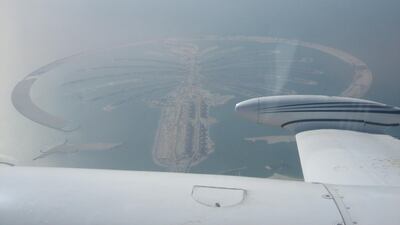
Dozens of scientists and researchers from around the globe are in the running for a $1.5 million grant to aid the UAE's efforts to boost cloud seeding and improve water security across the region and beyond.
The National Centre of Meteorology has selected eight promising research projects using the latest scientific methods and cutting-edge technology to address water scarcity for final evaluation before the key funds are awarded next year.
The fourth cycle of the UAE Research Programme for Rain Enhancement Science initially received 81 pre-proposals from 378 scientists and researchers affiliated with 159 institutions across 37 countries on five continents.
This number has now been whittled down to the final eight projects, who impressed the technical review committee with their work in areas such as cloud microphysics, cloud seeding assessment, new seeding materials assessment, droplet charge measurement, cloud seeding prediction support, and the use of artificial intelligence techniques.
Alya Al Mazroui, director of the UAE Research Programme for Rain Enhancement Science, said the scientific input will help ensure a water-secure future.
“During the evaluation process, the international technical review committee focused on proposals that can make a valuable addition to the UAE’s ambitious efforts to address water scarcity challenges in arid and semi-arid regions across the globe," she said.
"The shortlisted proposals stood out for their high quality and scientific merit. At the programme, we are committed to driving the development of rain enhancement research given its importance in ensuring a water-secure future. We look forward to the special event to be held beginning of next year to reveal more details about the winning projects.”
The $1.5 million grant for each winning research proposal — set to be announced at an event in January — will be distributed over three years, allowing teams to move their work from theory to practice.
Cloud seeding key to UAE strategy
Cloud seeding has been integral to the UAE's drive to boost rainfall in arid desert climates for decades.
Increasing rain is viewed as key to supporting water needs as well as aiding agriculture, allowing the Emirates to be less reliant on food imports and to become self-sufficient.
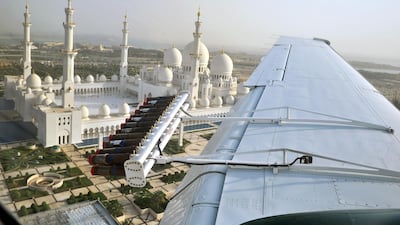
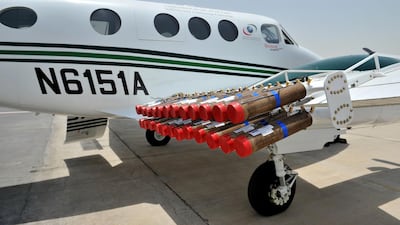
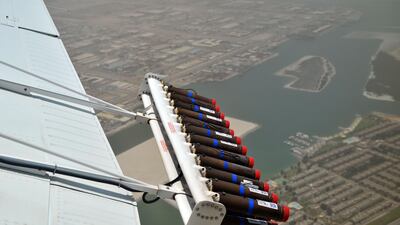
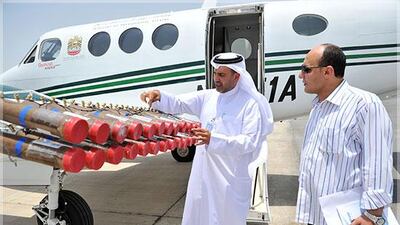
Cloud seeding is a method used to improve a cloud's ability to produce rain. Seeding involves shooting crystals, such as salt, into the cloud. Salt naturally attracts water, causing the water particles to collide with others, get bigger and hopefully fall as rain.
The UAE's seeding programme began in the 1990s and authorities conduct hundreds of missions every year when the conditions are right.
The NCM said seeding can boost rainfall from an individual cloud by as much as 35 per cent in a "clean atmosphere" and by up to 15 per cent in a dusty one. The lower figure is probably more representative of the UAE but authorities say more studies are needed.
Emirates embraces technology
Last month the NCM said it was considering using drones to boost its cloud seeding programme.
It followed key field tests in the US state of Colorado, to measure the capabilities of unmanned aerial vehicles.
The research, led by Prof Eric Frew of the University of Colorado, was carried out using three drones. Two were loaded with complex instruments to take cloud measurements, while the third seeded clouds.
A supercomputer is also being built to help the UAE’s national forecaster to predict weather patterns more accurately and improve cloud-seeding missions.
The high-performance computer, named Atmosphere, will allow meteorologists to better gauge how and when extreme weather will affect the region.
Developed by Hewlett Packard Enterprise, it will process data up to 600 per cent faster than the current prediction software used by the NCM.
Zayed Sustainability Prize
Ten tax points to be aware of in 2026
1. Domestic VAT refund amendments: request your refund within five years
If a business does not apply for the refund on time, they lose their credit.
2. E-invoicing in the UAE
Businesses should continue preparing for the implementation of e-invoicing in the UAE, with 2026 a preparation and transition period ahead of phased mandatory adoption.
3. More tax audits
Tax authorities are increasingly using data already available across multiple filings to identify audit risks.
4. More beneficial VAT and excise tax penalty regime
Tax disputes are expected to become more frequent and more structured, with clearer administrative objection and appeal processes. The UAE has adopted a new penalty regime for VAT and excise disputes, which now mirrors the penalty regime for corporate tax.
5. Greater emphasis on statutory audit
There is a greater need for the accuracy of financial statements. The International Financial Reporting Standards standards need to be strictly adhered to and, as a result, the quality of the audits will need to increase.
6. Further transfer pricing enforcement
Transfer pricing enforcement, which refers to the practice of establishing prices for internal transactions between related entities, is expected to broaden in scope. The UAE will shortly open the possibility to negotiate advance pricing agreements, or essentially rulings for transfer pricing purposes.
7. Limited time periods for audits
Recent amendments also introduce a default five-year limitation period for tax audits and assessments, subject to specific statutory exceptions. While the standard audit and assessment period is five years, this may be extended to up to 15 years in cases involving fraud or tax evasion.
8. Pillar 2 implementation
Many multinational groups will begin to feel the practical effect of the Domestic Minimum Top-Up Tax (DMTT), the UAE's implementation of the OECD’s global minimum tax under Pillar 2. While the rules apply for financial years starting on or after January 1, 2025, it is 2026 that marks the transition to an operational phase.
9. Reduced compliance obligations for imported goods and services
Businesses that apply the reverse-charge mechanism for VAT purposes in the UAE may benefit from reduced compliance obligations.
10. Substance and CbC reporting focus
Tax authorities are expected to continue strengthening the enforcement of economic substance and Country-by-Country (CbC) reporting frameworks. In the UAE, these regimes are increasingly being used as risk-assessment tools, providing tax authorities with a comprehensive view of multinational groups’ global footprints and enabling them to assess whether profits are aligned with real economic activity.
Contributed by Thomas Vanhee and Hend Rashwan, Aurifer
Some of Darwish's last words
"They see their tomorrows slipping out of their reach. And though it seems to them that everything outside this reality is heaven, yet they do not want to go to that heaven. They stay, because they are afflicted with hope." - Mahmoud Darwish, to attendees of the Palestine Festival of Literature, 2008
His life in brief: Born in a village near Galilee, he lived in exile for most of his life and started writing poetry after high school. He was arrested several times by Israel for what were deemed to be inciteful poems. Most of his work focused on the love and yearning for his homeland, and he was regarded the Palestinian poet of resistance. Over the course of his life, he published more than 30 poetry collections and books of prose, with his work translated into more than 20 languages. Many of his poems were set to music by Arab composers, most significantly Marcel Khalife. Darwish died on August 9, 2008 after undergoing heart surgery in the United States. He was later buried in Ramallah where a shrine was erected in his honour.
Museum of the Future in numbers
- 78 metres is the height of the museum
- 30,000 square metres is its total area
- 17,000 square metres is the length of the stainless steel facade
- 14 kilometres is the length of LED lights used on the facade
- 1,024 individual pieces make up the exterior
- 7 floors in all, with one for administrative offices
- 2,400 diagonally intersecting steel members frame the torus shape
- 100 species of trees and plants dot the gardens
- Dh145 is the price of a ticket
Where to Find Me by Alba Arikha
Alma Books
The%20trailblazers
%3Cp%3ESixteen%20boys%20and%2015%20girls%20have%20gone%20on%20from%20Go-Pro%20Academy%20in%20Dubai%20to%20either%20professional%20contracts%20abroad%20or%20scholarships%20in%20the%20United%20States.%20Here%20are%20two%20of%20the%20most%20prominent.%0D%3C%2Fp%3E%0A%3Cp%3E%3Cstrong%3EGeorgia%20Gibson%20(Newcastle%20United)%3C%2Fstrong%3E%0D%3Cbr%3EThe%20reason%20the%20academy%20in%20Dubai%20first%20set%20up%20a%20girls%E2%80%99%20programme%20was%20to%20help%20Gibson%20reach%20her%20potential.%20Now%20she%20plays%20professionally%20for%20Newcastle%20United%20in%20the%20UK.%0D%3C%2Fp%3E%0A%3Cp%3E%3Cstrong%3EMackenzie%20Hunt%20(Everton)%3C%2Fstrong%3E%0D%3Cbr%3EAttended%20DESS%20in%20Dubai%2C%20before%20heading%20to%20the%20UK%20to%20join%20Everton%20full%20time%20as%20a%20teenager.%20He%20was%20on%20the%20bench%20for%20the%20first%20team%20as%20recently%20as%20their%20fixture%20against%20Brighton%20on%20February%2024.%0D%3C%2Fp%3E%0A
Rock in a Hard Place: Music and Mayhem in the Middle East
Orlando Crowcroft
Zed Books
COMPANY PROFILE
Founders: Alhaan Ahmed, Alyina Ahmed and Maximo Tettamanzi
Total funding: Self funded
'Moonshot'
Director: Chris Winterbauer
Stars: Lana Condor and Cole Sprouse
Rating: 3/5
Indoor cricket in a nutshell
Indoor Cricket World Cup - Sep 16-20, Insportz, Dubai
16 Indoor cricket matches are 16 overs per side
8 There are eight players per team
9 There have been nine Indoor Cricket World Cups for men. Australia have won every one.
5 Five runs are deducted from the score when a wickets falls
4 Batsmen bat in pairs, facing four overs per partnership
Scoring In indoor cricket, runs are scored by way of both physical and bonus runs. Physical runs are scored by both batsmen completing a run from one crease to the other. Bonus runs are scored when the ball hits a net in different zones, but only when at least one physical run is score.
Zones
A Front net, behind the striker and wicketkeeper: 0 runs
B Side nets, between the striker and halfway down the pitch: 1 run
C Side nets between halfway and the bowlers end: 2 runs
D Back net: 4 runs on the bounce, 6 runs on the full
The specs
Engine: four-litre V6 and 3.5-litre V6 twin-turbo
Transmission: six-speed and 10-speed
Power: 271 and 409 horsepower
Torque: 385 and 650Nm
Price: from Dh229,900 to Dh355,000
The specs
Engine: 5.2-litre V10
Power: 640hp at 8,000rpm
Torque: 565Nm at 6,500rpm
Transmission: 7-speed dual-clutch auto
Price: From Dh1 million
On sale: Q3 or Q4 2022
Lampedusa: Gateway to Europe
Pietro Bartolo and Lidia Tilotta
Quercus