• Dubai's Museum of the Future will embody the forward-thinking spirit of the UAE's founding fathers, a senior Emirati minister said. Photo: UAE Government Media Office
    Dubai's Museum of the Future will embody the forward-thinking spirit of the UAE's founding fathers, a senior Emirati minister said. Photo: UAE Government Media Office
  • The museum opened its doors to the public on February 22. Photo: UAE Government Media Office
    The museum opened its doors to the public on February 22. Photo: UAE Government Media Office
  • Mohammed Al Gergawi, Minister of Cabinet Affairs, said that it would be much more than a museum, serving as a 'research lab' for the future. Photo: UAE Government Media Office
    Mohammed Al Gergawi, Minister of Cabinet Affairs, said that it would be much more than a museum, serving as a 'research lab' for the future. Photo: UAE Government Media Office
  • The museum will feature a dedicated space for children, helping to harness their love of learning. Photo: UAE Government Media Office
    The museum will feature a dedicated space for children, helping to harness their love of learning. Photo: UAE Government Media Office
  • Sheikh Mohammed bin Rashid, Vice President and Ruler of Dubai, hailed it as the "most beautiful building on Earth". Photo: UAE Government Media Office
    Sheikh Mohammed bin Rashid, Vice President and Ruler of Dubai, hailed it as the "most beautiful building on Earth". Photo: UAE Government Media Office
  • Workers are dwarfed by the Museum of the Future in this November 2019 picture. The intricate design is inspired by Arabic script. Antonie Robertson / The National
    Workers are dwarfed by the Museum of the Future in this November 2019 picture. The intricate design is inspired by Arabic script. Antonie Robertson / The National
  • The striking structure was years in the making. Chris Whiteoak / The National
    The striking structure was years in the making. Chris Whiteoak / The National
  • The opening date was pushed back several times and a 2020 opening date came and went as the pandemic hit. Photo: Dubai Media Office
    The opening date was pushed back several times and a 2020 opening date came and went as the pandemic hit. Photo: Dubai Media Office
  • This 2018 image shows the unique design taking shape. Antonie Robertson / The National
    This 2018 image shows the unique design taking shape. Antonie Robertson / The National
  • A cyclist poses for a photograph in front of the museum in November. AP Photo / Jon Gambrell
    A cyclist poses for a photograph in front of the museum in November. AP Photo / Jon Gambrell
  • The unique facade was voted among the most striking in the world in a recent poll. AP Photo
    The unique facade was voted among the most striking in the world in a recent poll. AP Photo
  • Sheikh Mohammed bin Rashid, Vice President and Ruler of Dubai, and Sheikh Mohamed bin Zayed, Crown Prince of Abu Dhabi and Deputy Supreme Commander of the Armed Forces, visit the museum in September. Wam
    Sheikh Mohammed bin Rashid, Vice President and Ruler of Dubai, and Sheikh Mohamed bin Zayed, Crown Prince of Abu Dhabi and Deputy Supreme Commander of the Armed Forces, visit the museum in September. Wam
  • Sheikh Mohammed bin Rashid tries out some of the museum's technological features. Wam
    Sheikh Mohammed bin Rashid tries out some of the museum's technological features. Wam

What lies inside Dubai's Museum of the Future?


Sarwat Nasir
  • English
  • Arabic

Dubai's Museum of the Future promises visitors an immersive experience that will help them imagine all that is possible for the world.

Opening to the public on February 22, the striking 78-metre-high structure in Downtown Dubai has seven floors that focus on topics such as space travel and living, climate change and ecology, health, wellness and spirituality.

While it is not clear what specific artwork will be inside, the museum aims to use advanced technology to represent art.

Each floor will resemble a futuristic film set with which visitors can explore and interact.

The museum combines elements of exhibition, immersive theatre and a themed attraction to create scenes to show what is possible in the future as we know it today and for the next five to 10 years.

Product, media, exhibition and experience designers have crafted the content.

Three floors of the museum will focus on possible scenarios for outer space resource development, ecosystems and bioengineering, health, wellness and spirituality.

Another floor will display near-future technology that addresses challenges in areas such as health, water, food, transportation and energy.

There is also a dedicated children’s floor, where they can explore and solve challenges “on their way to becoming future heroes”.

What does the shape of the museum signify?

The low-carbon, stainless steel-clad, torus-shaped museum is meant to look futuristic and show that buildings can take different forms and still look attractive.

The shape represents Dubai's perpetual energy and a vision of the future as we understand it via exhibitions, the architect Killa Design said.

The shape also represents humanity. The green mound on top is a symbol for the Earth and the void represents the unknown future.

The building's windows are shaped in the form of Arabic calligraphy – designed by Emirati artist Mattar bin Lahej – which shows that the building 'speaks Arabic'. The script is illuminated by 14 kilometres of LED lighting after dark.

What is written on the facade?

The facade features the poetry of Sheikh Mohammed bin Rashid, Vice President and Ruler of Dubai, about his vision for the city's future.

Translated into English, it says: “The future belongs to those who can imagine it, design it, and execute it. It isn’t something you await, but rather create.”

UAE landmarks from space - in pictures

  • US astronaut Scott Kelly shared this night-time image of Dubai's Palm Jumeirah in 2016. Photo: Scott Kelly Twitter
    US astronaut Scott Kelly shared this night-time image of Dubai's Palm Jumeirah in 2016. Photo: Scott Kelly Twitter
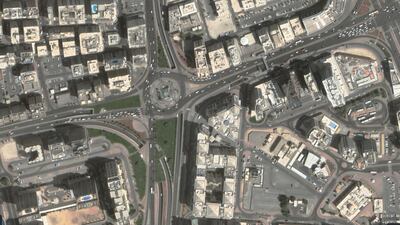
  • The Deira clock tower roundabout, which is one of Dubai's oldest landmarks. Photo: Google Earth
    The Deira clock tower roundabout, which is one of Dubai's oldest landmarks. Photo: Google Earth
  • Satellite imagery shows Dubai's Palm Jumeirah, World Islands and Palm Deira. Photo: Mohammed Bin Rashid Space Centre
    Satellite imagery shows Dubai's Palm Jumeirah, World Islands and Palm Deira. Photo: Mohammed Bin Rashid Space Centre
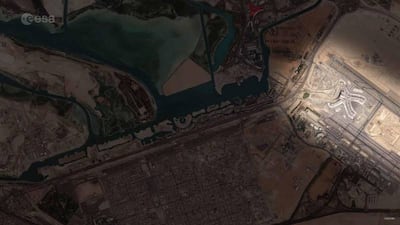
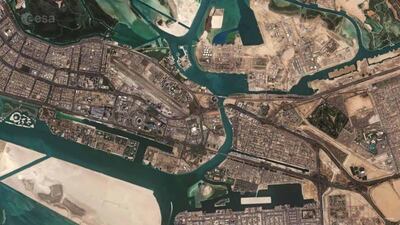
  • Abu Dhabi International Airport seen from space. Photo: European Space Agency
    Abu Dhabi International Airport seen from space. Photo: European Space Agency
  • UAE satellite KhalifaSat captured the Sheikh Khalifa bin Zayed Al Nahyan Mosque in Abu Dhabi. Photo: Mohammed Bin Rashid Space Centre
    UAE satellite KhalifaSat captured the Sheikh Khalifa bin Zayed Al Nahyan Mosque in Abu Dhabi. Photo: Mohammed Bin Rashid Space Centre
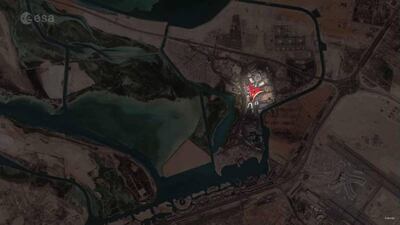
  • Abu Dhabi's Ferrari World captured in satellite imagery. Photo: European Space Agency
    Abu Dhabi's Ferrari World captured in satellite imagery. Photo: European Space Agency
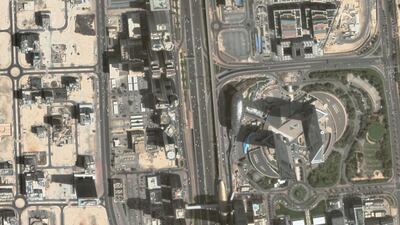
  • The Museum of the Future in Dubai can be seen in the centre of the image. Photo: Google Earth
    The Museum of the Future in Dubai can be seen in the centre of the image. Photo: Google Earth
  • Sheikh Zayed Bridge in Abu Dhabi. Photo: European Space Agency
    Sheikh Zayed Bridge in Abu Dhabi. Photo: European Space Agency
  • Dubai's man-made Love Lake, captured by KhalifaSat satellite. Photo: Mohammed Bin Rashid Space Centre
    Dubai's man-made Love Lake, captured by KhalifaSat satellite. Photo: Mohammed Bin Rashid Space Centre
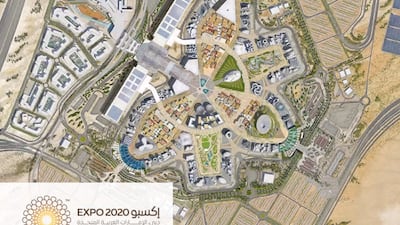
  • The Expo 2020 Dubai site in 2017. Photo: Expo 2020 Dubai Twitter
    The Expo 2020 Dubai site in 2017. Photo: Expo 2020 Dubai Twitter
  • Dubai's Palm Jumeirah in 2021. Photo: Shane Kimbrough Twitter
    Dubai's Palm Jumeirah in 2021. Photo: Shane Kimbrough Twitter
  • Dubai International Airport in 2021. Photo: Shane Kimbrough Twitter
    Dubai International Airport in 2021. Photo: Shane Kimbrough Twitter
  • Sharjah's largest mosque captured by UAE satellite KhalifaSat. Photo: Mohammed Bin Rashid Space Centre
    Sharjah's largest mosque captured by UAE satellite KhalifaSat. Photo: Mohammed Bin Rashid Space Centre
  • The Expo Centre in Sharjah in 2021. Photo: Google Earth
    The Expo Centre in Sharjah in 2021. Photo: Google Earth

Mercer, the investment consulting arm of US services company Marsh & McLennan, expects its wealth division to at least double its assets under management (AUM) in the Middle East as wealth in the region continues to grow despite economic headwinds, a company official said.

Mercer Wealth, which globally has $160 billion in AUM, plans to boost its AUM in the region to $2-$3bn in the next 2-3 years from the present $1bn, said Yasir AbuShaban, a Dubai-based principal with Mercer Wealth.

Within the next two to three years, we are looking at reaching $2 to $3 billion as a conservative estimate and we do see an opportunity to do so,” said Mr AbuShaban.

Mercer does not directly make investments, but allocates clients’ money they have discretion to, to professional asset managers. They also provide advice to clients.

“We have buying power. We can negotiate on their (client’s) behalf with asset managers to provide them lower fees than they otherwise would have to get on their own,” he added.

Mercer Wealth’s clients include sovereign wealth funds, family offices, and insurance companies among others.

From its office in Dubai, Mercer also looks after Africa, India and Turkey, where they also see opportunity for growth.

Wealth creation in Middle East and Africa (MEA) grew 8.5 per cent to $8.1 trillion last year from $7.5tn in 2015, higher than last year’s global average of 6 per cent and the second-highest growth in a region after Asia-Pacific which grew 9.9 per cent, according to consultancy Boston Consulting Group (BCG). In the region, where wealth grew just 1.9 per cent in 2015 compared with 2014, a pickup in oil prices has helped in wealth generation.

BCG is forecasting MEA wealth will rise to $12tn by 2021, growing at an annual average of 8 per cent.

Drivers of wealth generation in the region will be split evenly between new wealth creation and growth of performance of existing assets, according to BCG.

Another general trend in the region is clients’ looking for a comprehensive approach to investing, according to Mr AbuShaban.

“Institutional investors or some of the families are seeing a slowdown in the available capital they have to invest and in that sense they are looking at optimizing the way they manage their portfolios and making sure they are not investing haphazardly and different parts of their investment are working together,” said Mr AbuShaban.

Some clients also have a higher appetite for risk, given the low interest-rate environment that does not provide enough yield for some institutional investors. These clients are keen to invest in illiquid assets, such as private equity and infrastructure.

“What we have seen is a desire for higher returns in what has been a low-return environment specifically in various fixed income or bonds,” he said.

“In this environment, we have seen a de facto increase in the risk that clients are taking in things like illiquid investments, private equity investments, infrastructure and private debt, those kind of investments were higher illiquidity results in incrementally higher returns.”

The Abu Dhabi Investment Authority, one of the largest sovereign wealth funds, said in its 2016 report that has gradually increased its exposure in direct private equity and private credit transactions, mainly in Asian markets and especially in China and India. The authority’s private equity department focused on structured equities owing to “their defensive characteristics.”

ETFs explained

Exhchange traded funds are bought and sold like shares, but operate as index-tracking funds, passively following their chosen indices, such as the S&P 500, FTSE 100 and the FTSE All World, plus a vast range of smaller exchanges and commodities, such as gold, silver, copper sugar, coffee and oil.

ETFs have zero upfront fees and annual charges as low as 0.07 per cent a year, which means you get to keep more of your returns, as actively managed funds can charge as much as 1.5 per cent a year.

There are thousands to choose from, with the five biggest providers BlackRock’s iShares range, Vanguard, State Street Global Advisors SPDR ETFs, Deutsche Bank AWM X-trackers and Invesco PowerShares.

Updated: February 14, 2022, 1:49 PM