
New York University Abu Dhabi has set out ambitious plans to tackle climate change and help advance artificial intelligence through the establishment of four new research centres.
NYUAD's Research Institute will be the driving force behind plans to transform the seat of learning into a "hub of development and innovation" in the Emirates.
The university, based on Saadiyat Island, said it aims to support efforts to provide solutions to pressing global challenges through its work.
The four new departments are the Arabian Centre for Climate and Environmental Sciences (Access), the Centre for Artificial Intelligence and Robotics (CAIR), the Centre for Smart Engineering Materials (CSEM), and the Centre for Quantum and Topological Systems (CQTS).
“As a global liberal arts and research university in and of Abu Dhabi, the drive to address global challenges serves as the guiding force in our mission to be a hub of development, innovation, engagement, and positive change for the UAE, the region, and the world," said Arlie Peters, provost of NYUAD.
"We follow a multidisciplinary approach to the discovery of new knowledge, and the establishment of four new research centres is a meaningful addition to our existing efforts to contribute to the development of a diversified knowledge economy and society in Abu Dhabi, help to advance NYU’s global mission, and carve a new model for higher education for the betterment of humanity.
"We are extremely proud of our scholars and students who remain dedicated to driving discoveries that are making a positive change to the world.”
What will new centres do?
-
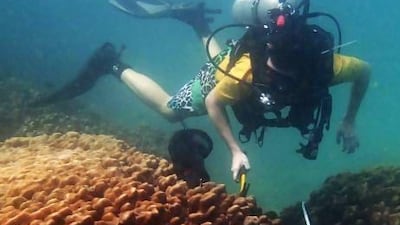
John Burt, associate professor of biology at New York University Abu Dhabi, has studied the region’s seas for the past 15 years. Photo: Joerg Wiedenmann -
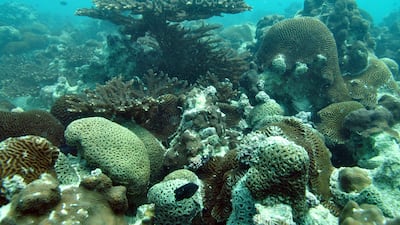
Table coral, such as the kind seen on the top left in Ghantoot, are among the heat-sensitive Acropora species. Photo: John Burt -
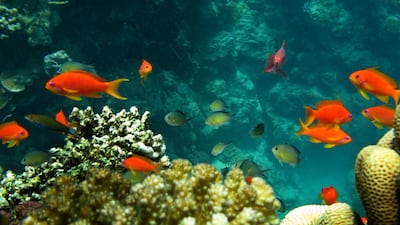
Researchers from NYU Abu Dhabi are looking for clues that could one day help coral reefs around the world survive the onslaught of global warming. Photo: John Burt -
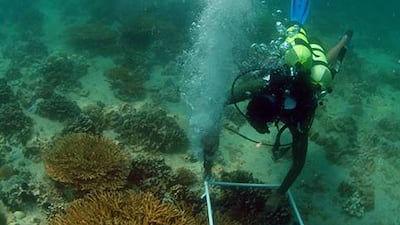
John Burt using a pneumatic drill to install coral monitoring equipment on the sea-bottom at Ras Ghanada reef in Ghantoot, UAE. Photo: John Burt -
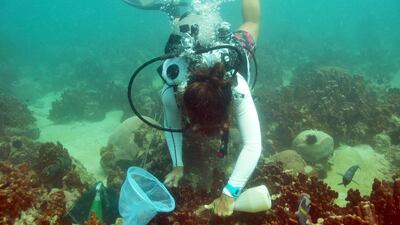
A scientist collects samples from a coral reef in Abu Dhabi, which scientists say have suffered a 'catastrophic event' because of warming waters. Photo: John Burt -
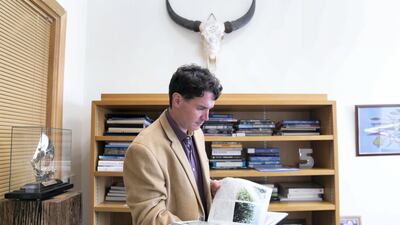
In 2017, John Burt, associate professor of biology at NYU Abu Dhabi calculated that 73 per cent of corals across all of the southern Gulf were lost. Reem Mohammed / The National -
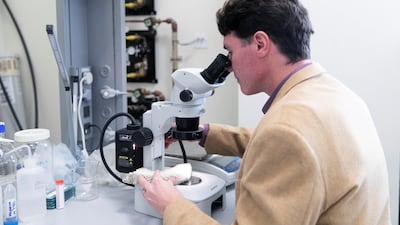
John Burt studied the corals from the Gulf waters for the far-reaching global report on warming waters and their affect on coral reefs. Reem Mohammed / The National -
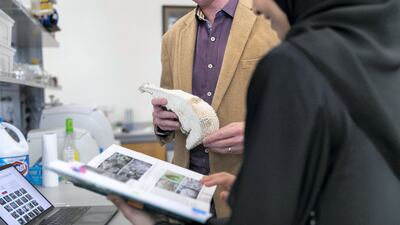
High sea temperatures cause coral to bleach and die. Reem Mohammed / The National


Access will focus on the climate of the Gulf region.
Its broad remit will include scientific research on rainfall, coral reefs and urban environments.
The centre will collaborate with government agencies and its scientists will be part of the Climate Change Research Network.
CAIR was set up by faculty from the university's electrical and computer engineering, psychology, and computer science departments to conduct fundamental research and develop applications in AI and robotics.
Its work includes investigating movement sensors for robots, autonomous decision-making and robotic safety and resilence.
CSEM will provide a platform for partnerships between scientific and engineering faculties.
It will explore how smart devices can be used to improve efficiency in industry, such as in the oil and gas and civil engineering sectors.
CQTS will bring together expertise in the theory and application of quantum topological systems, with an emphasis on quantum computers, taking in machine learning and quantum cryptography.
Investing in UAE's knowledge-based economy
“As a world-class hub for cutting-edge research, we are very proud to be adding these four new centres to our Research Institute, all of which will address various and critical areas of research," said Sehamuddin Galadari, managing director of NYUAD's Research Institute.
"We are committed to contributing to the UAE’s vision of becoming a knowledge-based economy through science and innovation, and we are confident that the addition of the centres will help fulfill this goal even further.”

