President Sheikh Mohamed says the condolences paid by people around the world after the death of Sheikh Khalifa on Friday have been a source of comfort.
Writing on social media on Wednesday, Sheikh Mohamed said the messages have helped his family as they mourn the late president.
World leaders and dignitaries have travelled to Abu Dhabi in recent days to offer support.
"The heartfelt condolences of people from across the UAE and around the world have been a source of comfort to our family as we mourn the late Sheikh Khalifa," Sheikh Mohamed said.
"This response is a testament to his far-reaching impact and the respect that was felt for him both at home and abroad."
-
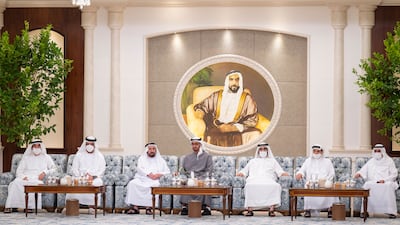
Sheikh Mohamed bin Zayed receives condolences from the UAE leaders; Sheikh Mohammed bin Rashid, Vice President and Ruler of Dubai, Sheikh Dr Sultan bin Muhammad Al Qasimi, Ruler of Sharjah, Sheikh Hamad bin Mohammed Al Sharqi, Ruler of Fujairah, Sheikh Humaid bin Rashid Al Nuaimi, Ruler of Ajman, Sheikh Saud bin Saqr Al Qasimi, Ruler of Ras Al Khaimah and Sheikh Saud bin Rashid Al Mualla, Ruler of Umm Al Quwain, following the death of Sheikh Khalifa. All photos: MOPA -
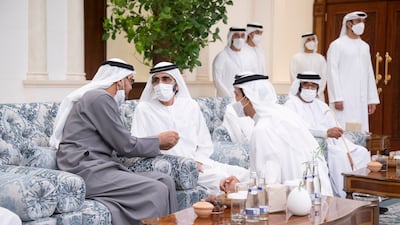
The rulers met Sheikh Mohamed at Al Mushrif Palace in Abu Dhabi. -

Sheikh Mohammed offers condolences to Sheikh Tahnoun bin Mohammed, Ruler's Representative in Al Ain Region. -
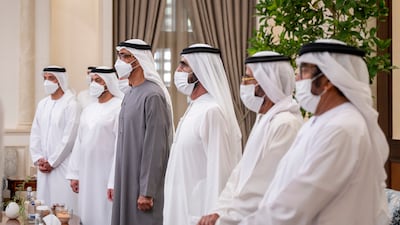
Sheikh Mohammed described Sheikh Khalifa as a dedicated leader who served and loved his people. -
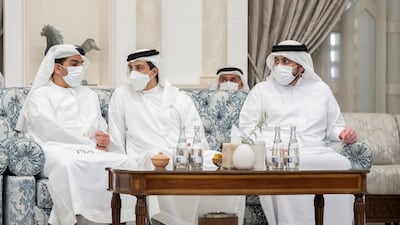
Sheikh Mansour bin Zayed, Deputy Prime Minister and Minister of Presidential Affairs, and Sheikh Hamed bin Zayed, member of Abu Dhabi Executive Council, receive condolences from Sheikh Ahmed bin Mohammed, Chairman of the Dubai Media Council. -
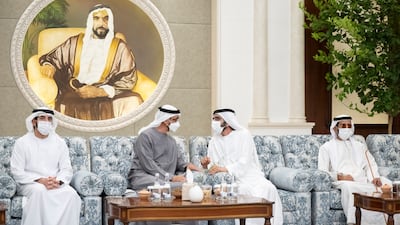
Sheikh Mohammed bin Rashid expresses his condolences to Sheikh Mohamed as Sheikh Hamdan bin Mohammed, Crown Prince of Dubai, and Sheikh Tahnoun bin Mohamed, the Ruler's Representative in Al Ain Region, look on. -
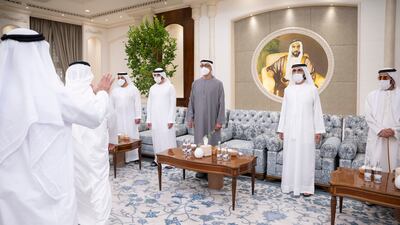
Sheikh Mohamed and other UAE leaders receive mourners. -
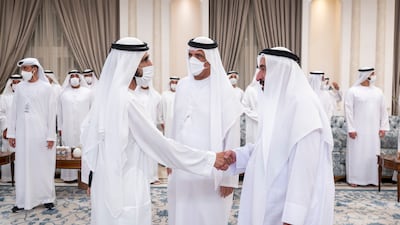
Sheikh Mohammed bin Rashid with Sheikh Dr Sultan bin Muhammad Al Qasimi and Sheikh Hamad bin Mohammed Al Sharqi. -
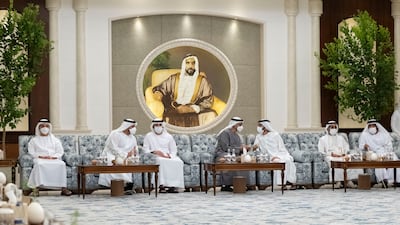
UAE leaders gathered in Abu Dhabi to pay tribute to Sheikh Khalifa, who died at the age of 73. -
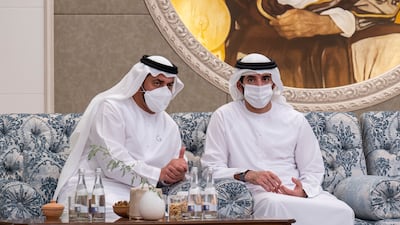
Sheikh Hamdan bin Zayed, Ruler’s Representative in Al Dhafra Region, receives condolences from the Crown Prince of Dubai. -
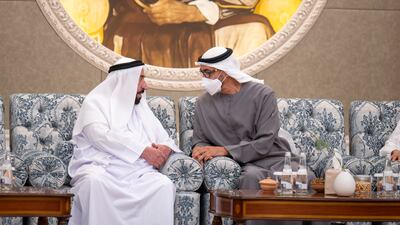
Sheikh Dr Sultan bin Muhammad Al Qasimi with Sheikh Mohamed. -

Sheikh Hamdan bin Zayed, Ruler’s Representative in Al Dhafra Region, left, receives condolences. -
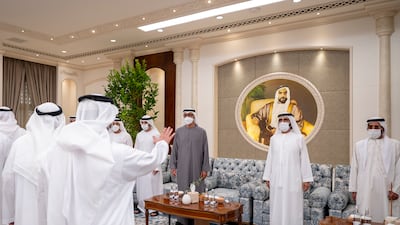
Sheikh Khalifa has been hailed as generous, kind, wise, respectful and loyal leader. -
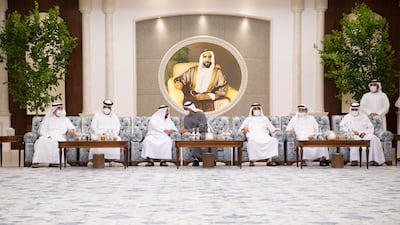
Sheikh Mohamed said the people of the UAE were united in grief as they mourned the death of Sheikh Khalifa. -
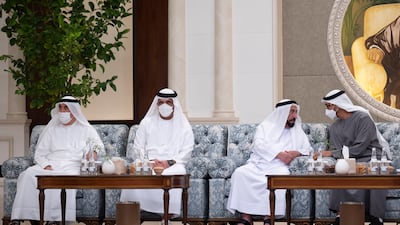
Sheikh Dr Sultan said Sheikh Khalifa was dedicated to his country, his religion, his nation and the world.
It follows a moving tribute that Sheikh Mohamed paid to Sheikh Khalifa on Tuesday.
“With his enduring wisdom and generosity, my brother, Khalifa bin Zayed, was the heart of our family and the guardian of our nation,” Sheikh Mohamed said.
“He was loved greatly and will be deeply missed, but his remarkable legacy will live on forever. May God grant him eternal peace.”

World Mental Health Day
The Saga Continues
Wu-Tang Clan
(36 Chambers / Entertainment One)
'Gold'
Director:Anthony Hayes
Stars:Zaf Efron, Anthony Hayes
Rating:3/5
Notable salonnières of the Middle East through history
Al Khasan (Okaz, Saudi Arabia)
Tamadir bint Amr Al Harith, known simply as Al Khasan, was a poet from Najd famed for elegies, earning great renown for the eulogy of her brothers Mu’awiyah and Sakhr, both killed in tribal wars. Although not a salonnière, this prestigious 7th century poet fostered a culture of literary criticism and could be found standing in the souq of Okaz and reciting her poetry, publicly pronouncing her views and inviting others to join in the debate on scholarship. She later converted to Islam.
Maryana Marrash (Aleppo)
A poet and writer, Marrash helped revive the tradition of the salon and was an active part of the Nadha movement, or Arab Renaissance. Born to an established family in Aleppo in Ottoman Syria in 1848, Marrash was educated at missionary schools in Aleppo and Beirut at a time when many women did not receive an education. After touring Europe, she began to host salons where writers played chess and cards, competed in the art of poetry, and discussed literature and politics. An accomplished singer and canon player, music and dancing were a part of these evenings.
Princess Nazil Fadil (Cairo)
Princess Nazil Fadil gathered religious, literary and political elite together at her Cairo palace, although she stopped short of inviting women. The princess, a niece of Khedive Ismail, believed that Egypt’s situation could only be solved through education and she donated her own property to help fund the first modern Egyptian University in Cairo.
Mayy Ziyadah (Cairo)
Ziyadah was the first to entertain both men and women at her Cairo salon, founded in 1913. The writer, poet, public speaker and critic, her writing explored language, religious identity, language, nationalism and hierarchy. Born in Nazareth, Palestine, to a Lebanese father and Palestinian mother, her salon was open to different social classes and earned comparisons with souq of where Al Khansa herself once recited.
%20Ramez%20Gab%20Min%20El%20Akher
Ten tax points to be aware of in 2026
1. Domestic VAT refund amendments: request your refund within five years
If a business does not apply for the refund on time, they lose their credit.
2. E-invoicing in the UAE
Businesses should continue preparing for the implementation of e-invoicing in the UAE, with 2026 a preparation and transition period ahead of phased mandatory adoption.
3. More tax audits
Tax authorities are increasingly using data already available across multiple filings to identify audit risks.
4. More beneficial VAT and excise tax penalty regime
Tax disputes are expected to become more frequent and more structured, with clearer administrative objection and appeal processes. The UAE has adopted a new penalty regime for VAT and excise disputes, which now mirrors the penalty regime for corporate tax.
5. Greater emphasis on statutory audit
There is a greater need for the accuracy of financial statements. The International Financial Reporting Standards standards need to be strictly adhered to and, as a result, the quality of the audits will need to increase.
6. Further transfer pricing enforcement
Transfer pricing enforcement, which refers to the practice of establishing prices for internal transactions between related entities, is expected to broaden in scope. The UAE will shortly open the possibility to negotiate advance pricing agreements, or essentially rulings for transfer pricing purposes.
7. Limited time periods for audits
Recent amendments also introduce a default five-year limitation period for tax audits and assessments, subject to specific statutory exceptions. While the standard audit and assessment period is five years, this may be extended to up to 15 years in cases involving fraud or tax evasion.
8. Pillar 2 implementation
Many multinational groups will begin to feel the practical effect of the Domestic Minimum Top-Up Tax (DMTT), the UAE's implementation of the OECD’s global minimum tax under Pillar 2. While the rules apply for financial years starting on or after January 1, 2025, it is 2026 that marks the transition to an operational phase.
9. Reduced compliance obligations for imported goods and services
Businesses that apply the reverse-charge mechanism for VAT purposes in the UAE may benefit from reduced compliance obligations.
10. Substance and CbC reporting focus
Tax authorities are expected to continue strengthening the enforcement of economic substance and Country-by-Country (CbC) reporting frameworks. In the UAE, these regimes are increasingly being used as risk-assessment tools, providing tax authorities with a comprehensive view of multinational groups’ global footprints and enabling them to assess whether profits are aligned with real economic activity.
Contributed by Thomas Vanhee and Hend Rashwan, Aurifer
While you're here
Hussein Ibish: There are reasons for Democrats and Republicans to be happy
Rashmee Roshan Lall: Who are the women driving Joe Biden's success?
While you're here
Mina Al-Oraibi: Beirut's suffering is a direct result of a failed political system
Michael Young: From one crisis to the next, where is Lebanon headed?
Joyce Karam: US delegation to push for independent government

