

The Hubble Space Telescope has captured the moment an enormous black hole twisted a star into a doughnut shape as it was “violently swallowing it”.
Located 300 million light-years away, the black hole is at the core of a galaxy called ESO 583-G004.
Astronomers used Hubble’s powerful instruments to study the light from the shredded star.
Black holes are places in space with gravitational forces so strong that not even light can escape them.
“We're looking somewhere on the edge of that doughnut,” said Peter Maksym of the Harvard—Smithsonian Centre for Astrophysics in Cambridge, Massachusetts in a statement.
“We're seeing a stellar wind from the black hole sweeping over the surface that's being projected towards us at speeds of 20 million miles per hour (3 per cent the speed of light).
“We really are still getting our heads around the event. You shred the star and then it's got this material that's making its way into the black hole.
“And so, you've got models where you think you know what is going on, and then you've got what you actually see. This is an exciting place for scientists to be: right at the interface of the known and the unknown.”
The event, which has been labelled as AT2022dsb, was first captured by ground telescopes on March 1, 2022, but then Hubble astronomers carried out further research.
Over the years, about 100 similar events around black holes — known as tidal disruption events — have been detected by astronomers.
These help researchers learn more about black holes, which continue to be one of the most mysterious places in space.
“Typically, these events are hard to observe. You get maybe a few observations at the beginning of the disruption when it's really bright,” said Mr Maksym.
“Our programme is different in that it is designed to look at a few tidal events over a year to see what happens.
“We saw this early enough that we could observe it at these very intense black hole accretion stages. We saw the accretion rate drop as it turned to a trickle over time.”
In 2019, an image of a black hole was captured by scientists for the first time. The picture showed a black hole in the Messier 87 galaxy.
It had a mass more than six billion times that of the Sun and the picture helped to prove astronomers’ theories about black holes.
They used the Event Horizon Telescope, a global network of synchronised radio observatories, to capture the image.
Striking images captured by the James Webb Space Telescope — in pictures
-
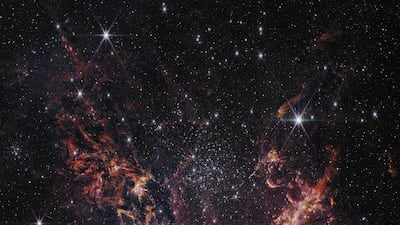
A cluster of stars in the Small Magellanic Cloud in an image taken by the James Webb Space Telescope. PA -
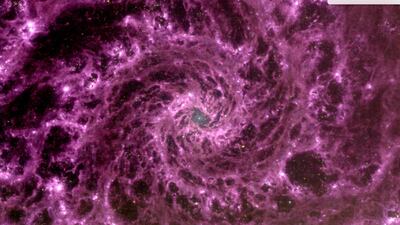
A colour composite image of the Messier 74 galaxy. Photo: Gabriel Brammer (Cosmic Dawn Center, Niels Bohr Institute, University of Copenhagen) / James Webb Space Telescope -
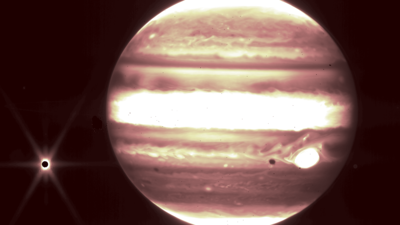
Jupiter and its moon Europa, left, are seen through the James Webb Space Telescope. Photo: Nasa -
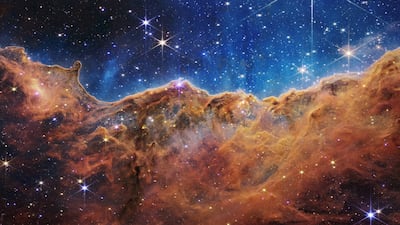
Captured in infrared light by Nasa's new James Webb Space Telescope, this image reveals areas of star birth in Carina Nebula. All photos: James Webb Space Telescope -
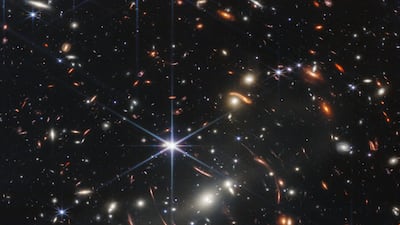
Known as Webb's First Deep Field, the picture showcases a galaxy cluster called SMACS 0723 as it appeared 4.6 billion years ago. The image was revealed by US President Joe Biden on July 11 during an event at the White House. -
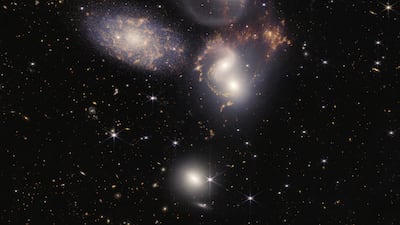
An image of Stephan's Quintet, an area in space with a group of five galaxies. -
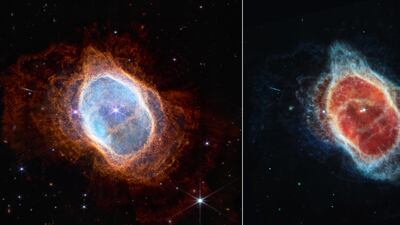
Side-by-side comparison shows observations of the Southern Ring Nebula in near-infrared light (left) and mid-infrared light. -
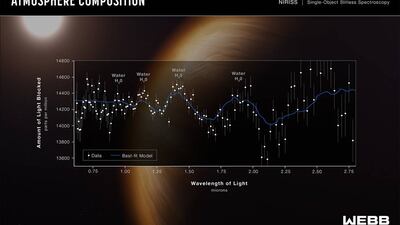
The telescope has captured the distinct signature of water, along with evidence for clouds and haze, in the atmosphere surrounding a hot, puffy gas giant planet orbiting a distant Sun-like star, called WASP-96 b. Photo: James Webb Space Telescope



