Dubai Civil Defence chiefs said they are facing challenges in convincing high-rise building owners to do away with hazardous facade cladding.
Aluminium composite panel cladding was prohibited in the Emirates under the country's Fire and Life Safety Code of Practice which was introduced in January 2017.
Further updates came into effect the following year.
New buildings must be fitted with advanced non-combustible cladding that is able to stop the spread of flames and is more durable under intense heat.
But, it is not mandatory for buildings built before the new legislation was introduced.
“The compliance of existing building facades is a challenge,” said Salma Humaid Saeed, head of drawing and projects at Dubai Civil Defence, at the recent Intersec Conference in Dubai.

“They are legally acceptable, but if there is an accident in the building or if the building owner wants to comply with the new regulations, then fire and safety companies need to help them renovate with the right kind of facade,” said Ms Saeed, whose role involves assessing the fire safety of building design blueprints.
“It is the owner’s responsibility to decide if they are willing to change it.
“We will not obligate the owners of existing buildings to change the whole facade.”
Action taken after major blazes
The 35-storey 8 Boulevard Walk in Downtown Dubai was the latest high-rise to be hit by fire in November, with much of the exterior cladding on one corner of the building severely damaged.
Old cladding of both Adriatic on The Palm Jumeirah and Sulafa Tower in Dubai Marina where fires broke out, have been retrofitted with fire-resistant cladding.
Existing buildings with cladding fitted before the updated safety standards, are legal and acceptable.
-
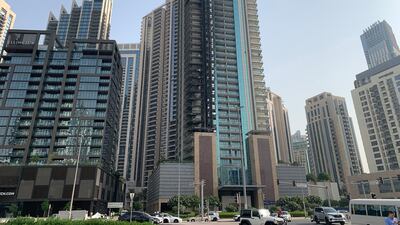
The charred facade of the residential tower that caught fire in Downtown Dubai. Pawan Singh / The National -

Fire damage at the high-rise on Monday morning after a blaze broke out overnight. Pawan Singh / The National -

The tower is situated to the right of Burj Khalifa. AP -
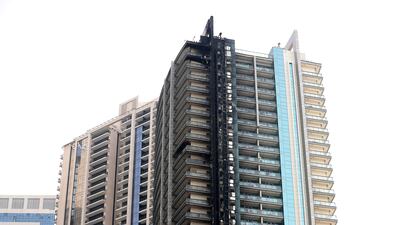
The residential tower is part of the 8 Boulevard Walk complex. Pawan Singh / The National -

The blaze was extinguished shortly before dawn. Pawan Singh / The National -
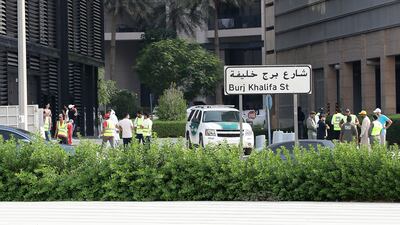
Police and Civil Defence personnel at the site. Pawan Singh / The National -

Footage of the building on fire in the early hours of the morning. Supplied -
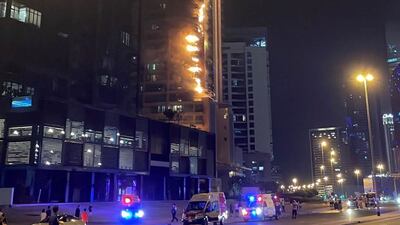
Witnesses said the fire broke out on one of the lower floors, possibly floor four, and then rapidly spread to the cladding. Photo: Chetan Fernandes -
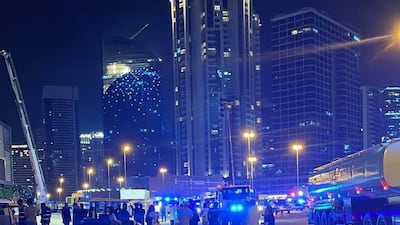
Residents of the tower are still waiting to return home. Photo: Chetan Fernandes -
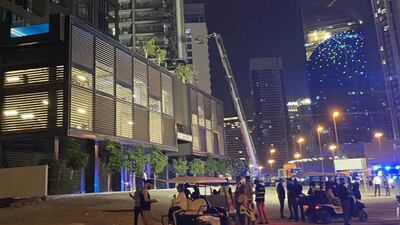
Dubai Police cordoned off the area so recovery work could take place and debris cleared from the streets below. Photo: Chetan Fernandes


Dubai Civil Defence does not initiate compliance requirements for facade replacement for building owners.
Officers said that the DCD will validate a building facade as safe, if it has been replaced in its entirety.
“In the last three years we have seen many developers take the initiative to replace their facades,” said Pramod Challa, senior engineer at Dubai Civil Defence.
“It is very expensive to replace the entire facade to make it fire compliant, so they try to come up with other mitigation measures.
“Developers are taking the initiative, but we will not validate buildings unless 100 per cent compliance is achieved.”
A high-rise tower that was gutted in May, 2020, was covered with cladding which is banned on new buildings.
Sharjah's Abbco Tower was built in 2005 with an external material that was widely used in the Emirates until it was prohibited in 2017.
“The fire spread faster because of the cladding,” Col Sami Al Naqbi, head of Sharjah Civil Defence, had said at the time.
“Since the building is somewhat old, it was installed with the cladding before it was banned.”
Speaking at the fire safety conference, specialists said there was a big demand on new building projects for solid metal aluminium panels, due to their durability and aesthetics.
Latest fire resistant materials cost about 40 per cent more expensive, leading to some building owners to seek other cheaper safety measures instead.
Dh30m bill to replace cladding
At Sulafa Tower, 97 per cent of the work to retrofit the buildings exterior cladding is complete at a cost of about Dh30 million.
Residents of the 75-storey building were evacuated in July 2016 after a discarded cigarette butt on the 61st floor started a blaze.
Ian Richards, a British fire services specialist in the UAE, said safety measures to guard against fire should be a building owner’s priority.
“The onus is on the owners to upgrade, and considering the number of fires here and elsewhere in the world, they should also consider other additional measures to improve their fire safety standards,” Mr Richards said.
“Some have had waking fire watches, or upgraded alarm systems.
“When we see fire spreading up the outside of buildings they affect the central core, firefighting staircases and lifts.
“If we can upgrade fire doors and ensure smoke detection systems it will give those living in the non-affected side of the building a chance to escape.
“That should be part of an overall safety package.”