Drivers have backed the introduction of a 120kph minimum speed limit on a major Abu Dhabi motorway.
Abu Dhabi Police announced this week that the new traffic measures for Sheikh Mohammed bin Rashid Road will apply to drivers travelling in the first and second lanes from the left.
The maximum speed limit for the route, which links Abu Dhabi and Dubai, will remain at 140kph.
The third lane and the last lane for use by heavy vehicles will not include minimum speed violations, police confirmed.
The rules come into effect this month with fines of Dh400 for travelling below 120kph in designated lanes to be applied from May 1.
“The goal of the low-speed activation is to ensure the safety of drivers, to require slow vehicles to move on the right lanes and to always make way for vehicles with preference coming from behind or from the left,” said General Ahmed Saif Al Muhairi, director of Central Operations Sector at Abu Dhabi Police.
Drivers travelling slowly — particularly in the far-left lane — can often be subject to aggressive tailgating from faster moving vehicles approaching from behind.
Their behaviour can also force motorists travelling at far higher speeds to take evasive action, such as slowing down suddenly and swiftly switching lanes, which can also be hazardous.
Public support for plan
Abu Dhabi Police shared a poll on social media on Friday, asking the public if the scheme would "enhance the safety of road users?".
More than 3,400 people responded to the poll, with 78.5 per cent in favour of the new speed limit.
Twitter users also offered their views in the comments section of the post.
"We benefit greatly from it. Some people walk at 60 and the street speed is 140," wrote one driver.
"People follow the speeds and are surprised by the speed of the one who turns to avoid them or slows down suddenly."
Another said it was important to examine the issue of motorists travelling too slowly on roads.
"We hope that this thing will be addressed, especially since the phenomenon is widespread, which is driving slowly by some well-known drivers."
One driver suggested specific speed limits be introduced for each lane on a motorway.
"In my opinion, each lane must have a specific minimum speed, meaning if the maximum street speed is 140, then the lowest left lane will be 120, and the next lane is 100, and the next lane is 80," he said.
The AA, a UK-based roadside assistance and motoring organisation, highlights the risks of failing to maintain appropriate speeds in a blog post offering guidance to learner drivers.
"To avoid speeding or driving dangerously, you may think it wise to keep at a slow pace well below the speed limit on your test," the post reads.
"Being hesitant and driving too slowly can actually lead you to fail your test, as it can be dangerous. Examiners pass positive drivers, not negative or risk-taking ones. Driving too slowly can also signal that you don’t know what the speed limit is, which the examiner will view as you being unfit to drive."
Sheikh Mohammed bin Rashid Road, named in honour of the Vice President and Ruler of Dubai, opened in November 2016.
The 62-kilometre motorway, built at a cost of Dh2.1 billion, shares traffic with Sheikh Zayed Road to ease congestion between the two cities.
Road safety in the Middle East — in pictures
-
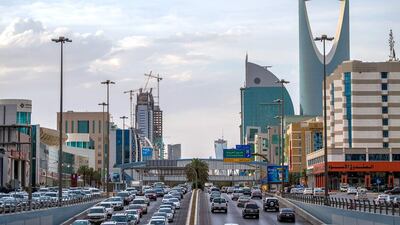
Traffic on the King Fahd highway, in Riyadh, Saudi Arabia. The National -
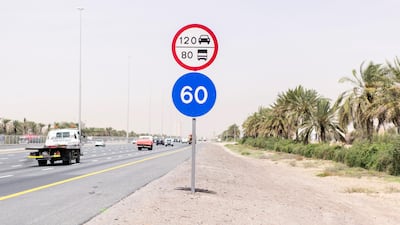
Speed limits have been cut on some roads in the UAE to bolster safety. -

Heavy traffic in Lebanon's capital city of Beirut. EPA -
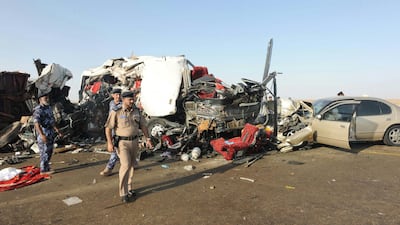
Omani police inspect the site of a collision between a lorry and a bus in western Oman in 2016 in which 18 people were killed. AFP