Temperatures are forecast to rise across the UAE during the Eid Al Fitr holiday, according to the National Centre of Meteorology.
On Friday, temperatures in Dubai will reach 36°C, 6°C higher than the previous day, and Abu Dhabi is expected to be 35°C, up 3°C from the previous day.
Saturday will be much the same as Friday, with the mercury at night dipping to the low 20°Cs.
On Sunday, highs of 37°C are expected in Abu Dhabi and Dubai, while winds could kick up dust clouds during the day and reduce visibility.
Light rain is expected in some western and southern areas, as well as winds of 35kph. The sea will be light to moderate.
The Eid Al Fitr holiday begins on Thursday, April 20, for private and government workers and will continue through to Sunday, April 23, if Ramadan lasts for 29 days, or Monday, April 24, if the holy month is 30 days.
The exact starting date of Eid is to be decided by the UAE's moon-sighting committee.
Abu Dhabi is expected to record a high of 37°C on Monday, while Dubai will start the week slight cooler at 34°C.
Staycations are a popular choice during the Eid break, but temperatures will be similar across the country.
There will be highs of 36°C in Fujairah and 37°C in Ras Al Khaimah on Saturday, the centre said in its weekly bulletin.
Eid Al Fitr preparations around the world: in pictures
-

A man shops for sweets at a market before Eid Al Fitr in the port city of Sidon, Lebanon. Reuters -
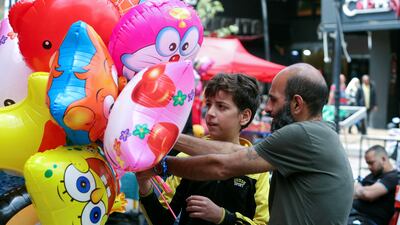
A street vendor sells balloons in Sidon. Reuters -
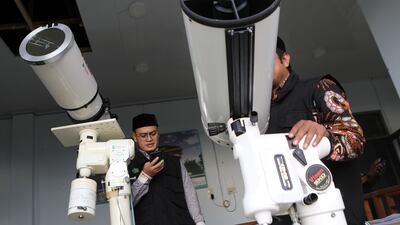
Ministry of Religion employees in Aceh, Indonesia, observe the position of the Moon to determine when Eid Al Fitr will fall. EPA -
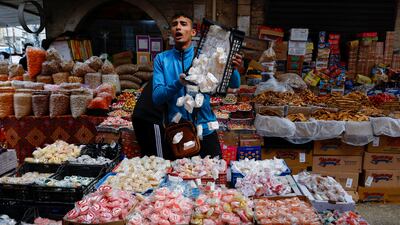
A vendor selling sweets as Palestinians prepare for the Eid Al Fitr holiday in Khan Younis, the southern Gaza Strip. Reuters -
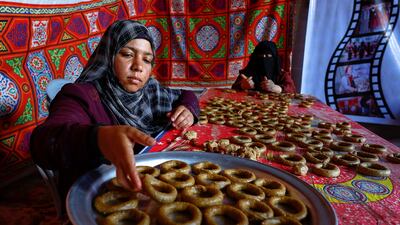
Palestinian women make traditional cakes in Rafah, the southern Gaza Strip. Reuters -
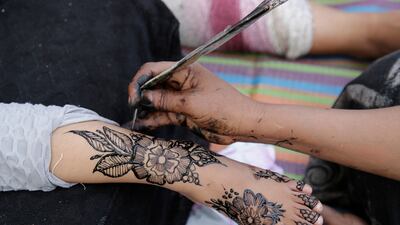
A woman has her arm decorated with henna at a street market in the run-up to Eid Al Fitr, which marks the end Ramadan, in Mogadishu, Somalia. AP -

Henna designs are the order of the day in Mogadishu. AP -
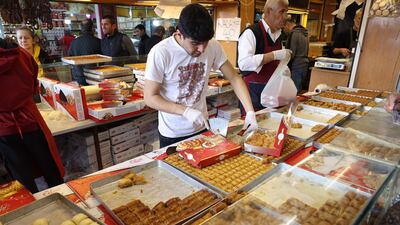
Pastries on display at a market stall in the Ulus district of Ankara, ahead of the Eid Al Fitr holiday. AFP -

Many Muslims head back to their home towns and villages from bigger cities to spend Eid Al Fitr with family, such as this man and his children leaving Dhaka, Bangladesh. EPA -

The sunglasses are on as the packed train leaves Dhaka. EPA -

Passengers prepare to board a train in Surabaya, Indonesia, as people head home for the Eid holiday. AFP -

Excitement is building for Eid Al Fitr in Karachi. EPA -
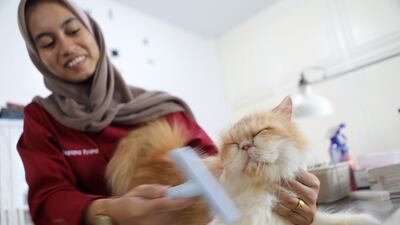
A pet hotel attendant with a cat staying at the facility while its owners enjoy the Eid Al Fitr holiday in Banda Aceh, Indonesia. EPA -

A Pakistani craftsman works on women's embroidered clothes before Eid Al Fitr in Peshawar, Pakistan. EPA -

Embroidered cloth being stitched for Eid Al Fitr. EPA -
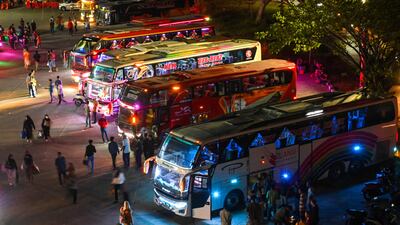
Passengers at a bus station in Banda Aceh start the journey home for the festivities. AFP -
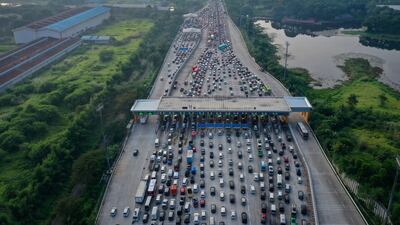
Traffic at a toll booth as Muslims head home for Eid Al Fitr, known locally as Mudik, in Karawang, Indonesia. Reuters -
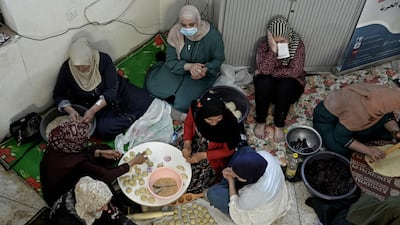
Iraqi women prepare traditional cookies in Mosul ahead of Eid Al Fitr. AFP -
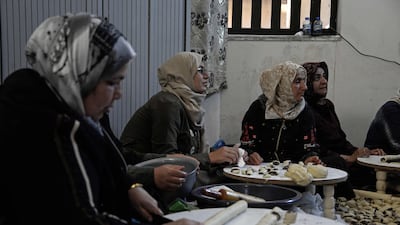
The bakes are known as kleicha. AFP -

Women visit a market ahead of Eid Al Fitr in Karachi. AP -

A Palestinian girl prepares traditional date-filled cookies with her family in Rafah, in the southern Gaza Strip. AFP -
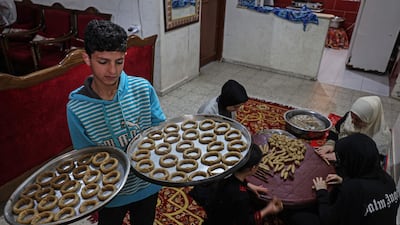
A Palestinian family prepares food for Eid Al Fitr. AFP -
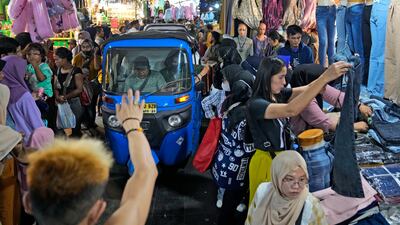
A three-wheeled taxi, known as a 'bajaj', navigates its way through Tanah Abang market in Jakarta. AP -

A vendor waits for costumers at a market in Jakarta. AP -
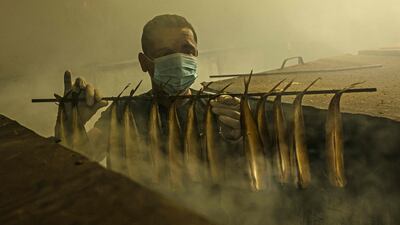
A Palestinian worker prepares smoked fish at a factory in Rafah. AFP
The Book of Collateral Damage
Sinan Antoon
(Yale University Press)
While you're here
Kareem Shaheen: Even a pandemic could not unite today's America
Michele Wucker: The difference between a black swan and a grey rhino
Robert Matthews: Has flawed science and rushed research failed us?
On Women's Day
Dr Nawal Al-Hosany: Why more women should be on the frontlines of climate action
Samar Elmnhrawy: How companies in the Middle East can catch up on gender equality
The National Editorial: Is there much to celebrate on International Women's Day 2021?
Justin Thomas: Challenge the notion that 'men are from Mars, women are from Venus'
Mercer, the investment consulting arm of US services company Marsh & McLennan, expects its wealth division to at least double its assets under management (AUM) in the Middle East as wealth in the region continues to grow despite economic headwinds, a company official said.
Mercer Wealth, which globally has $160 billion in AUM, plans to boost its AUM in the region to $2-$3bn in the next 2-3 years from the present $1bn, said Yasir AbuShaban, a Dubai-based principal with Mercer Wealth.
“Within the next two to three years, we are looking at reaching $2 to $3 billion as a conservative estimate and we do see an opportunity to do so,” said Mr AbuShaban.
Mercer does not directly make investments, but allocates clients’ money they have discretion to, to professional asset managers. They also provide advice to clients.
“We have buying power. We can negotiate on their (client’s) behalf with asset managers to provide them lower fees than they otherwise would have to get on their own,” he added.
Mercer Wealth’s clients include sovereign wealth funds, family offices, and insurance companies among others.
From its office in Dubai, Mercer also looks after Africa, India and Turkey, where they also see opportunity for growth.
Wealth creation in Middle East and Africa (MEA) grew 8.5 per cent to $8.1 trillion last year from $7.5tn in 2015, higher than last year’s global average of 6 per cent and the second-highest growth in a region after Asia-Pacific which grew 9.9 per cent, according to consultancy Boston Consulting Group (BCG). In the region, where wealth grew just 1.9 per cent in 2015 compared with 2014, a pickup in oil prices has helped in wealth generation.
BCG is forecasting MEA wealth will rise to $12tn by 2021, growing at an annual average of 8 per cent.
Drivers of wealth generation in the region will be split evenly between new wealth creation and growth of performance of existing assets, according to BCG.
Another general trend in the region is clients’ looking for a comprehensive approach to investing, according to Mr AbuShaban.
“Institutional investors or some of the families are seeing a slowdown in the available capital they have to invest and in that sense they are looking at optimizing the way they manage their portfolios and making sure they are not investing haphazardly and different parts of their investment are working together,” said Mr AbuShaban.
Some clients also have a higher appetite for risk, given the low interest-rate environment that does not provide enough yield for some institutional investors. These clients are keen to invest in illiquid assets, such as private equity and infrastructure.
“What we have seen is a desire for higher returns in what has been a low-return environment specifically in various fixed income or bonds,” he said.
“In this environment, we have seen a de facto increase in the risk that clients are taking in things like illiquid investments, private equity investments, infrastructure and private debt, those kind of investments were higher illiquidity results in incrementally higher returns.”
The Abu Dhabi Investment Authority, one of the largest sovereign wealth funds, said in its 2016 report that has gradually increased its exposure in direct private equity and private credit transactions, mainly in Asian markets and especially in China and India. The authority’s private equity department focused on structured equities owing to “their defensive characteristics.”
In-demand jobs and monthly salaries
- Technology expert in robotics and automation: Dh20,000 to Dh40,000
- Energy engineer: Dh25,000 to Dh30,000
- Production engineer: Dh30,000 to Dh40,000
- Data-driven supply chain management professional: Dh30,000 to Dh50,000
- HR leader: Dh40,000 to Dh60,000
- Engineering leader: Dh30,000 to Dh55,000
- Project manager: Dh55,000 to Dh65,000
- Senior reservoir engineer: Dh40,000 to Dh55,000
- Senior drilling engineer: Dh38,000 to Dh46,000
- Senior process engineer: Dh28,000 to Dh38,000
- Senior maintenance engineer: Dh22,000 to Dh34,000
- Field engineer: Dh6,500 to Dh7,500
- Field supervisor: Dh9,000 to Dh12,000
- Field operator: Dh5,000 to Dh7,000

