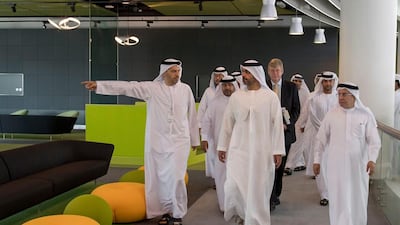
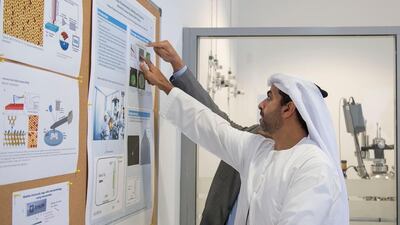
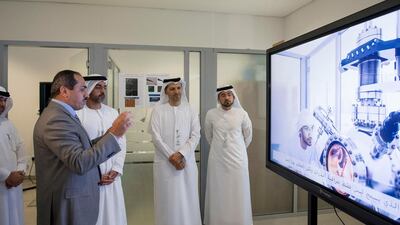
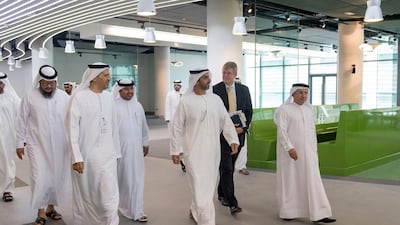
Emirati high-school pupils will be able to get first-hand knowledge of job opportunities in space, robotics, health sciences, computer science, energy, and cybersecurity at a boot camp organised by Mubadala Investment Company and Khalifa University of Science and Technology this month.
The two organisations announced on Wednesday that they would jointly host a five-day career boot camp aimed at pupils in grades 10 to 12, to help them learn more about STEM careers and jobs in emerging technology.
The camp will be organised at Khalifa University’s main campus and at its Sas Al Nakhl campus from August 15 to 19.
Artificial intelligence has being tipped to be the UAE's most important industry over the next 10 years, with universities urged to step up efforts to prepare the next generation of high-tech workers.
The fast-rising sector was ranked ahead of construction, electronics, aerospace, robotics, design engineering and IT, and cybersecurity, in a poll of technology and engineering employees in the Emirates.
The UAE government is driving forwards with ambitious plans to establish itself as a global AI hub.
The event is part of Mubadala’s Emiratisation programme.
“As a responsible investor, Mubadala’s Emiratisation programme is committed to delivering knowledge, expertise and change for Abu Dhabi, building our community, talent pool and creating sustainable careers for UAE nationals,” said Fatima Al Marzouqi, director of the Emiratisation portfolio at Mubadala.
“Our partnership with Khalifa University will support delivering curated programmes that will educate the UAE youth on job prospects and pave the way for a more sustainable and rewarding future.”
The boot camp will have dedicated sessions on space, covering earth sciences, astronomy and aerospace, an introduction to CubeSats, and the YahSat Space Lab projects at the Khalifa University Space Technology and Innovation Centre.
In computer science and robotics sessions, pupils will be offered an introduction to artificial intelligence.
Dr Ahmed Al Shoaibi, senior vice-president of academic and student affairs at Khalifa University, said the subjects that will be covered in the boot camp will significantly help pupils to chart their future career path, while acclimatising themselves with the latest technology developments in these fields.
The energy sessions will focus on sustainable energy, energy production technologies, basic principles of nuclear reactor and nuclear energy, and integration of nuclear energy.
The life and health sciences sessions will focus on biology, biomedical and medicine, while Telecom and Cybersecurity sessions will focus on analog and digital communication systems.
Pupils will be asked to present a project on the last day of the boot camp covering their chosen career path, the reason for the choice, its importance in the community and details of potential challenges they may face.
Mercer, the investment consulting arm of US services company Marsh & McLennan, expects its wealth division to at least double its assets under management (AUM) in the Middle East as wealth in the region continues to grow despite economic headwinds, a company official said.
Mercer Wealth, which globally has $160 billion in AUM, plans to boost its AUM in the region to $2-$3bn in the next 2-3 years from the present $1bn, said Yasir AbuShaban, a Dubai-based principal with Mercer Wealth.
“Within the next two to three years, we are looking at reaching $2 to $3 billion as a conservative estimate and we do see an opportunity to do so,” said Mr AbuShaban.
Mercer does not directly make investments, but allocates clients’ money they have discretion to, to professional asset managers. They also provide advice to clients.
“We have buying power. We can negotiate on their (client’s) behalf with asset managers to provide them lower fees than they otherwise would have to get on their own,” he added.
Mercer Wealth’s clients include sovereign wealth funds, family offices, and insurance companies among others.
From its office in Dubai, Mercer also looks after Africa, India and Turkey, where they also see opportunity for growth.
Wealth creation in Middle East and Africa (MEA) grew 8.5 per cent to $8.1 trillion last year from $7.5tn in 2015, higher than last year’s global average of 6 per cent and the second-highest growth in a region after Asia-Pacific which grew 9.9 per cent, according to consultancy Boston Consulting Group (BCG). In the region, where wealth grew just 1.9 per cent in 2015 compared with 2014, a pickup in oil prices has helped in wealth generation.
BCG is forecasting MEA wealth will rise to $12tn by 2021, growing at an annual average of 8 per cent.
Drivers of wealth generation in the region will be split evenly between new wealth creation and growth of performance of existing assets, according to BCG.
Another general trend in the region is clients’ looking for a comprehensive approach to investing, according to Mr AbuShaban.
“Institutional investors or some of the families are seeing a slowdown in the available capital they have to invest and in that sense they are looking at optimizing the way they manage their portfolios and making sure they are not investing haphazardly and different parts of their investment are working together,” said Mr AbuShaban.
Some clients also have a higher appetite for risk, given the low interest-rate environment that does not provide enough yield for some institutional investors. These clients are keen to invest in illiquid assets, such as private equity and infrastructure.
“What we have seen is a desire for higher returns in what has been a low-return environment specifically in various fixed income or bonds,” he said.
“In this environment, we have seen a de facto increase in the risk that clients are taking in things like illiquid investments, private equity investments, infrastructure and private debt, those kind of investments were higher illiquidity results in incrementally higher returns.”
The Abu Dhabi Investment Authority, one of the largest sovereign wealth funds, said in its 2016 report that has gradually increased its exposure in direct private equity and private credit transactions, mainly in Asian markets and especially in China and India. The authority’s private equity department focused on structured equities owing to “their defensive characteristics.”
Nancy 9 (Hassa Beek)
Nancy Ajram
(In2Musica)
How Islam's view of posthumous transplant surgery changed
Transplants from the deceased have been carried out in hospitals across the globe for decades, but in some countries in the Middle East, including the UAE, the practise was banned until relatively recently.
Opinion has been divided as to whether organ donations from a deceased person is permissible in Islam.
The body is viewed as sacred, during and after death, thus prohibiting cremation and tattoos.
One school of thought viewed the removal of organs after death as equally impermissible.
That view has largely changed, and among scholars and indeed many in society, to be seen as permissible to save another life.
First Person
Richard Flanagan
Chatto & Windus