

Lack of resources hinder e-learning initiatives at affordable schools as parents struggle to provide gadgets to support their children.
Shiny Davison, director of learning at Gulf Model School in Dubai, which charges Dh3,600 a year for kindergarten to Dh6,600 annually for grade 12, said schools are trying hard to improve online offerings to pupils.
But things are moving forward as teachers adapt to working remotely.
The school now offers Google Classroom and Google Hangout for better virtual interaction but only to older children from grade six to 12.
Ms Davison said the school will have to invest in tech-savvy classrooms in the future as the pandemic has disrupted and digitised education completely.
Moreover, families are also struggling to provide their children with tools that will help them stay logged-in during the school day.
Pascal Hassan, a French parent in Dubai said it was difficult to get a laptop or iPad for each member in the family.
“Some parents don’t have printers at home and not all of us have several iPads to spare. I have to share my laptop with my daughter when she has online classes,’’ said the father of two girls aged, 9 and 4.
"We cannot call this e-learning as the school does not have the tools. At present, schools scan worksheets and send them to parents, which is extremely hectic as children need full-time support.”
Ms Davison of Gulf Model School said the school does realise the limitations some families may face.
“We do not advocate the use of worksheets because families at the school cannot afford to use printers. They do face difficulties like having four children in a family and few devices,” she said.
In 2016, when Gems Founders School opened its doors, it admitted 1,700 children, an extremely high number for a school in Dubai.
Its fees range from Dh20,900 to Dh29,000 per year, making it one of the few affordable British curriculum schools in the emirate.
But with the sudden switch, the parents now believe its classes are lacking in quality.
Nimi, an Indian parent who has two children at the school, said there have been only a few live lessons.
“The material is inadequate and teachers do not explain concepts clearly," said the mother.
Last week, the UAE’s Ministry of Education asked schools to engage pupils through online learning portals and move away from worksheets.
However, parents allege it is a slow work-in-progress that is stalling effective learning.
P Rao, an Indian engineer whose daughter is in grade nine at a Gems school in Dubai, said distance learning could be improved by incorporating feedback from pupils and parents, including one-on-one sessions and assessments, and providing structured feedback to parents on progress of their children.
-
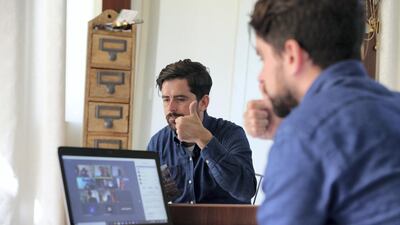
Zack Stewart , Grade 12 teacher at the Dubai American Academy, teaching online class from his home in the Springs in March. Pawan Singh / The National -

A teacher from Yung Wing School in New York, USA remotely teaches on her laptop from her roof on March 24, 2020 in New York City. Getty Images / AFP -
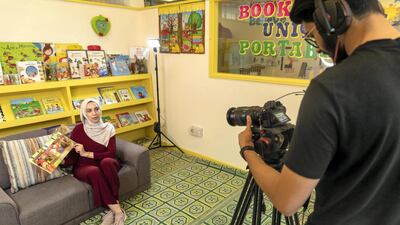
Shorooq Sharaf, a teacher at Chubby Cheeks Nursery in Abu Dhabi, gives an Arabic reading lesson to children at home via video link. Antonie Robertson / The National -
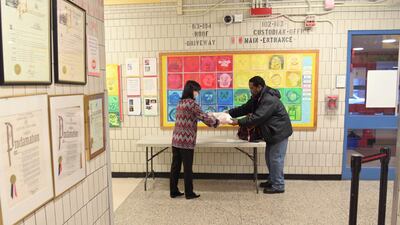
The parent of a student (R) receives one of many laptops being loaned to students in need for remote learning at Yung Wing School in New York City. Getty Images / AFP -
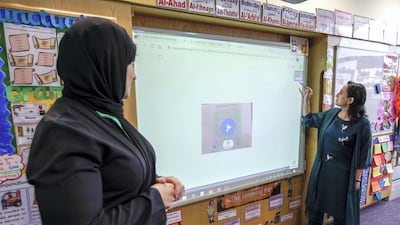
Teacher, Taira Astab during an online lecture at the Al Yasmina Academy in Abu Dhabi, on March 19, 2020. Victor Besa / The National -
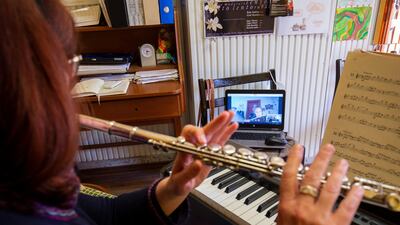
A music school teacher holds a one-to-one online flute lesson in her home in Nagykanizsa, southwestern Hungary, on March 17, 2020. EPA -
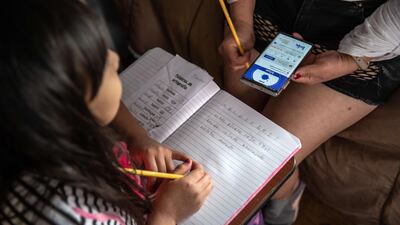
A mother and daughter, 8, from Honduras, study English on March 30, 2020 in Mineola, New York. Getty Images / AFP -
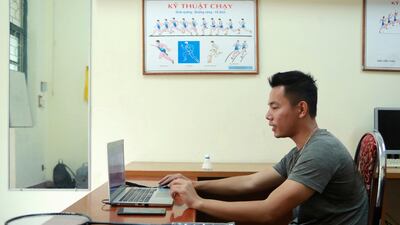
A PE teacher talks with his students during an online class at Nguyen Tat Thanh school in Hanoi, Vietnam, on March 19, 2020. AP -
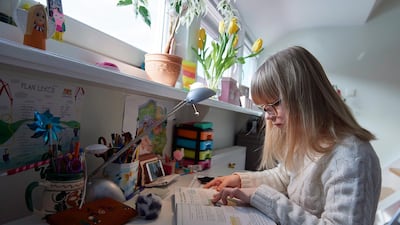
A girl in primary school does her homework, which was received on a digital portal, in her home in Gdansk, Poland, on March 17, 2020. EPA


Alicia Hol, an Australian mother of three girls, said her daughter’s schools, Safa Community School and Dubai English Speaking College, had asked for feedback from parents and used their suggestions.
“The school has fine-tuned their offerings. Earlier, my daughters just had assignments, worksheets and projects. But now, all my children have live contact with teachers," said Ms Hol.
She said her youngest daughter, eight-year-old Brooke, has improved her knowledge of Arabic through online learning.
“Video lessons have helped her and she is doing better now than she does in class. She can pause the session and listen to it again," she said.
Teachers at Ambassador School give task sheets and project work, to minimise parental involvement as parents are working.
"We started online classes for pupils and pupils in grades one to three get three-and-a-half-hours of live lessons," said Sheela Menon, principal at Ambassador School.
"We realised that just having video recordings will not work. We want parents to get the value for the fees that they paid."
Gems Education, the country’s largest private education provider, was prepared to make the switch to online learning even before the school closure was announced, according to the group’s chief innovation officer.
"Teachers are growing in confidence with pupils and we have seen an increase in live sessions,” said Michael Gernon.
"There is an increasing number of hours during which children and teachers have direct interaction.
"We wanted to make sure we have the right balance between online and offline.”

