Pupils and staff in Sharjah must undergo a nasal swab test to prove they are negative for Covid-19 before they return to class after the summer.
The emirate’s private school regulator urged head teachers to keep school schedules flexible at the start of term given testing and the wait for results could have an effect.
Testing might "continue at different times during the remainder of the academic year", officials said.
The decision by Sharjah Private Education Authority followed similar rules set out by Abu Dhabi's school authorities last month.
Officials have yet to clarify whether parents must get their children tested before the start of term, or if pupils would be tested on school grounds.
Pupils may have to return in groups at different times given thousands will be tested.
Families who have been overseas must submit a travel declaration form at least 14 days before the first day of term.
Under the authority's rules, staff members and pupils over the age of 6 must wear face masks throughout the school day when they return after the summer break.
Staff and pupils in grade one and above will have to carry at least two face masks to school every day.
Each school has to create a Covid-19 task force which will be responsible for handling all emergency health situations.
The teams will also follow up and monitor the implementation of health and safety procedures on campus.
Desks should be set at a distance of 1.5 meters and there should be proper signage in corridors and canteens to remind pupils to maintain physical distancing.
School libraries will also allow staggered entry to pupils to limit the number of children at a given time.
Schools have been asked to ensure pupils with high-risk conditions are given an online education alternative.
Teachers and school staff have been discouraged from leaving the school during the day but if they must, for emergency purposes, they can only return to the building once they have fully sanitised and changed their clothes. They must undergo thermal screening before they enter the building.
How will schools handle a potential Covid-19 case?
A pupil or member of staff who is suspected of having the virus will be immediately moved to a dedicated isolation room, where only the school medical's staff will be allowed to enter.
Parents of the pupil will be called and authorities will be informed.
All areas that may have been used by the patient will be immediately closed and disinfected.
Any suspected cases must undergo a PCR test and can only return to school on receiving a negative test result. Doctors may also recommend a 14-day quarantine period.
Anyone who came into contact with the pupil or staff member may also need to be tested.
"If two or more cases are confirmed this might result in the suspension of normal classes and the beginning distance learning for all students," officials said.
Staff and pupils must stay home if they feel unwell.
Can parents drop and pick children at school?
Pupils will arrive and leave the school at fixed, possibly staggered, times.
Only one family member or guardian should pick up or drop off their child at designated areas.
Schools must allocate entrance and exit points and must implement a detailed traffic management plan to ensure the safe drop off and collection of pupils.
People with existing health conditions should not pick up or drop off pupils.
School buses will be allowed to operate at 50 per cent capacity.
Will children have to wear face masks?
Yes. Pupils above the age of six must wear masks for the duration of the school day.
Pupils in grade one and above, as well as staff will be required to bring a minimum of two masks to school every day.
Teachers and assistants will help younger pupils follow necessary hand washing procedures.
Will pupils be allowed to eat at canteens?
Yes, canteens and dining halls will be in use.
Seating arrangements will be clearly marked with signage, and pupils will not be allowed to sit adjacent or next to each other.
Pupils must maintain a physical distance of two meters in the canteen.
Canteens will serve pre-packed lunches.
Will libraries be open for pupils?
Yes. Pupils will be able to access libraries using a staggered entry process.
Reading corners must be at least 1.5m apart.
The librarian and support staff must wear face masks, gloves, and use a hand sanitiser after each interaction, while the library counter will be sanitised every hour.
Teachers will supervise children to prevent them from touching too many books.
Books made from material that is difficult to clean should not be displayed.
Will pupils be allowed to use prayer rooms?
Yes but teachers and pupils will bring their own personal prayer mats, wear a face mask and stay at least 2 metres apart.
Prayer rooms can only be used by pupils while staff members have been asked to pray in their own offices.
Prayer rooms must be cleaned after each use.
______________
Coronavirus around the world – latest images
-
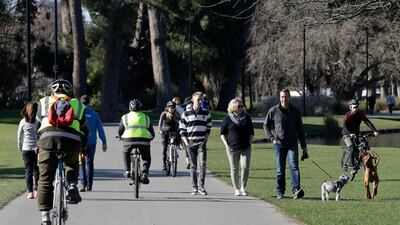
Residents exercise at Hagley Park in Christchurch, New Zealand. AP Photo -
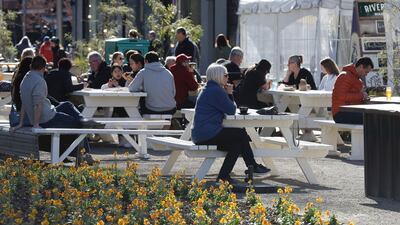
Customers enjoy lunch in the sunshine at the Riverside Market in Christchurch, New Zealand. AP Photo -
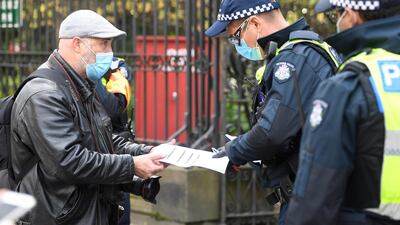
A press photographer has his work permit checked by police during an anti-lockdown protest in Melbourne, Australia. EPA -
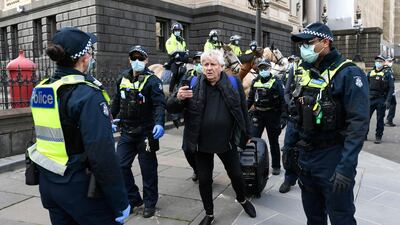
A man leaves after being questioned by police during an anti-lockdown protest in Melbourne, Australia. EPA -
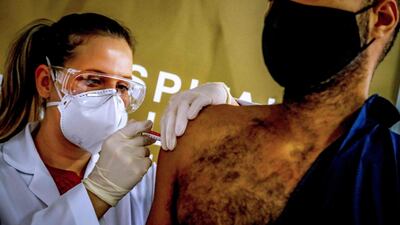
Health worker and volunteer Paulo Roberto Oliveira receives a Covid-19 vaccine produced by Chinese company Sinovac Biotech at the Sao Lucas Hospital, in Porto Alegre, southern Brazil. AFP -
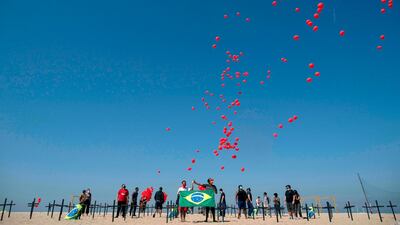
A thousand red balloons are released during a tribute to Covid-19 victims organised by the Rio de Paz NGO at the Copacabana beach in Rio de Janeiro, Brazil. AFP -
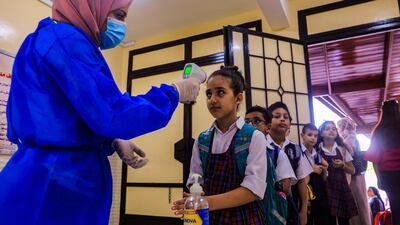
A staff member of the Rosary Sisters school in Gaza City checks the temperature of returning students on the first day of school. AFP -
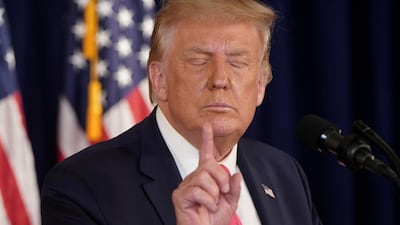
US President Donald Trump gestures after signing executive orders for economic relief during a news conference at his golf resort in Bedminster, New Jersey, US. Reuters -
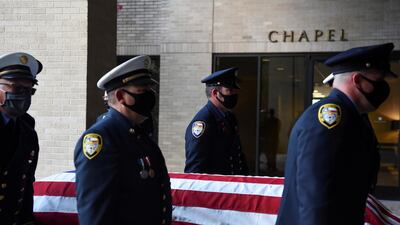
Members of the Houston Fire Department carry the casket of Jerry Pacheco, a firefighter who died of coronavirus, at a memorial service in Houston, Texas, US. Reuters -
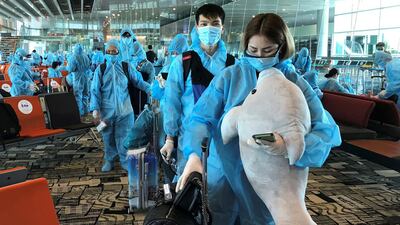
A Vietnamese woman carries a stuffed animal while boarding a repatriation flight from Singapore to Vietnam, at Changi airport, Singapore. Reuters -
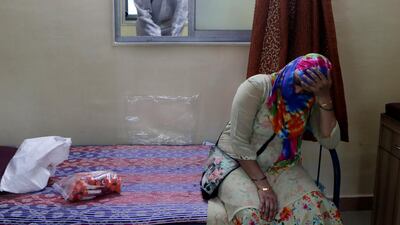
A woman waits to give a nasal swab sample at a medical camp in Mumbai, India. AP Photo -
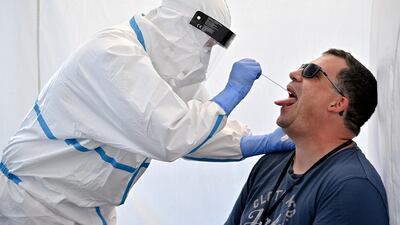
A traveler gets his swab sample collected at a walk-in test centre at the Cologne Bonn Airport in Cologne, Germany. EPA