• The worlds deepest blue hole is Dragon Hole in the South China Sea. Photo: Wikimedia
    The worlds deepest blue hole is Dragon Hole in the South China Sea. Photo: Wikimedia
  • Dean's Blue Hole, Long Island, Bahamas. Photo: Wikimedia
    Dean's Blue Hole, Long Island, Bahamas. Photo: Wikimedia
  • Blue Hole is off the Sinai Peninsula on Egypt’s Red Sea coast. Photo: Wikimedia
    Blue Hole is off the Sinai Peninsula on Egypt’s Red Sea coast. Photo: Wikimedia
  • Great Blue Hole lies about 40 miles off the coast of Belize. Getty
    Great Blue Hole lies about 40 miles off the coast of Belize. Getty

Abu Dhabi's blue hole: how does this marine phenomenon compare to world's largest?


Daniel Bardsley
  • English
  • Arabic

The discovery of a “blue hole” off Abu Dhabi has linked the UAE to nations across the globe that are also home to stunning marine sinkholes.

From Belize to the Bahamas, from China to Malta, blue holes are breathtaking sights often characterised by water that, because of the hole’s depth, appears a much darker blue than the surrounding sea.

Typically formed in areas of limestone or coral, they can be rich in life nearer the water surface and often contain numerous species of fish.

Some, even if the surface area is smaller, are much deeper than Abu Dhabi's newly revealed blue hole, stretching hundreds of metres vertically.

However, with poor circulation, deeper blue holes may be oxygen-depleted further down, where the waters are home to many types of micro-organisms.

Dr Jamie Pringle, a senior lecturer in geosciences at Keele University in the UK, said the mechanism by which blue holes are formed was unusual.

Sinkholes on land are created typically, he said, by the flow of rain or groundwater, which gradually wears material down over time before the areas of erosion connect to form caverns.

The blue holes, by contrast, are thought to be formed by the exposure of structures on land at a time of lower sea levels. The eroded areas are filled by water when sea levels rise.

“It is interesting and unusual as it needs both soluble bedrock that is exposed to the surface for a relatively long time, then is covered with water to preserve [the blue hole],” Dr Pringle said.

The Abu Dhabi blue hole, which lies off Al Dhafra, is skirted by coral and is about 200 metres wide and with a depth of about 12 metres it is relatively shallow compared to other large blue holes. Like others, it is home to many fish species, including in this case emperor fish and jackfish.

No less stunning than blue holes are some of the sinkholes that form on land, such as cenotes, a name usually used in Mexico for pools formed when limestone bedrock – the solid rock that sits underneath the soil – collapses.

These are filled with groundwater and in come cases become popular swimming spots. The term 'cenote' is sometimes applied to blue holes, too.

Related structures include karst lakes, which are created by the collapse of caves in limestone regions when the underlying bedrock has dissolved.

Here are some of the world’s most impressive blue holes:

Dragon Hole

The worlds deepest blue hole is Dragon Hole in the South China Sea. Photo: Wikimedia

The world’s deepest known blue hole is in a coral reef off the Paracel Islands, a disputed archipelago in the South China Sea.

Known as Dragon Hole and the Sansha Yongle Blue Hole, it was described in a 2018 article in the journal Scientific Reports as resembling a ballet dancer’s shoe and has a depth of 301 metres.

Its upper section has a roughly vertical cylindrical shape but further down the hole narrows and is angled diagonally.

Bahama Blue Hole

Alexey Molchanov dove 130 metres below the surface of Dean's Blue Hole in the Bahamas breaking a world record. Photo: Wikimedia

With a depth of about 202 metres, the Bahama Blue Hole or Dean’s Blue Hole was the deepest known in the world until the Dragon Hole was analysed.

Dean’s Blue Hole has been the location for numerous world records in free-diving, in which participants dive without breathing apparatus.

One record set there, in 2018, was by Alexey Molchanov, a Russian, who went 130 metres below the surface, described by Guinness World Records as “the deepest self-propelled dive in history”.

Blue Hole (Sinai Peninsula)

Blue Hole is also a popular spot for snorkelling and tourists. Photo: Wikimedia

Known simply as Blue Hole, a site at Dahab off the Sinai Peninsula on Egypt’s Red Sea coast has a depth of slightly more than 100 metres and is a popular diving location.

There have been numerous deaths at Blue Hole, partly because it contains a tunnel known as the Arch, which is said to be hazardous.

It is also a popular spot for snorkelling and tourism companies offer trips, with visitors able to enjoy a variety of multicoloured coral and many fish species.

Great Blue Hole

Great Blue Hole lies about 40 miles off the coast of Belize. Getty

The Great Blue Hole off Belize in Central America lies near the centre of a coral atoll and was made famous by Jacques Cousteau, the French ocean explorer.

Famously, Cousteau berthed his ship, the Calypso, in the blue hole in the early 1970s and detected stalactites beneath the surface, indicating that the structure had formed on land before a rise in the sea level.

Another popular diving spot, it lies about 40 miles from the coast of Belize and is part of a reef system that is a Unesco World Heritage Site.

Blue Hole (Gozo)

Another site called Blue Hole is found off the Maltese island of Gozo and is a popular location for diving, free diving and snorkelling.

It is a sinkhole in the limestone that measures about 10 metres by five metres and is sheltered from the sea by a fringe of rock.

The Blue Hole has a depth of about 25 metres and at nine metres is an archway that connects to the open sea.

Natural disasters from space - in pictures

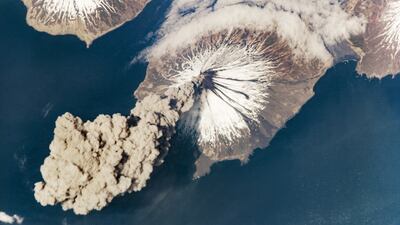
  • 1. An enormous plume of ash rises from the Cleveland Volcano on May 23, 2006. The image was captured from the International Space Station by astronaut Jeff Williams. The ash cloud rose as high as 6,000 metres above sea level. Photo: Nasa Earth Observatory
    1. An enormous plume of ash rises from the Cleveland Volcano on May 23, 2006. The image was captured from the International Space Station by astronaut Jeff Williams. The ash cloud rose as high as 6,000 metres above sea level. Photo: Nasa Earth Observatory
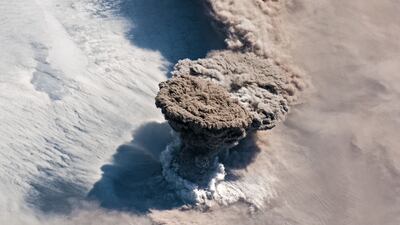
  • 2. The Raikoke Volcano on the Kamchatka Peninsula erupts on June 22, 2019. The last time it exploded was in 1924. Photo: Nasa Earth Observatory
    2. The Raikoke Volcano on the Kamchatka Peninsula erupts on June 22, 2019. The last time it exploded was in 1924. Photo: Nasa Earth Observatory
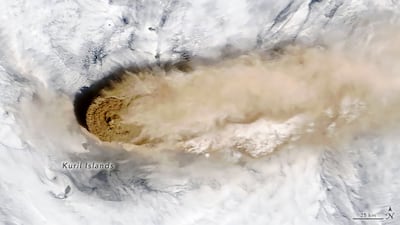
  • 3. Another image of the Raikoke eruption was captured on the same morning by the Suomi NPP satellite. Photo: Nasa Earth Observatory
    3. Another image of the Raikoke eruption was captured on the same morning by the Suomi NPP satellite. Photo: Nasa Earth Observatory
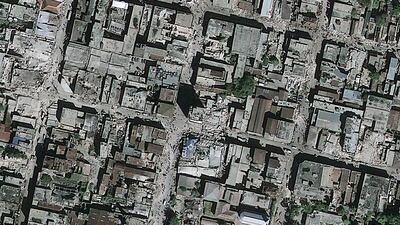
  • 4. One of the deadliest earthquakes struck Haiti in 2010. This GeoEye-1 satellite image shows rubble on the streets of Port-au-Prince on January 13. About 250,000 people were killed in the 7.0 magnitude earthquake. Photo: Nasa Earth Observatory
    4. One of the deadliest earthquakes struck Haiti in 2010. This GeoEye-1 satellite image shows rubble on the streets of Port-au-Prince on January 13. About 250,000 people were killed in the 7.0 magnitude earthquake. Photo: Nasa Earth Observatory
  • 5. A huge sandstorm rolls across the Sahara Desert on August 1, 2018. Astronaut Ricky Arnold captured this image from the ISS. Photo: Ricky Arnold Twitter
    5. A huge sandstorm rolls across the Sahara Desert on August 1, 2018. Astronaut Ricky Arnold captured this image from the ISS. Photo: Ricky Arnold Twitter
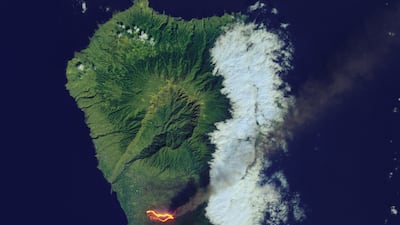
  • 6. Satellite images show an active volcano on the Spanish island of La Palma on September 26, 2021. Photo: Nasa Earth Observatory
    6. Satellite images show an active volcano on the Spanish island of La Palma on September 26, 2021. Photo: Nasa Earth Observatory
  • 7. The La Palma volcanic eruption has destroyed hundreds of homes. Photo: Nasa Earth Observatory
    7. The La Palma volcanic eruption has destroyed hundreds of homes. Photo: Nasa Earth Observatory
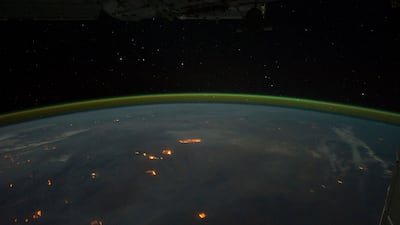
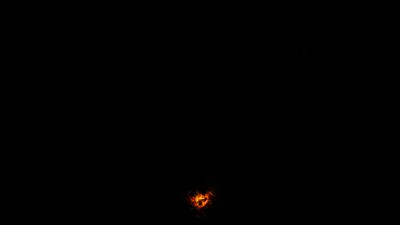
  • 8. Astronauts on the space station captured images of auroras australis, or southern lights, while flying over the Indian Ocean. Light created by the wildfires in Australia can also be seen. Photo: Nasa Earth Observatory
    8. Astronauts on the space station captured images of auroras australis, or southern lights, while flying over the Indian Ocean. Light created by the wildfires in Australia can also be seen. Photo: Nasa Earth Observatory
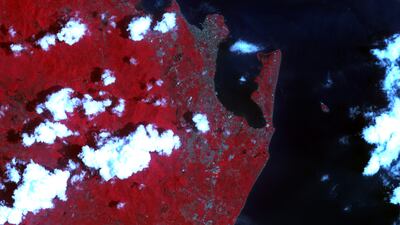
  • 9. This Terra satellite image shows how green (represented in red in this photo) the island of Leyte was before the deadly super typhoon Haiyan hit Philippines in 2013. Photo: Nasa Earth Observatory
    9. This Terra satellite image shows how green (represented in red in this photo) the island of Leyte was before the deadly super typhoon Haiyan hit Philippines in 2013. Photo: Nasa Earth Observatory
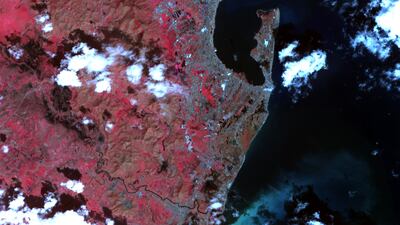
  • 10. Much of the vegetation and properties on the island was destroyed after the typhoon struck with winds of near 315 kilometres per hour. Photo: Nasa Earth Observatory
    10. Much of the vegetation and properties on the island was destroyed after the typhoon struck with winds of near 315 kilometres per hour. Photo: Nasa Earth Observatory
  • 11. A view of super typhoon Haiyan from space taken by Nasa’s Aqua satellite. Photo: Nasa Earth Observatory
    11. A view of super typhoon Haiyan from space taken by Nasa’s Aqua satellite. Photo: Nasa Earth Observatory
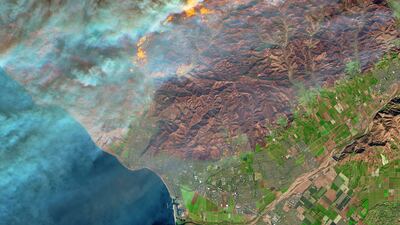
  • 12. The European Space Agency’s Sentinel-2 satellite captured an image of the fires in southern California on December 5, 2017. This photo shows the largest of the blazes in Ventura County, which destroyed more than 65,000 acres. Photo: Nasa Earth Observatory
    12. The European Space Agency’s Sentinel-2 satellite captured an image of the fires in southern California on December 5, 2017. This photo shows the largest of the blazes in Ventura County, which destroyed more than 65,000 acres. Photo: Nasa Earth Observatory
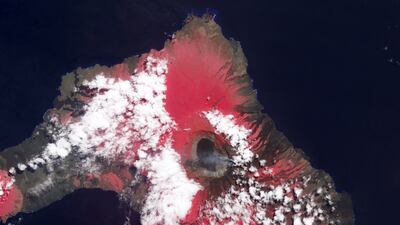
  • 13. The highest volcano in the Galapagos Islands erupted for the first time in 33 years in 2015. An image captured by the Terra satellite shows volcanic ash and gases about 15 km high. Photo: Nasa Earth Observatory
    13. The highest volcano in the Galapagos Islands erupted for the first time in 33 years in 2015. An image captured by the Terra satellite shows volcanic ash and gases about 15 km high. Photo: Nasa Earth Observatory
  • 14. An image of the Hurricane Dorian taken by US astronaut Christina Koch in 2019. The natural disaster struck the Bahamas and killed more than 70 people. Photo: Nasa Earth Observatory
    14. An image of the Hurricane Dorian taken by US astronaut Christina Koch in 2019. The natural disaster struck the Bahamas and killed more than 70 people. Photo: Nasa Earth Observatory
  • 15. Astronaut Christina Koch shared an image of smoke pluming over the Australian continent. The 2019-2020 bushfires destroyed thousands of homes and killed more than 30 people. Photo: Christina Koch Twitter
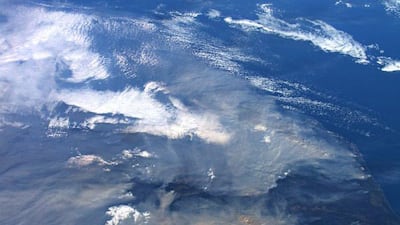
    15. Astronaut Christina Koch shared an image of smoke pluming over the Australian continent. The 2019-2020 bushfires destroyed thousands of homes and killed more than 30 people. Photo: Christina Koch Twitter
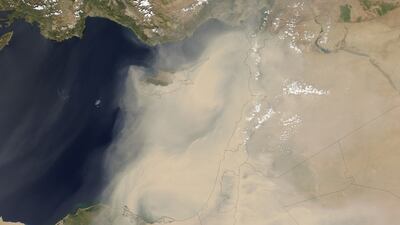
  • 16. Satellite images show a dust storm sweeping over the Middle East in 2015. The storm hit Lebanon, Israel, Jordan, Cyprus and Palestine, causing many cancelled flights and the closure of seaports. Photo: Nasa Earth Observatory
    16. Satellite images show a dust storm sweeping over the Middle East in 2015. The storm hit Lebanon, Israel, Jordan, Cyprus and Palestine, causing many cancelled flights and the closure of seaports. Photo: Nasa Earth Observatory
  • 17. A shield volcano erupts on Iceland’s Reykjanes peninsula on March 22, 2021. Photo: Nasa Earth Observatory
    17. A shield volcano erupts on Iceland’s Reykjanes peninsula on March 22, 2021. Photo: Nasa Earth Observatory
  • 18. Astronaut Luca Parmitano shared an image of the wildfires in Australia on January 13, 2020. Photo: European Space Agency
    18. Astronaut Luca Parmitano shared an image of the wildfires in Australia on January 13, 2020. Photo: European Space Agency
  • 19. A 2007 view of Japan’s Tohoku region before one of the world’s deadliest earthquake destroyed most of the area in 2011. Photo: Nasa Earth Observatory
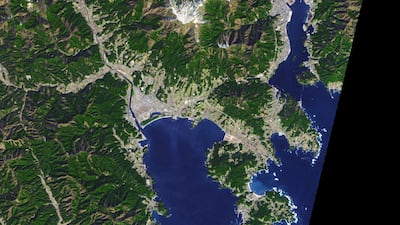
    19. A 2007 view of Japan’s Tohoku region before one of the world’s deadliest earthquake destroyed most of the area in 2011. Photo: Nasa Earth Observatory
  • 20. The 2004 Indian Ocean earthquake and tsunamis killed nearly 230,000 people. A satellite image shows the Indonesian town of Lhoknga destroyed by the natural disaster on December 26. All properties were destroyed, except for a white mosque that is visible in the image. Photo: Nasa
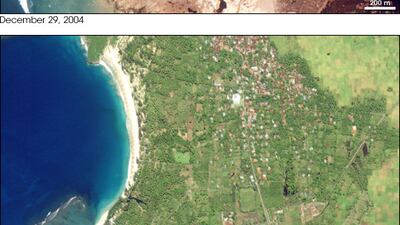
    20. The 2004 Indian Ocean earthquake and tsunamis killed nearly 230,000 people. A satellite image shows the Indonesian town of Lhoknga destroyed by the natural disaster on December 26. All properties were destroyed, except for a white mosque that is visible in the image. Photo: Nasa
  • 21. The tsunamis, caused by a 9.0 magnitude earthquake, also struck Sri Lanka. Photo: Nasa
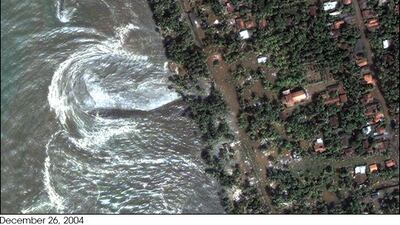
    21. The tsunamis, caused by a 9.0 magnitude earthquake, also struck Sri Lanka. Photo: Nasa
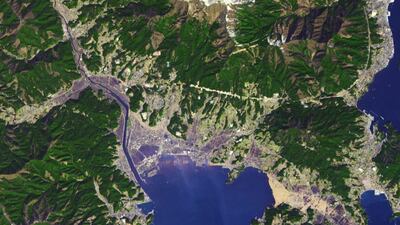
  • 22. A satellite image taken after a 9.1 magnitude earthquake struck the Tohoku region in Japan, with tsunami waves destroying most of the coastal area. About five to 10 metre waves flooded into the town. The photo shows flooding, a destroyed seawall and debris. Photo: Nasa Earth Observatory
    22. A satellite image taken after a 9.1 magnitude earthquake struck the Tohoku region in Japan, with tsunami waves destroying most of the coastal area. About five to 10 metre waves flooded into the town. The photo shows flooding, a destroyed seawall and debris. Photo: Nasa Earth Observatory
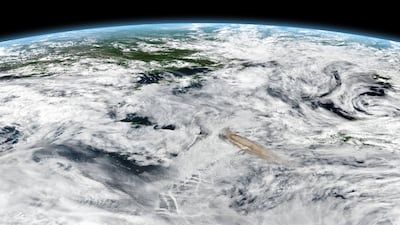
  • 23. The Raikoke Volcano eruption seen from space on June 22, 2019. Photo: Nasa Earth Observatory
    23. The Raikoke Volcano eruption seen from space on June 22, 2019. Photo: Nasa Earth Observatory
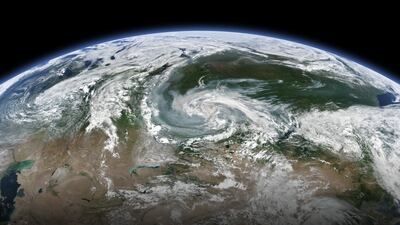
  • 24. A Suomi NPP satellite image shows smoke over Russia, as wildfires burned across 11 regions of the country in July 2019. Photo: Nasa Earth Observatory
    24. A Suomi NPP satellite image shows smoke over Russia, as wildfires burned across 11 regions of the country in July 2019. Photo: Nasa Earth Observatory
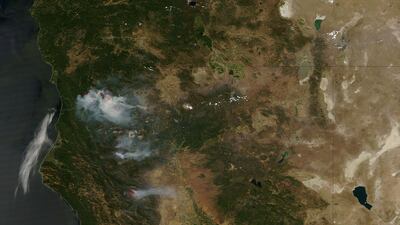
  • 25. Satellite image of forest fires in Northern California captured in August 2008. Photo: Nasa Earth Observatory
    25. Satellite image of forest fires in Northern California captured in August 2008. Photo: Nasa Earth Observatory
  • 26. The Fagradalsfjall volcano in southwestern Iceland erupted on May 9, 2021. Photo: Nasa Earth Observatory
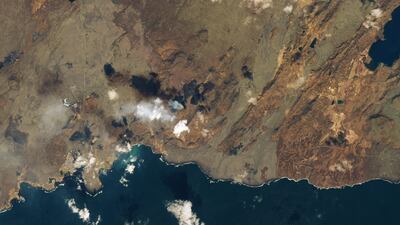
    26. The Fagradalsfjall volcano in southwestern Iceland erupted on May 9, 2021. Photo: Nasa Earth Observatory
  • 27. The 2011 tsunami in Japan was so intense, it caused calving of large icebergs from the Sulzberger Ice Shelf on the Antarctic coast, as shown in this image captured by European Space Agency’s Envisat satellite. Photo: Nasa Earth Observatory
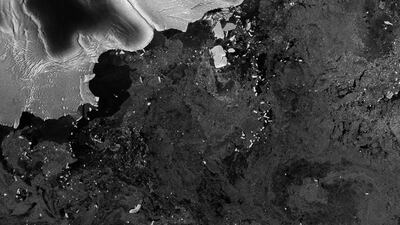
    27. The 2011 tsunami in Japan was so intense, it caused calving of large icebergs from the Sulzberger Ice Shelf on the Antarctic coast, as shown in this image captured by European Space Agency’s Envisat satellite. Photo: Nasa Earth Observatory
  • 28. Satellite image shows a powerful tornado (brown horizontal line in the middle of image) sweeping across Massachusetts on June 2011. It wreaked havoc for 63 kilometres, killing three people and destroying property. Photo: Nasa Earth Observatory
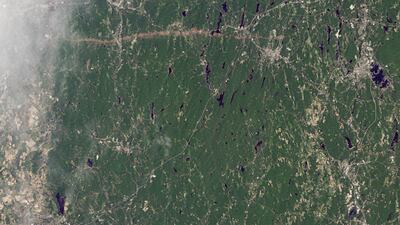
    28. Satellite image shows a powerful tornado (brown horizontal line in the middle of image) sweeping across Massachusetts on June 2011. It wreaked havoc for 63 kilometres, killing three people and destroying property. Photo: Nasa Earth Observatory
  • 29. A satellite image of the Hurricane Katrina over the US in 2005. It struck the state of Louisiana, killing 1,833 people and destroying thousands of homes. Photo: Nasa Earth Observatory
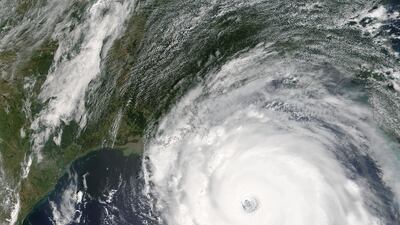
    29. A satellite image of the Hurricane Katrina over the US in 2005. It struck the state of Louisiana, killing 1,833 people and destroying thousands of homes. Photo: Nasa Earth Observatory
  • 30. The Caldor fire reached Lake Tahoe on the California and Nevada border on September 15, 2021, as seen in this Landsat 8 satellite image. The fire had been burning for 10 weeks. Photo: Nasa Earth Observatory
    30. The Caldor fire reached Lake Tahoe on the California and Nevada border on September 15, 2021, as seen in this Landsat 8 satellite image. The fire had been burning for 10 weeks. Photo: Nasa Earth Observatory
Ten tax points to be aware of in 2026

1. Domestic VAT refund amendments: request your refund within five years

If a business does not apply for the refund on time, they lose their credit.

2. E-invoicing in the UAE

Businesses should continue preparing for the implementation of e-invoicing in the UAE, with 2026 a preparation and transition period ahead of phased mandatory adoption. 

3. More tax audits

Tax authorities are increasingly using data already available across multiple filings to identify audit risks. 

4. More beneficial VAT and excise tax penalty regime

Tax disputes are expected to become more frequent and more structured, with clearer administrative objection and appeal processes. The UAE has adopted a new penalty regime for VAT and excise disputes, which now mirrors the penalty regime for corporate tax.

5. Greater emphasis on statutory audit

There is a greater need for the accuracy of financial statements. The International Financial Reporting Standards standards need to be strictly adhered to and, as a result, the quality of the audits will need to increase.

6. Further transfer pricing enforcement

Transfer pricing enforcement, which refers to the practice of establishing prices for internal transactions between related entities, is expected to broaden in scope. The UAE will shortly open the possibility to negotiate advance pricing agreements, or essentially rulings for transfer pricing purposes. 

7. Limited time periods for audits

Recent amendments also introduce a default five-year limitation period for tax audits and assessments, subject to specific statutory exceptions. While the standard audit and assessment period is five years, this may be extended to up to 15 years in cases involving fraud or tax evasion. 

8. Pillar 2 implementation 

Many multinational groups will begin to feel the practical effect of the Domestic Minimum Top-Up Tax (DMTT), the UAE's implementation of the OECD’s global minimum tax under Pillar 2. While the rules apply for financial years starting on or after January 1, 2025, it is 2026 that marks the transition to an operational phase.

9. Reduced compliance obligations for imported goods and services

Businesses that apply the reverse-charge mechanism for VAT purposes in the UAE may benefit from reduced compliance obligations. 

10. Substance and CbC reporting focus

Tax authorities are expected to continue strengthening the enforcement of economic substance and Country-by-Country (CbC) reporting frameworks. In the UAE, these regimes are increasingly being used as risk-assessment tools, providing tax authorities with a comprehensive view of multinational groups’ global footprints and enabling them to assess whether profits are aligned with real economic activity. 

Contributed by Thomas Vanhee and Hend Rashwan, Aurifer

RESULTS FOR STAGE 4

Stage 4 Dubai to Hatta, 197 km, Road race.

Overall leader Primoz Roglic SLO (Team Jumbo - Visma)

Stage winners: 1. Caleb Ewan AUS (Lotto - Soudal) 2. Matteo Moschetti ITA (Trek - Segafredo) 3. Primoz Roglic SLO (Team Jumbo - Visma)

%20Ramez%20Gab%20Min%20El%20Akher
%3Cp%3E%3Cstrong%3ECreator%3A%3C%2Fstrong%3E%20Ramez%20Galal%3C%2Fp%3E%0A%3Cp%3E%3Cstrong%3EStarring%3A%3C%2Fstrong%3E%20Ramez%20Galal%3C%2Fp%3E%0A%3Cp%3E%3Cstrong%3EStreaming%20on%3A%20%3C%2Fstrong%3EMBC%20Shahid%3C%2Fp%3E%0A%3Cp%3E%3Cstrong%3ERating%3A%20%3C%2Fstrong%3E2.5%2F5%3C%2Fp%3E%0A
SERIES INFO

Schedule:
All matches at the Harare Sports Club
1st ODI, Wed Apr 10
2nd ODI, Fri Apr 12
3rd ODI, Sun Apr 14
4th ODI, Sun Apr 16

UAE squad
Mohammed Naveed (captain), Rohan Mustafa, Ashfaq Ahmed, Shaiman Anwar, Mohammed Usman, CP Rizwan, Chirag Suri, Mohammed Boota, Ghulam Shabber, Sultan Ahmed, Imran Haider, Amir Hayat, Zahoor Khan, Qadeer Ahmed

Zimbabwe squad
Peter Moor (captain), Solomon Mire, Brian Chari, Regis Chakabva, Sean Williams, Timycen Maruma, Sikandar Raza, Donald Tiripano, Kyle Jarvis, Tendai Chatara, Chris Mpofu, Craig Ervine, Brandon Mavuta, Ainsley Ndlovu, Tony Munyonga, Elton Chigumbura

RESULTS

2.30pm Jaguar I-Pace – Conditions (PA) Dh80,000 (Dirt)
1,600m 

Winner Namrood, Antonio Fresu (jockey), Musabah Al Muhairi
(trainer) 

3.05pm Land Rover Defender – Maiden (TB) Dh82,500 (D)
1,400m 

Winner Shadzadi, Tadhg O’Shea, Bhupat Seemar 

3.40pm Jaguar F-Type – Maiden (TB) Dh82,500 (Turf) 1,600m 

Winner Tahdeed, Fernando Jara, Nicholas Bachalard 

4.15pm New Range Rover – Handicap (TB) Dh87,500 (D) 1,400m 

Winner Shanty Star, Richard Mullen, Rashed Bouresly 

4.50pm Land Rover – Handicap (TB) Dh95,000 (T) 2,400m 

Winner Autumn Pride, Bernardo Pinheiro, Helal Al Alawi 

5.25pm Al Tayer Motor – Handicap (TB) Dh95,000  T) 1,000m 

Winner Dahawi, Antonio Fresu, Musabah Al Muhairi 

6pm Jaguar F-Pace SVR – Handicap (TB) Dh87,500 (D) 1,600m 

Winner Scabbard, Sam Hitchcock, Doug Watson  

A Long Way Home by Peter Carey
Faber & Faber

Mercer, the investment consulting arm of US services company Marsh & McLennan, expects its wealth division to at least double its assets under management (AUM) in the Middle East as wealth in the region continues to grow despite economic headwinds, a company official said.

Mercer Wealth, which globally has $160 billion in AUM, plans to boost its AUM in the region to $2-$3bn in the next 2-3 years from the present $1bn, said Yasir AbuShaban, a Dubai-based principal with Mercer Wealth.

Within the next two to three years, we are looking at reaching $2 to $3 billion as a conservative estimate and we do see an opportunity to do so,” said Mr AbuShaban.

Mercer does not directly make investments, but allocates clients’ money they have discretion to, to professional asset managers. They also provide advice to clients.

“We have buying power. We can negotiate on their (client’s) behalf with asset managers to provide them lower fees than they otherwise would have to get on their own,” he added.

Mercer Wealth’s clients include sovereign wealth funds, family offices, and insurance companies among others.

From its office in Dubai, Mercer also looks after Africa, India and Turkey, where they also see opportunity for growth.

Wealth creation in Middle East and Africa (MEA) grew 8.5 per cent to $8.1 trillion last year from $7.5tn in 2015, higher than last year’s global average of 6 per cent and the second-highest growth in a region after Asia-Pacific which grew 9.9 per cent, according to consultancy Boston Consulting Group (BCG). In the region, where wealth grew just 1.9 per cent in 2015 compared with 2014, a pickup in oil prices has helped in wealth generation.

BCG is forecasting MEA wealth will rise to $12tn by 2021, growing at an annual average of 8 per cent.

Drivers of wealth generation in the region will be split evenly between new wealth creation and growth of performance of existing assets, according to BCG.

Another general trend in the region is clients’ looking for a comprehensive approach to investing, according to Mr AbuShaban.

“Institutional investors or some of the families are seeing a slowdown in the available capital they have to invest and in that sense they are looking at optimizing the way they manage their portfolios and making sure they are not investing haphazardly and different parts of their investment are working together,” said Mr AbuShaban.

Some clients also have a higher appetite for risk, given the low interest-rate environment that does not provide enough yield for some institutional investors. These clients are keen to invest in illiquid assets, such as private equity and infrastructure.

“What we have seen is a desire for higher returns in what has been a low-return environment specifically in various fixed income or bonds,” he said.

“In this environment, we have seen a de facto increase in the risk that clients are taking in things like illiquid investments, private equity investments, infrastructure and private debt, those kind of investments were higher illiquidity results in incrementally higher returns.”

The Abu Dhabi Investment Authority, one of the largest sovereign wealth funds, said in its 2016 report that has gradually increased its exposure in direct private equity and private credit transactions, mainly in Asian markets and especially in China and India. The authority’s private equity department focused on structured equities owing to “their defensive characteristics.”

The specs

Engine: 3.0-litre flat-six twin-turbocharged

Transmission: eight-speed PDK automatic

Power: 445bhp

Torque: 530Nm

Price: Dh474,600

On Sale: Now

Ziina users can donate to relief efforts in Beirut

Ziina users will be able to use the app to help relief efforts in Beirut, which has been left reeling after an August blast caused an estimated $15 billion in damage and left thousands homeless. Ziina has partnered with the United Nations High Commissioner for Refugees to raise money for the Lebanese capital, co-founder Faisal Toukan says. “As of October 1, the UNHCR has the first certified badge on Ziina and is automatically part of user's top friends' list during this campaign. Users can now donate any amount to the Beirut relief with two clicks. The money raised will go towards rebuilding houses for the families that were impacted by the explosion.”

The specs

Engine: 3-litre twin-turbo V6

Power: 400hp

Torque: 475Nm

Transmission: 9-speed automatic

Price: From Dh215,900

On sale: Now

ICC Awards for 2021

MEN

Cricketer of the Year – Shaheen Afridi (Pakistan)

T20 Cricketer of the Year – Mohammad Rizwan (Pakistan)

ODI Cricketer of the Year – Babar Azam (Pakistan)

Test Cricketer of the Year – Joe Root (England)

WOMEN

Cricketer of the Year – Smriti Mandhana (India)

ODI Cricketer of the Year – Lizelle Lee (South Africa)

T20 Cricketer of the Year – Tammy Beaumont (England)

PULITZER PRIZE 2020 WINNERS

JOURNALISM 

Public Service
Anchorage Daily News in collaboration with ProPublica

Breaking News Reporting
Staff of The Courier-Journal, Louisville, Ky.

Investigative Reporting
Brian M. Rosenthal of The New York Times

Explanatory Reporting
Staff of The Washington Post

Local Reporting  
Staff of The Baltimore Sun

National Reporting
T. Christian Miller, Megan Rose and Robert Faturechi of ProPublica

and    

Dominic Gates, Steve Miletich, Mike Baker and Lewis Kamb of The Seattle Times

International Reporting
Staff of The New York Times

Feature Writing
Ben Taub of The New Yorker

Commentary
Nikole Hannah-Jones of The New York Times

Criticism
Christopher Knight of the Los Angeles Times

Editorial Writing
Jeffery Gerritt of the Palestine (Tx.) Herald-Press

Editorial Cartooning
Barry Blitt, contributor, The New Yorker

Breaking News Photography
Photography Staff of Reuters

Feature Photography
Channi Anand, Mukhtar Khan and Dar Yasin of the Associated Press

Audio Reporting
Staff of This American Life with Molly O’Toole of the Los Angeles Times and Emily Green, freelancer, Vice News for “The Out Crowd”

LETTERS AND DRAMA

Fiction
"The Nickel Boys" by Colson Whitehead (Doubleday)

Drama
"A Strange Loop" by Michael R. Jackson

History
"Sweet Taste of Liberty: A True Story of Slavery and Restitution in America" by W. Caleb McDaniel (Oxford University Press)

Biography
"Sontag: Her Life and Work" by Benjamin Moser (Ecco/HarperCollins)

Poetry
"The Tradition" by Jericho Brown (Copper Canyon Press)

General Nonfiction
"The Undying: Pain, Vulnerability, Mortality, Medicine, Art, Time, Dreams, Data, Exhaustion, Cancer, and Care" by Anne Boyer (Farrar, Straus and Giroux)

and

"The End of the Myth: From the Frontier to the Border Wall in the Mind of America" by Greg Grandin (Metropolitan Books)

Music
"The Central Park Five" by Anthony Davis, premiered by Long Beach Opera on June 15, 2019

Special Citation
Ida B. Wells


Updated: October 12, 2021, 6:50 AM