


A school and a restaurant in Dubai have come together to create artificial reefs using hundreds of thousands of discarded oyster shells.
Used shells from The Maine oyster bar restaurants, which are usually just thrown out and end up in landfill, are being reused to help create structures where marine animals and plants can grow.
Pupils from The Arbor School in Dubai have received more than 250,000 shells, which they have placed in the water near Ghantoot, close to the border with Abu Dhabi.
The Dubai Oyster Project will also help to reduce the amount of food waste, organisers said.
“We produce about 50,000 oysters each month,” said Joey Ghazal, managing partner at The Maine.
environmental education specialist at The Arbor School
“They are usually destined for landfills and so far we’ve given more than 250,000 oysters to the project.”
Coral reefs have sustained significant damage over the years.
A study from 2017, conducted by a professor from New York University Abu Dhabi, found that 73 per cent of all corals in the region were lost as a result of mass bleaching.
This is caused by a change in temperature, which results in corals expelling living algae from inside due to stress levels.
It is estimated the risk of bleaching increases by around four per cent each year due to climate change.

Bleaching leaves corals at risk of disease, often killing them, which can create serious repercussions for organisms that depend on the reefs.
Coral reefs also provide vital protection, reducing the impact of waves as they hit coastal areas.
It is not uncommon for one coral reef to provide a home for thousands of species.
“We’re taking the used oyster shells and sending them to the pupils of the Arbor School who are putting them in gargoors, which are the illegal fishing nets the government has been seizing,” said Mr Ghazal, who is also a co-founder of the project.
“Basically, we are using them to create biological building blocks to create artificial reefs.”
He said the scheme was inspired by similar plans across the world, including the Billion Oysters Project which has the goal of introducing a billion oysters into New York Harbour by 2035.
He also called on other restaurants in the UAE to support projects that help to tackle food waste.
“The industry needs to start asking itself what more it can do to help reduce waste and get the communities involved,” said Mr Ghazal.
“There is definitely a lot more hotels and restaurants can do.”
The UAE Ministry of Climate Change and Environment estimated food waste was costing the country Dh13 billion each year.
Ben Hren, the environmental education specialist at The Arbor School, said younger generations were very much putting climate at the top of the agenda.
“In my 40 years in education I’ve often noticed children have an interest in environmental issues,” said Mr Hren.
“But one of the big things that have happened in recent years is that interest alone is no longer enough.
“It’s important to be able to help provide opportunities for the children to create the kind of future they want for themselves.”
Mr Hren said he hoped the project would be adopted in other parts of the UAE and across the region.
“This is the first step and we hope the idea has the potential to be replicated in other places,” he said.
“Hopefully, we will then start to observe a major difference in water quality and will see significant improvements to marine life.”
Fadi Abu Ghali, the co-founder of the project, said a wider expansion of the project was very much on the horizon.
“This is just the beginning. I can see this growing and we want to get more schools, communities and businesses involved,” he said.
“It’s important to be able to say in the future we helped to clean up the world.”
How are oyster shells used to build coral reefs?
The discarded oyster shells are laid out in an outdoor setting for three to six months, a period of time called "curing time".
Curing time ensures the shells are free of all organic material, bacteria or parasites before being used for other purposes.
The next step is to prepare the shells for restoration. They are collected in plastic mesh bags and then placed back in the water.
The oysters are carefully placed in the sea by pupils of The Arbor School, under the supervision of experts from Emirates Marine Environmental Group.
Oyster shells can act as a form of compost as they do not decompose.
The areas where they are placed tend to be those most likely to produce a high yield of oyster larvae.
UAE coral reefs studied by researchers - in pictures
-
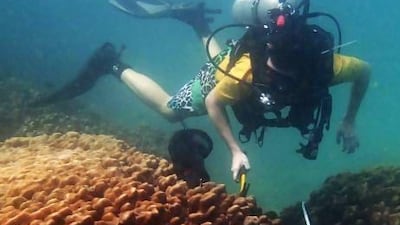
John Burt, associate professor of biology at New York University Abu Dhabi, has studied the region’s seas for the past 15 years. Photo: Joerg Wiedenmann -
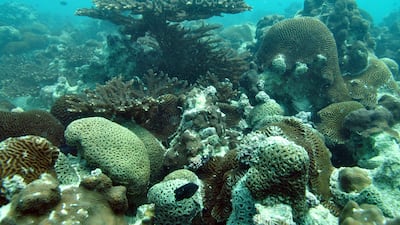
Table coral, such as the kind seen on the top left in Ghantoot, are among the heat-sensitive Acropora species. Photo: John Burt -
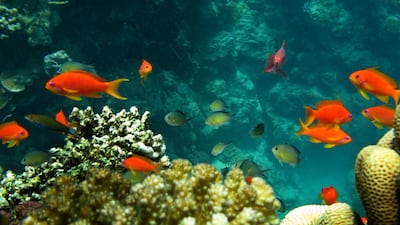
Researchers from NYU Abu Dhabi are looking for clues that could one day help coral reefs around the world survive the onslaught of global warming. Photo: John Burt -
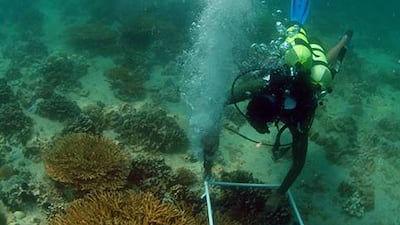
John Burt using a pneumatic drill to install coral monitoring equipment on the sea-bottom at Ras Ghanada reef in Ghantoot, UAE. Photo: John Burt -
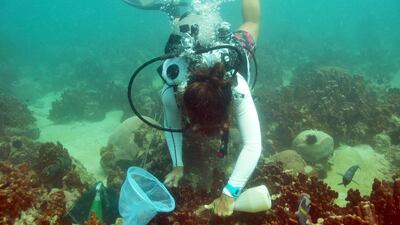
A scientist collects samples from a coral reef in Abu Dhabi, which scientists say have suffered a 'catastrophic event' because of warming waters. Photo: John Burt -
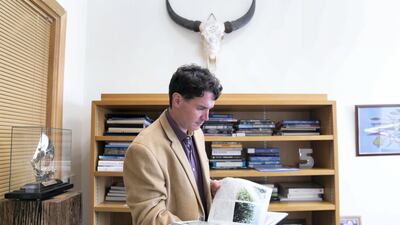
In 2017, John Burt, associate professor of biology at NYU Abu Dhabi calculated that 73 per cent of corals across all of the southern Gulf were lost. Reem Mohammed / The National -
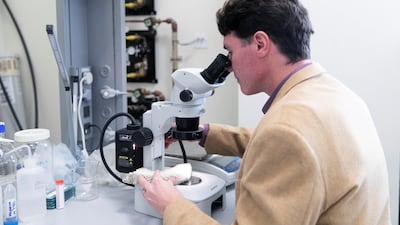
John Burt studied the corals from the Gulf waters for the far-reaching global report on warming waters and their affect on coral reefs. Reem Mohammed / The National -
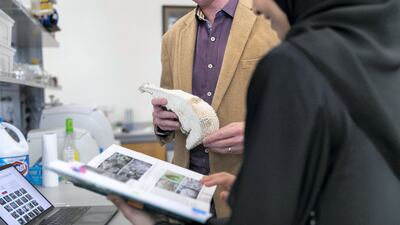
High sea temperatures cause coral to bleach and die. Reem Mohammed / The National



