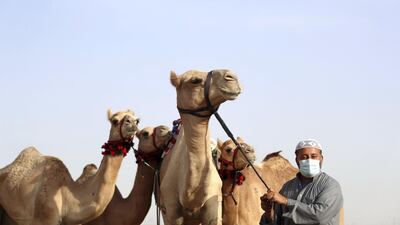
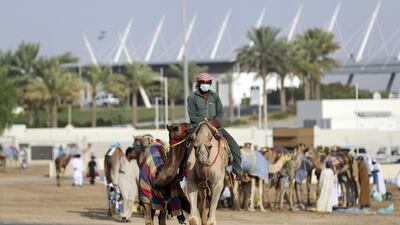
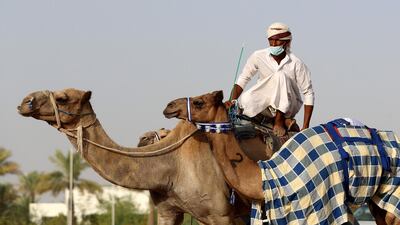
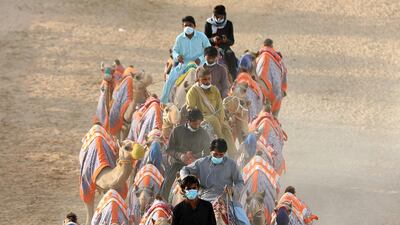
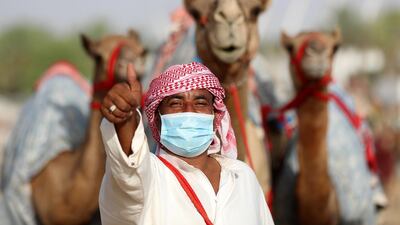
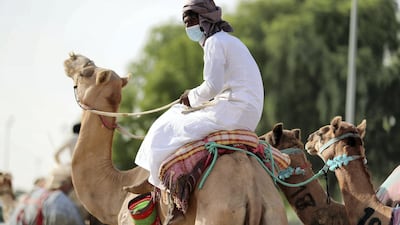
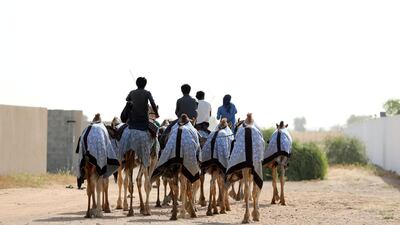
The time-honoured tradition of camel racing is included on the Unesco Representative List of the Intangible Cultural Heritage of Humanity, as is aflaj – the system of Iron Age water channels used for farm irrigation in Al Ain.
Camel races were submitted jointly by the UAE and Oman, while aflaj was submitted by the Emirates.
The UN list aims to ensure protection of culture and heritage and the UAE now has 11 elements registered.
Much is known about the glory of camel racing, but aflaj is a lesser known yet no less important element.
Aflaj water channels are dug by hand and provide irrigation to arable land.
These channels flow through farming villages in Al Ain, dividing irrigation equally between farms in a series of underground streams.
The technique is still commonly used in Oman. Used during the Iron Age, they allowed settlements to expand.
The famous Al Ain aflaj system is thought to be one of the region’s oldest, having been in existence for about 3,000 years.
It was restored by the Founding President, Sheikh Zayed, in 1946.
Popular oases can be found in Al Ain’s Hili, Bida bin Saoud, Thugaiban, Al Madam and Jabeeb. But what is their story and how do they work?
How does aflaj irrigation work?
Water is extracted from underground wadis and wells by digging out deep channels.
Gravity does its work and the water flows through the system without need for mechanical pumps.
It provides a constant flow of water through the oasis that increases in capacity during heavy rain.
Components of the Aflaj system
Aflaj systems have three parts.
The first is umm al falaj, or mother well, which is the main water source, from where tunnels of varying length deliver large amounts of water underground to its destination.
Access shafts are built at 20-metre intervals along the water tunnels, protected by rings of clay as a fail-safe to stop flooding should the tunnels collapse.
Aflaj is the plural of the word ‘falaj’. There are various types. A Dawoodi falaj supplies water year-round, with channels up to 10 metres long.
An Ayni falaj collects water from springs, while a ghaili falaj draws supplies from natural resources such as ponds or lakes and is used more during times of increased rain.
Camel racing
Camel racing is a bedrock of Emirati heritage. Every year, tens of thousands of camels from across the Gulf compete for hundreds of millions of dirhams in prize money at landmark calendar events.
The Sheikh Hamdan bin Mohammed Festival, usually held in February, is one of the UAE's largest camel racing events. It is held at Al Marmoon racetrack in Dubai, where participants compete to win more than Dh100 million in prize money.
More than 300 races are held during the festival, with the fastest camels qualifying for the season’s finale at the Al Marmoon Heritage Festival in April.
Emirati camels compete with others from Saudi Arabia, Kuwait and Oman, with prizes handed out to the five fastest.
The festival culminates with a nod to Emirati heritage, with craft stalls, foods and dancing during five days of celebration.
Ten tax points to be aware of in 2026
1. Domestic VAT refund amendments: request your refund within five years
If a business does not apply for the refund on time, they lose their credit.
2. E-invoicing in the UAE
Businesses should continue preparing for the implementation of e-invoicing in the UAE, with 2026 a preparation and transition period ahead of phased mandatory adoption.
3. More tax audits
Tax authorities are increasingly using data already available across multiple filings to identify audit risks.
4. More beneficial VAT and excise tax penalty regime
Tax disputes are expected to become more frequent and more structured, with clearer administrative objection and appeal processes. The UAE has adopted a new penalty regime for VAT and excise disputes, which now mirrors the penalty regime for corporate tax.
5. Greater emphasis on statutory audit
There is a greater need for the accuracy of financial statements. The International Financial Reporting Standards standards need to be strictly adhered to and, as a result, the quality of the audits will need to increase.
6. Further transfer pricing enforcement
Transfer pricing enforcement, which refers to the practice of establishing prices for internal transactions between related entities, is expected to broaden in scope. The UAE will shortly open the possibility to negotiate advance pricing agreements, or essentially rulings for transfer pricing purposes.
7. Limited time periods for audits
Recent amendments also introduce a default five-year limitation period for tax audits and assessments, subject to specific statutory exceptions. While the standard audit and assessment period is five years, this may be extended to up to 15 years in cases involving fraud or tax evasion.
8. Pillar 2 implementation
Many multinational groups will begin to feel the practical effect of the Domestic Minimum Top-Up Tax (DMTT), the UAE's implementation of the OECD’s global minimum tax under Pillar 2. While the rules apply for financial years starting on or after January 1, 2025, it is 2026 that marks the transition to an operational phase.
9. Reduced compliance obligations for imported goods and services
Businesses that apply the reverse-charge mechanism for VAT purposes in the UAE may benefit from reduced compliance obligations.
10. Substance and CbC reporting focus
Tax authorities are expected to continue strengthening the enforcement of economic substance and Country-by-Country (CbC) reporting frameworks. In the UAE, these regimes are increasingly being used as risk-assessment tools, providing tax authorities with a comprehensive view of multinational groups’ global footprints and enabling them to assess whether profits are aligned with real economic activity.
Contributed by Thomas Vanhee and Hend Rashwan, Aurifer
Mercer, the investment consulting arm of US services company Marsh & McLennan, expects its wealth division to at least double its assets under management (AUM) in the Middle East as wealth in the region continues to grow despite economic headwinds, a company official said.
Mercer Wealth, which globally has $160 billion in AUM, plans to boost its AUM in the region to $2-$3bn in the next 2-3 years from the present $1bn, said Yasir AbuShaban, a Dubai-based principal with Mercer Wealth.
“Within the next two to three years, we are looking at reaching $2 to $3 billion as a conservative estimate and we do see an opportunity to do so,” said Mr AbuShaban.
Mercer does not directly make investments, but allocates clients’ money they have discretion to, to professional asset managers. They also provide advice to clients.
“We have buying power. We can negotiate on their (client’s) behalf with asset managers to provide them lower fees than they otherwise would have to get on their own,” he added.
Mercer Wealth’s clients include sovereign wealth funds, family offices, and insurance companies among others.
From its office in Dubai, Mercer also looks after Africa, India and Turkey, where they also see opportunity for growth.
Wealth creation in Middle East and Africa (MEA) grew 8.5 per cent to $8.1 trillion last year from $7.5tn in 2015, higher than last year’s global average of 6 per cent and the second-highest growth in a region after Asia-Pacific which grew 9.9 per cent, according to consultancy Boston Consulting Group (BCG). In the region, where wealth grew just 1.9 per cent in 2015 compared with 2014, a pickup in oil prices has helped in wealth generation.
BCG is forecasting MEA wealth will rise to $12tn by 2021, growing at an annual average of 8 per cent.
Drivers of wealth generation in the region will be split evenly between new wealth creation and growth of performance of existing assets, according to BCG.
Another general trend in the region is clients’ looking for a comprehensive approach to investing, according to Mr AbuShaban.
“Institutional investors or some of the families are seeing a slowdown in the available capital they have to invest and in that sense they are looking at optimizing the way they manage their portfolios and making sure they are not investing haphazardly and different parts of their investment are working together,” said Mr AbuShaban.
Some clients also have a higher appetite for risk, given the low interest-rate environment that does not provide enough yield for some institutional investors. These clients are keen to invest in illiquid assets, such as private equity and infrastructure.
“What we have seen is a desire for higher returns in what has been a low-return environment specifically in various fixed income or bonds,” he said.
“In this environment, we have seen a de facto increase in the risk that clients are taking in things like illiquid investments, private equity investments, infrastructure and private debt, those kind of investments were higher illiquidity results in incrementally higher returns.”
The Abu Dhabi Investment Authority, one of the largest sovereign wealth funds, said in its 2016 report that has gradually increased its exposure in direct private equity and private credit transactions, mainly in Asian markets and especially in China and India. The authority’s private equity department focused on structured equities owing to “their defensive characteristics.”
What can victims do?
Always use only regulated platforms
Stop all transactions and communication on suspicion
Save all evidence (screenshots, chat logs, transaction IDs)
Report to local authorities
Warn others to prevent further harm
Courtesy: Crystal Intelligence
THE BIO
Favourite place to go to in the UAE: The desert sand dunes, just after some rain
Who inspires you: Anybody with new and smart ideas, challenging questions, an open mind and a positive attitude
Where would you like to retire: Most probably in my home country, Hungary, but with frequent returns to the UAE
Favorite book: A book by Transilvanian author, Albert Wass, entitled ‘Sword and Reap’ (Kard es Kasza) - not really known internationally
Favourite subjects in school: Mathematics and science
Company profile
Company name: Suraasa
Started: 2018
Founders: Rishabh Khanna, Ankit Khanna and Sahil Makker
Based: India, UAE and the UK
Industry: EdTech
Initial investment: More than $200,000 in seed funding
The biog
Profession: Senior sports presenter and producer
Marital status: Single
Favourite book: Al Nabi by Jibran Khalil Jibran
Favourite food: Italian and Lebanese food
Favourite football player: Cristiano Ronaldo
Languages: Arabic, French, English, Portuguese and some Spanish
Website: www.liliane-tannoury.com
Points Classification after Stage 1
1. Geraint Thomas (Britain / Team Sky) 20
2. Stefan Kueng (Switzerland / BMC Racing) 17
3. Vasil Kiryienka (Belarus / Team Sky) 15
4. Tony Martin (Germany / Katusha) 13
5. Matteo Trentin (Italy / Quick-Step) 11
6. Chris Froome (Britain / Team Sky) 10
7. Jos van Emden (Netherlands / LottoNL) 9
8. Michal Kwiatkowski (Poland / Team Sky) 8
9. Marcel Kittel (Germany / Quick-Step) 7
10. Edvald Boasson Hagen (Norway / Dimension Data) 6
The biog
Age: 32
Qualifications: Diploma in engineering from TSI Technical Institute, bachelor’s degree in accounting from Dubai’s Al Ghurair University, master’s degree in human resources from Abu Dhabi University, currently third years PHD in strategy of human resources.
Favourite mountain range: The Himalayas
Favourite experience: Two months trekking in Alaska
GAC GS8 Specs
Engine: 2.0-litre 4cyl turbo
Power: 248hp at 5,200rpm
Torque: 400Nm at 1,750-4,000rpm
Transmission: 8-speed auto
Fuel consumption: 9.1L/100km
On sale: Now
Price: From Dh149,900
Match info:
Real Betis v Sevilla, 10.45pm (UAE)
UAE currency: the story behind the money in your pockets
Company profile
Company: Eighty6
Date started: October 2021
Founders: Abdul Kader Saadi and Anwar Nusseibeh
Based: Dubai, UAE
Sector: Hospitality
Size: 25 employees
Funding stage: Pre-series A
Investment: $1 million
Investors: Seed funding, angel investors
India cancels school-leaving examinations
ALRAWABI%20SCHOOL%20FOR%20GIRLS
%3Cp%3ECreator%3A%20Tima%20Shomali%3C%2Fp%3E%0A%3Cp%3EStarring%3A%C2%A0Tara%20Abboud%2C%C2%A0Kira%20Yaghnam%2C%20Tara%20Atalla%3C%2Fp%3E%0A%3Cp%3ERating%3A%204%2F5%3C%2Fp%3E%0A
MATCH INFO
Chelsea 1
Alonso (62')
Huddersfield Town 1
Depoitre (50')