The UAE's investments and policies in climate action over the last 15 years have "quickly paid off".
Hana AlHashimi, who heads the office of UAE Special Envoy for Climate Change, Dr Sultan Al Jaber, said the UAE is continuously reviewing its strategy anddriving forward sustainable development goals.
She said the UAE regards climate-friendly policies as a market opportunity, not an imposition.
"Climate action is certainly at the centre of the UAE's economic growth and diversification strategy, and our investments and policies over the last 15 years have quickly paid off," she said.
The clean energy sector and agricultural innovation are two main areas where the Emirates seeks to drive change.
The Hope probe to Mars will support the UAE's mission to research and reduce global warming, said Ms AlHashimi in an online seminar hosted by the US-UAE Business Council where she called on the private sector to partner with the Emirates on green technology.
So far, the US, the EU, Japan and Korea, together with more than 110 other countries, have pledged carbon neutrality by 2050 with the purpose of keeping global warming below an average of 2° Celsius.
Also attending the webinar was David Livingston, senior adviser to John Kerry, US special presidential envoy for climate.
Mr Kerry visited the UAE last week, for the second time since he took up office, for talks with the Sheikh Mohamed bin Zayed, Crown Prince of Abu Dhabi and Deputy Supreme Commander of the Armed Forces.
Mr Livingston said the UAE was an important partner for the US on climate change.
"There's a recognition of the unique role that the UAE plays in the region – as among hydrocarbon-rich economies and producers.
"The UAE's greatest contributions to the climate challenge will come from decarbonising its own economy, scaling up the deployment of renewables and setting an example in that sense for the rest of the world.
"But also [its contribution] in terms of the innovations, the technologies that it develops, and in the way that it can reach emerging economies and major economies around the world, with some of those innovative solutions and models."
Need for speed
The UAE's enthusiasm to grasp the nettle of climate change was also mentioned by Mr Livingston.
"It's important to maintain a dialogue with partners that are willing to move fast, to move at a pace that the United States is looking to move that," he said.
"The Middle East is a part of the globe that is warming at twice the rate of the Earth's average warming. So it will bear the brunt of these challenges."
Both webinar guests spoke of the importance of the private sector in increasing investment and innovation in green technology.
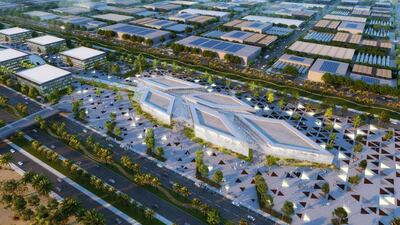
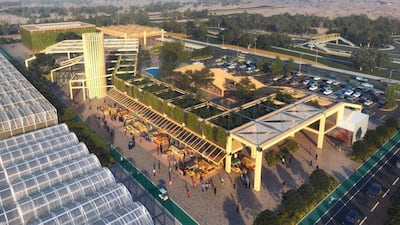
Agriculture was identified as a key sector for eco-friendly growth, in particular in the UAE, where the country recently launched the first phase of Food Tech Valley, which aims to triple food production.
The Emirates has also invested heavily in solar energy, and more recently in green and blue hydrogen production, which are considered more sustainable than fossil fuels.
Ms AlHashimi said: "If I can give you one proof point – we have broken the world record for solar multiple times, and it's actually now the cheapest daytime power source in the Middle East, which enables industries and businesses to enjoy lower input costs and a smaller environmental footprint.
"This is really significant. Investment in solar power strengthened our economy and paved the way to a greener future.
"Now, the UAE is well positioned to take advantage of the new wave of green investment opportunities."
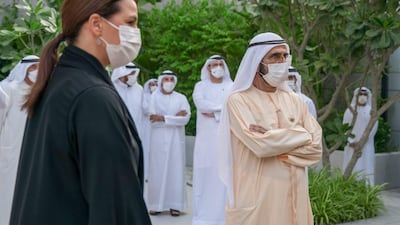
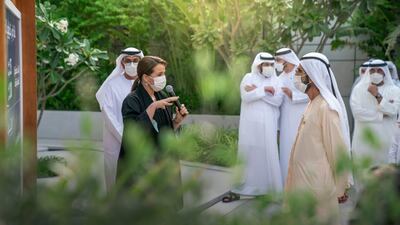
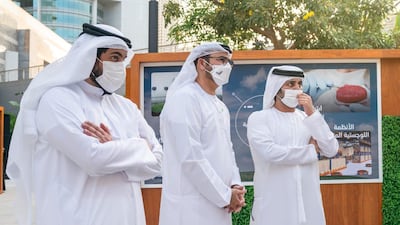
In pictures: Sheikh Mohammed launches Dubai Food Tech Valley
Real estate tokenisation project
Dubai launched the pilot phase of its real estate tokenisation project last month.
The initiative focuses on converting real estate assets into digital tokens recorded on blockchain technology and helps in streamlining the process of buying, selling and investing, the Dubai Land Department said.
Dubai’s real estate tokenisation market is projected to reach Dh60 billion ($16.33 billion) by 2033, representing 7 per cent of the emirate’s total property transactions, according to the DLD.
More on animal trafficking
Mobile phone packages comparison
The%20Witcher%20-%20season%20three
%3Cp%3E%3Cstrong%3EDirector%3A%20%3C%2Fstrong%3EVarious%0D%3Cbr%3E%3Cstrong%3E%0D%3Cbr%3EStars%3A%20%3C%2Fstrong%3EHenry%20Cavill%2C%20Freya%20Allan%2C%20Anya%20Chalotra%3Cstrong%3E%0D%3Cbr%3E%0D%3Cbr%3ERating%3A%3C%2Fstrong%3E%203%2F5%3C%2Fp%3E%0A
The%20specs
%3Cp%3E%3Cstrong%3EEngine%3A%20%3C%2Fstrong%3E2.3-litre%204cyl%20turbo%0D%3Cbr%3E%3Cstrong%3EPower%3A%20%3C%2Fstrong%3E299hp%20at%205%2C500rpm%0D%3Cbr%3E%3Cstrong%3ETorque%3A%20%3C%2Fstrong%3E420Nm%20at%202%2C750rpm%0D%3Cbr%3E%3Cstrong%3ETransmission%3A%20%3C%2Fstrong%3E10-speed%20auto%0D%3Cbr%3E%3Cstrong%3EFuel%20consumption%3A%20%3C%2Fstrong%3E12.4L%2F100km%0D%3Cbr%3E%3Cstrong%3EOn%20sale%3A%20%3C%2Fstrong%3ENow%0D%3Cbr%3E%3Cstrong%3EPrice%3A%20%3C%2Fstrong%3EFrom%20Dh157%2C395%20(XLS)%3B%20Dh199%2C395%20(Limited)%3C%2Fp%3E%0A
Mercer, the investment consulting arm of US services company Marsh & McLennan, expects its wealth division to at least double its assets under management (AUM) in the Middle East as wealth in the region continues to grow despite economic headwinds, a company official said.
Mercer Wealth, which globally has $160 billion in AUM, plans to boost its AUM in the region to $2-$3bn in the next 2-3 years from the present $1bn, said Yasir AbuShaban, a Dubai-based principal with Mercer Wealth.
“Within the next two to three years, we are looking at reaching $2 to $3 billion as a conservative estimate and we do see an opportunity to do so,” said Mr AbuShaban.
Mercer does not directly make investments, but allocates clients’ money they have discretion to, to professional asset managers. They also provide advice to clients.
“We have buying power. We can negotiate on their (client’s) behalf with asset managers to provide them lower fees than they otherwise would have to get on their own,” he added.
Mercer Wealth’s clients include sovereign wealth funds, family offices, and insurance companies among others.
From its office in Dubai, Mercer also looks after Africa, India and Turkey, where they also see opportunity for growth.
Wealth creation in Middle East and Africa (MEA) grew 8.5 per cent to $8.1 trillion last year from $7.5tn in 2015, higher than last year’s global average of 6 per cent and the second-highest growth in a region after Asia-Pacific which grew 9.9 per cent, according to consultancy Boston Consulting Group (BCG). In the region, where wealth grew just 1.9 per cent in 2015 compared with 2014, a pickup in oil prices has helped in wealth generation.
BCG is forecasting MEA wealth will rise to $12tn by 2021, growing at an annual average of 8 per cent.
Drivers of wealth generation in the region will be split evenly between new wealth creation and growth of performance of existing assets, according to BCG.
Another general trend in the region is clients’ looking for a comprehensive approach to investing, according to Mr AbuShaban.
“Institutional investors or some of the families are seeing a slowdown in the available capital they have to invest and in that sense they are looking at optimizing the way they manage their portfolios and making sure they are not investing haphazardly and different parts of their investment are working together,” said Mr AbuShaban.
Some clients also have a higher appetite for risk, given the low interest-rate environment that does not provide enough yield for some institutional investors. These clients are keen to invest in illiquid assets, such as private equity and infrastructure.
“What we have seen is a desire for higher returns in what has been a low-return environment specifically in various fixed income or bonds,” he said.
“In this environment, we have seen a de facto increase in the risk that clients are taking in things like illiquid investments, private equity investments, infrastructure and private debt, those kind of investments were higher illiquidity results in incrementally higher returns.”
The Abu Dhabi Investment Authority, one of the largest sovereign wealth funds, said in its 2016 report that has gradually increased its exposure in direct private equity and private credit transactions, mainly in Asian markets and especially in China and India. The authority’s private equity department focused on structured equities owing to “their defensive characteristics.”
More on Quran memorisation:
Quick pearls of wisdom
Focus on gratitude: And do so deeply, he says. “Think of one to three things a day that you’re grateful for. It needs to be specific, too, don’t just say ‘air.’ Really think about it. If you’re grateful for, say, what your parents have done for you, that will motivate you to do more for the world.”
Know how to fight: Shetty married his wife, Radhi, three years ago (he met her in a meditation class before he went off and became a monk). He says they’ve had to learn to respect each other’s “fighting styles” – he’s a talk it-out-immediately person, while she needs space to think. “When you’re having an argument, remember, it’s not you against each other. It’s both of you against the problem. When you win, they lose. If you’re on a team you have to win together.”
Babumoshai Bandookbaaz
Director: Kushan Nandy
Starring: Nawazuddin Siddiqui, Bidita Bag, Jatin Goswami
Three stars
Specs
%3Cp%3E%3Cstrong%3EEngine%3A%3C%2Fstrong%3E%201.5-litre%20turbo%204-cylinder%20%2F%202.0%20turbo%204-cylinder%20(S3)%0D%3Cbr%3E%3Cstrong%3EPower%3A%3C%2Fstrong%3E%20148bhp%20%2F%20328bhp%20(S3)%0D%3Cbr%3E%3Cstrong%3ETorque%3A%3C%2Fstrong%3E%20250Nm%20%2F%20420Nm%20(S3)%0D%3Cbr%3E%3Cstrong%3EOn%20sale%3A%3C%2Fstrong%3E%20December%0D%3Cbr%3E%3Cstrong%3EPrice%3A%3C%2Fstrong%3E%20TBA%0D%3C%2Fp%3E%0A
What are the influencer academy modules?
- Mastery of audio-visual content creation.
- Cinematography, shots and movement.
- All aspects of post-production.
- Emerging technologies and VFX with AI and CGI.
- Understanding of marketing objectives and audience engagement.
- Tourism industry knowledge.
- Professional ethics.