Sheikh Mohamed bin Zayed and Russian President Vladimir Putin assessed the fight against the Covid-19 pandemic during a phone call.
The Crown Prince of Abu Dhabi and Deputy Supreme Commander of the Armed Forces and Mr Putin also discussed ways to further bolster ties between the UAE and Russia.
The leaders discussed several issues of common interest, particularly the ongoing fight against Covid-19.
"During a phone call with Russian President Vladimir Putin, we discussed strengthening our strategic partnership and our countries' bilateral co-operation on several issues of common interest, especially the efforts to combat the Covid-19 pandemic and its repercussions," Sheikh Mohamed said in a tweet on Monday.
The Russian leader hailed the UAE as a very "close and promising partner" before embarking on a landmark tour of the Emirates last October.
It was his first visit to the UAE in 12 years.
Sheikh Mohamed previously met Mr Putin during visits to Russia in 2017 and 2018.
During Mr Putin's visit, UAE and Russian officials agreed on a host of deals across energy, nuclear power, aviation and the environment.
The two nations have worked closely together in the space sector in recent times.
UAE astronaut Hazza Al Mansouri flew to the International Space Station last September on board a Russian-made Soyuz rocket, etching his name in history as the first Emirati to travel to space.
Vladimir Putin visits the UAE:
-

Sheikh Mohamed bin Zayed bids farewell to Mr. Putin at the Presidential Airport. Rashed Al Mansoori / Ministry of Presidential Affairs -

A cubic artwork showcasing Sheikh Mohamed bin Zayed and Mr. Putin is displayed at the Presidential Airport. Rashed Al Mansoori / Ministry of Presidential Affairs -

Sheikh Mohamed bin Zayed receives a gyrfalcon as a gift from Mr Putin. Mohamed Al Hammadi / Ministry of Presidential Affairs -

Sheikh Mohamed bin Zayed and Mr Putin exchange gifts during a state visit at Qasr Al Watan. Mohamed Al Hammadi / Ministry of Presidential Affairs -
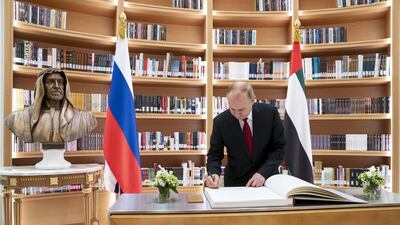
Mr Putin signs the guest book. Mohamed Al Hammadi / Ministry of Presidential Affairs -
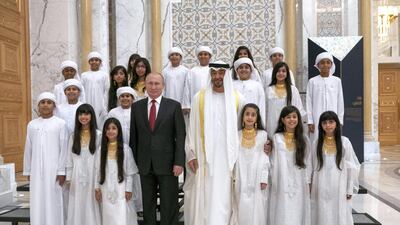
Sheikh Mohamed bin Zayed and Mr Putin stand for a photograph with musicians during a state visit reception at Qasr Al Watan. Hamad Al Kaabi / Ministry of Presidential Affairs -

UAE Astronaut Sultan Al Neyadi presents a gift commemorating the UAE Space mission to Mr Putin. Mohamed Al Hammadi / Ministry of Presidential Affairs -
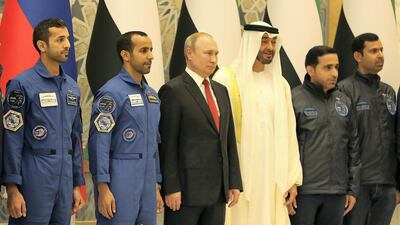
Mr Putin and the Crown Prince meet Emirati astronauts Hazza Al Mansouri and Sultan Al Neyadi. Pawan Singh / The National -
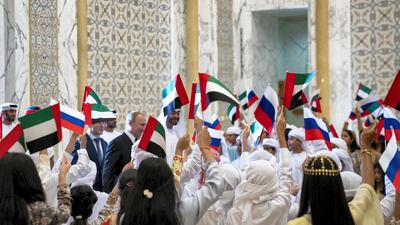
Mohamed bin Zayed receives Russian President Vladimir Putin at Qasr Al Watan, commencing a state visit to the UAE. Courtesy: Ministry of Presidential Affairs -
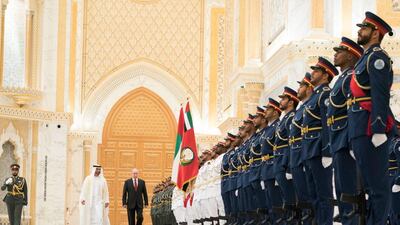
Sheikh Mohamed and Mr Putin observe an honour guard at Qasr Al Watan. Courtesy: Ministry of Presidential Affairs -
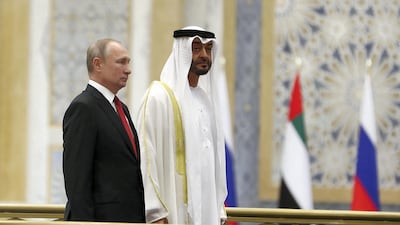
Sheikh Mohamed welcomed Mr Putin at the airport and drove with him through the city to Qasr Al Watan. Pawan Singh / The National -
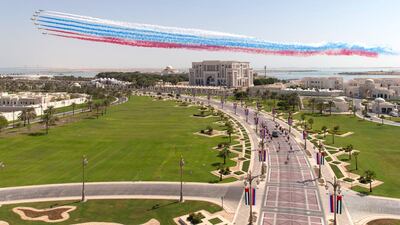
Al Fursan acrobatics squadron flies over Qasr Al Watan, Abu Dhabi's presidential palace. Courtesy: Ministry of Presidential Affairs -
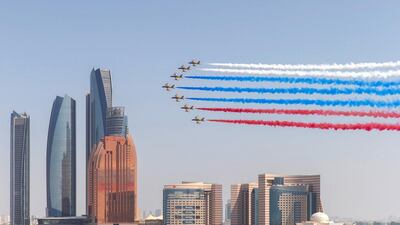
The seven jets marking the seven emirates soar over the Corniche. Courtesy: Ministry of Presidential Affairs -
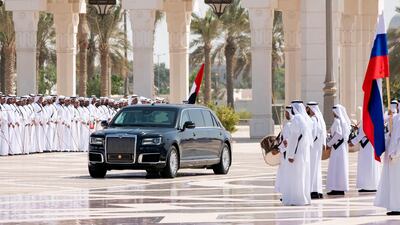
Mr Putin's limousine arrives at Qasr Al Watan. Courtesy: Ministry of Presidential Affairs -
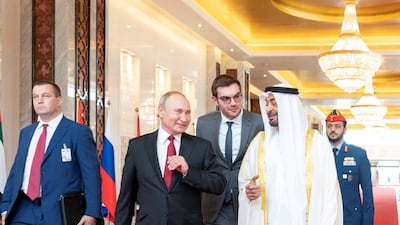
Mr Putin and Sheikh Mohamed bin Zayed are signing a series of dealt to benefit both nations on Tuesday. Courtesy: Ministry of Presidential Affairs -

Members of the honour guard mark inside the palace. Pawan Singh / The National -

Mr. Putin and Sheikh Mohamed bin Zayed attend the official welcome ceremony in Abu Dhabi. Reuters -
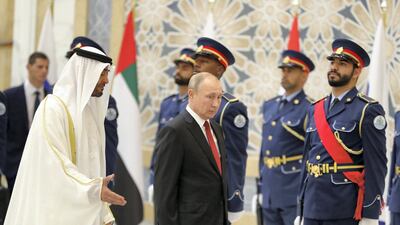
The Russian president and the Abu Dhabi Crown Prince inspect a guard of honour. Pawan Singh / The National -
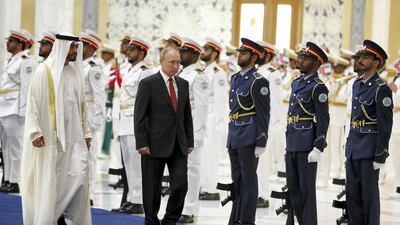
The Russian President and the Abu Dhabi Crown Prince inspect a guard of honour. Pawan Singh / The National -

Sheikh Mohamed bin Zayed and Mr. Putin stand for a photograph during a state visit reception at Qasr Al Watan. Rashed Al Mansoori / Ministry of Presidential Affairs -

The honour guard stands to attention at the palace. Pawan Singh / The National -
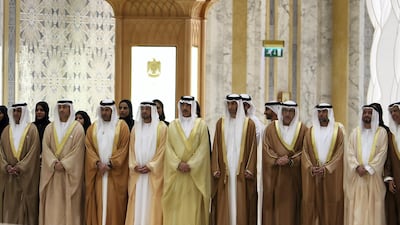
Senior Emirati dignitaries await the arrival of Mr Putin. Pawan Singh / The National -
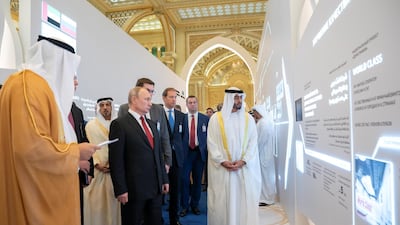
Sheikh Mohamed and Mr. Putin view a UAE-Russia investment exhibition presented by Mubadala at Qasr Al Watan. Seen with Sheikh Mansour bin Zayed, UAE Deputy Prime Minister and Minister of Presidential Affairs, left. Hamad Al Kaabi / Ministry of Presidential Affairs
More on animal trafficking
While you're here
SPEC%20SHEET
RESULTS
5pm Maiden (PA) Dh80,000 (Turf) 1,600m
Winner Thabet Al Reef, Bernardo Pinheiro (jockey), Abdallah Al Hammadi (trainer)
5.30pm Handicap (PA) Dh80,000 (T) 1,600m
Winner Blue Diamond, Pat Cosgrave, Abdallah Al Hammadi
6pm Arabian Triple Crown Round-1 Listed (PA) Dh230,000 (T) 1,600m
Winner Hameem, Adrie de Vries, Abdallah Al Hammadi
6.30pm Wathba Stallions Cup Handicap (PA) Dh70,000 (T) 1,400m
Winner Shoja’A Muscat, Szczepan Mazur, Ibrahim Al Hadhrami
7pm Maiden (PA) Dh80,000 (T) 1,200m
Winner Heros De Lagarde, Szczepan Mazur, Ibrahim Al Hadhrami
7.30pm Handicap (TB) Dh100,000 (T) 2,400m
Winner Good Tidings, Antonio Fresu, Musabah Al Muhairi
You might also like
How a groundbreaking soil-less farming inititiave is empowering rural communities across Jordan
Essay: Venice's floods should serve as a wake-up call for the world
UAE ready for innovation in area of water management – this is not a pipe dream
Saudi artist Manal AlDowayan unveils new piece of land art addressing water scarcity in Al Ula
Ten tax points to be aware of in 2026
1. Domestic VAT refund amendments: request your refund within five years
If a business does not apply for the refund on time, they lose their credit.
2. E-invoicing in the UAE
Businesses should continue preparing for the implementation of e-invoicing in the UAE, with 2026 a preparation and transition period ahead of phased mandatory adoption.
3. More tax audits
Tax authorities are increasingly using data already available across multiple filings to identify audit risks.
4. More beneficial VAT and excise tax penalty regime
Tax disputes are expected to become more frequent and more structured, with clearer administrative objection and appeal processes. The UAE has adopted a new penalty regime for VAT and excise disputes, which now mirrors the penalty regime for corporate tax.
5. Greater emphasis on statutory audit
There is a greater need for the accuracy of financial statements. The International Financial Reporting Standards standards need to be strictly adhered to and, as a result, the quality of the audits will need to increase.
6. Further transfer pricing enforcement
Transfer pricing enforcement, which refers to the practice of establishing prices for internal transactions between related entities, is expected to broaden in scope. The UAE will shortly open the possibility to negotiate advance pricing agreements, or essentially rulings for transfer pricing purposes.
7. Limited time periods for audits
Recent amendments also introduce a default five-year limitation period for tax audits and assessments, subject to specific statutory exceptions. While the standard audit and assessment period is five years, this may be extended to up to 15 years in cases involving fraud or tax evasion.
8. Pillar 2 implementation
Many multinational groups will begin to feel the practical effect of the Domestic Minimum Top-Up Tax (DMTT), the UAE's implementation of the OECD’s global minimum tax under Pillar 2. While the rules apply for financial years starting on or after January 1, 2025, it is 2026 that marks the transition to an operational phase.
9. Reduced compliance obligations for imported goods and services
Businesses that apply the reverse-charge mechanism for VAT purposes in the UAE may benefit from reduced compliance obligations.
10. Substance and CbC reporting focus
Tax authorities are expected to continue strengthening the enforcement of economic substance and Country-by-Country (CbC) reporting frameworks. In the UAE, these regimes are increasingly being used as risk-assessment tools, providing tax authorities with a comprehensive view of multinational groups’ global footprints and enabling them to assess whether profits are aligned with real economic activity.
Contributed by Thomas Vanhee and Hend Rashwan, Aurifer
WHAT ARE NFTs?
Non-fungible tokens (NFTs) are tokens that represent ownership of unique items. They allow the tokenisation of things such as art, collectibles and even real estate.
An NFT can have only one official owner at one time. And since they're minted and secured on the Ethereum blockchain, no one can modify the record of ownership, not even copy-paste it into a new one.
This means NFTs are not interchangeable and cannot be exchanged with other items. In contrast, fungible items, such as fiat currencies, can be exchanged because their value defines them rather than their unique properties.
Killing of Qassem Suleimani
National Editorial: Suleimani has been killed, now we must de-escalate
Mina Al Oraibi: Air strike casts a long shadow over the decade ahead
Jack Moore: Why the assassination is such a monumental gamble
Matthew Levitt: Iran retains its ability to launch terror attacks
Hussein Ibish: Trump's order on solid constitutional ground
Simon Waldman: Cautious Israel keeping a low profile
While you're here
Con Coughlin: To survive, Nato must renew its sense of common purpose
Gavin Esler: Nato summit failed for making news more than it made deals
Simon Waldman: Nato continues to be Ankara’s best security guarantor
Specs
Mercer, the investment consulting arm of US services company Marsh & McLennan, expects its wealth division to at least double its assets under management (AUM) in the Middle East as wealth in the region continues to grow despite economic headwinds, a company official said.
Mercer Wealth, which globally has $160 billion in AUM, plans to boost its AUM in the region to $2-$3bn in the next 2-3 years from the present $1bn, said Yasir AbuShaban, a Dubai-based principal with Mercer Wealth.
“Within the next two to three years, we are looking at reaching $2 to $3 billion as a conservative estimate and we do see an opportunity to do so,” said Mr AbuShaban.
Mercer does not directly make investments, but allocates clients’ money they have discretion to, to professional asset managers. They also provide advice to clients.
“We have buying power. We can negotiate on their (client’s) behalf with asset managers to provide them lower fees than they otherwise would have to get on their own,” he added.
Mercer Wealth’s clients include sovereign wealth funds, family offices, and insurance companies among others.
From its office in Dubai, Mercer also looks after Africa, India and Turkey, where they also see opportunity for growth.
Wealth creation in Middle East and Africa (MEA) grew 8.5 per cent to $8.1 trillion last year from $7.5tn in 2015, higher than last year’s global average of 6 per cent and the second-highest growth in a region after Asia-Pacific which grew 9.9 per cent, according to consultancy Boston Consulting Group (BCG). In the region, where wealth grew just 1.9 per cent in 2015 compared with 2014, a pickup in oil prices has helped in wealth generation.
BCG is forecasting MEA wealth will rise to $12tn by 2021, growing at an annual average of 8 per cent.
Drivers of wealth generation in the region will be split evenly between new wealth creation and growth of performance of existing assets, according to BCG.
Another general trend in the region is clients’ looking for a comprehensive approach to investing, according to Mr AbuShaban.
“Institutional investors or some of the families are seeing a slowdown in the available capital they have to invest and in that sense they are looking at optimizing the way they manage their portfolios and making sure they are not investing haphazardly and different parts of their investment are working together,” said Mr AbuShaban.
Some clients also have a higher appetite for risk, given the low interest-rate environment that does not provide enough yield for some institutional investors. These clients are keen to invest in illiquid assets, such as private equity and infrastructure.
“What we have seen is a desire for higher returns in what has been a low-return environment specifically in various fixed income or bonds,” he said.
“In this environment, we have seen a de facto increase in the risk that clients are taking in things like illiquid investments, private equity investments, infrastructure and private debt, those kind of investments were higher illiquidity results in incrementally higher returns.”
The Abu Dhabi Investment Authority, one of the largest sovereign wealth funds, said in its 2016 report that has gradually increased its exposure in direct private equity and private credit transactions, mainly in Asian markets and especially in China and India. The authority’s private equity department focused on structured equities owing to “their defensive characteristics.”
What is Genes in Space?
Genes in Space is an annual competition first launched by the UAE Space Agency, The National and Boeing in 2015.
It challenges school pupils to design experiments to be conducted in space and it aims to encourage future talent for the UAE’s fledgling space industry. It is the first of its kind in the UAE and, as well as encouraging talent, it also aims to raise interest and awareness among the general population about space exploration.
GROUP RESULTS
Group A
Results
Ireland beat UAE by 226 runs
West Indies beat Netherlands by 54 runs
Group B
Results
Zimbabwe tied with Scotland
Nepal beat Hong Kong by five wickets
The specs: Volvo XC40
Price: base / as tested: Dh185,000
Engine: 2.0-litre, turbocharged in-line four-cylinder
Gearbox: Eight-speed automatic
Power: 250hp @ 5,500rpm
Torque: 350Nm @ 1,500rpm
Fuel economy, combined: 10.4L / 100km
Super%20Mario%20Bros%20Wonder
Kareem Shaheen on Canada
THE CARD
2pm: Maiden Dh 60,000 (Dirt) 1,400m
2.30pm: Handicap Dh 76,000 (D) 1,400m
3pm: Handicap Dh 64,000 (D) 1,200m
3.30pm: Shadwell Farm Conditions Dh 100,000 (D) 1,000m
4pm: Maiden Dh 60,000 (D) 1,000m
4.30pm: Handicap 64,000 (D) 1,950m
How to apply for a drone permit
- Individuals must register on UAE Drone app or website using their UAE Pass
- Add all their personal details, including name, nationality, passport number, Emiratis ID, email and phone number
- Upload the training certificate from a centre accredited by the GCAA
- Submit their request
What are the regulations?
- Fly it within visual line of sight
- Never over populated areas
- Ensure maximum flying height of 400 feet (122 metres) above ground level is not crossed
- Users must avoid flying over restricted areas listed on the UAE Drone app
- Only fly the drone during the day, and never at night
- Should have a live feed of the drone flight
- Drones must weigh 5 kg or less
World politics
Sholto Byrnes: How liberals in the West forgot what liberalism is
Rashmee Roshan Lall: Donald Trump will disrupt US democracy
Sholto Byrnes: Populists are the product of failed political parties
Ferrari
While you're here
Rashmee Roshan Lall: Climate refugees is not a new term but get used to hearing it more often
Gavin Esler: 'The new normal' must mean more compassion – not complacence
Sholto Byrnes: From the Amazon to South-East Asia, our house is on fire

