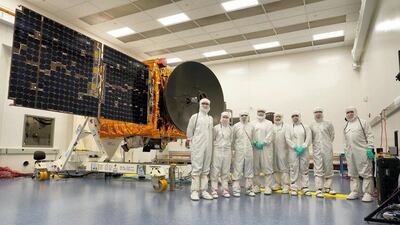
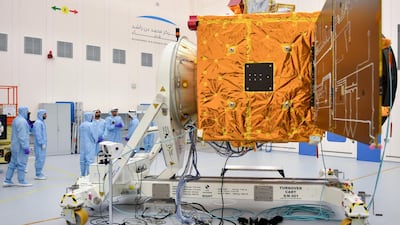
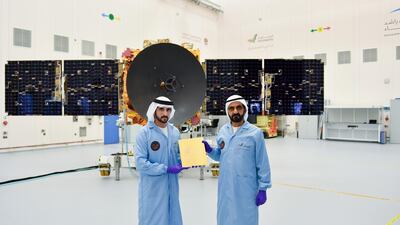
The UAE's flourishing space sector is taking another leap forward as a satellite testing and assembly centre is prepared for launch in Al Ain.
Tawazun Economic Council has joined forces with major airline and aerospace manufacturer Airbus and the National Space Science and Technology Centre (NSSTC), at UAE and University, to drive forward plans to begin operations at the centre early next year.
The project will create 32 jobs, with 22 of the new employees to be Emirati.
Workers will receive training at Airbus facilities in France as well as locally.
The partnership was formed by Tawazun, a body which was was founded in 1992 to help develop a sustainable defence and security industry in the UAE.
"This is our second project after Yahsat, and there are many more projects to come, as Tawazun works to further develop the UAE space sector," said Matar Ali Al Romaithi, chief economic development officer for Tawazun.
"The UAE is building and acquiring the knowledge required to become a regional hub for space activities and advanced research and development.
"This centre is an integral part of those plans and consequently Tawazun has worked to make sure that it operates as a sustainable resource for the next five to seven years with a view to becoming permanent.
"We also value the significant contribution that Airbus is making to the Centre’s sustainability, as well as to the increase and development of our Emirati resource and expertise. NSSTC will accumulate critical knowledge from Airbus through this project, and our national competencies and skills will increase significantly."
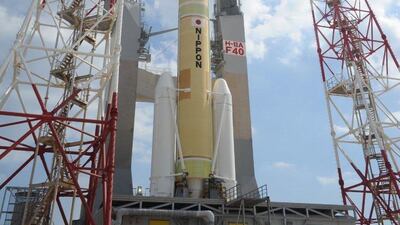
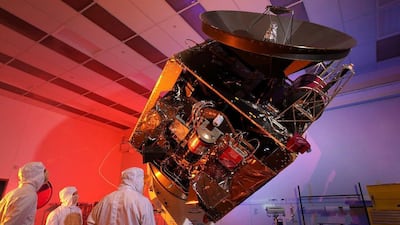
The UAE successfully launched KhalifaSat, the first satellite designed, tested and manufactured entirely by Emirati engineers, from Japan in October, 2018.
This week, the Mohammed Bin Rashid Space Centre released new high-resolution images of Abu Dhabi and Dubai, captured by KhalifaSat.
The UAE's space sector has enjoyed remarkable success in recent years, with the launch of KhalifaSat followed by the country's first astronaut, Hazza Al Mansouri, travelling aboard the International Space Centre last September.
Only last month, the Hope probe began its milestone mission to Mars.
The Satellite Assembly, Integration and Testing Centre will develop and build communication, navigation and hyperspectral satellites ranging in size between 50 and 250 kilogrammes.
It will be based at the NSSTC site in Al Ain, with Airbus supporting the design, outfitting and commissioning of the facility.
Airbus will also manage the procurement, installation and operational qualification required for the equipment.
Airbus has pledged to play a leading role in bolstering the UAE aerospace industry.
"The space industry is an important and strategic sector for the UAE, as it enables the development of high-level skills and drives innovation," said Mikail Houari, president of the Mena region for Airbus.
"Airbus remains committed to supporting the advancement of all key elements of the UAE’s aerospace industry. For many years, we have worked closely in partnership with the nation’s leading industrial entities to help create new technological solutions and provide global expertise and experience to local talent."
The growing UAE space sector has provided 3,000 jobs at 50 space related entities, five space research and development centres and three universities offering space degrees.
"This is in line with the vision of the UAE government, achieving the goals of the national agenda through the implementation of contemporary, sustainable developmental projects," said Saeed Ahmed Ghobash, chancellor of UAE University.
The NSSTC was created by the UAE University alongside the UAE Space Agency.
"UAE University possesses distinctive scientific and technical capabilities that enable it to keep abreast of global trends in applied scientific research, the fourth industrial revolution, the requirements of artificial intelligence, and space science and technology. The university’s work contributes to the development of a knowledge and digital based economy."
The UAE Space Agency is funding the first two projects that will be completed under the management and operation of NSSTC.
The first will be a satellite that will augment navigational capabilities for the UAE and the second will be the Arab 813 Satellite.
Both projects are currently underway with the support of Airbus and will be completed at the new facilities.
Manikarnika: The Queen of Jhansi
Director: Kangana Ranaut, Krish Jagarlamudi
Producer: Zee Studios, Kamal Jain
Cast: Kangana Ranaut, Ankita Lokhande, Danny Denzongpa, Atul Kulkarni
Rating: 2.5/5
Our family matters legal consultant
Name: Hassan Mohsen Elhais
Position: legal consultant with Al Rowaad Advocates and Legal Consultants.
The%20Genius%20of%20Their%20Age
%3Cp%3EAuthor%3A%20S%20Frederick%20Starr%3Cbr%3EPublisher%3A%20Oxford%20University%20Press%3Cbr%3EPages%3A%20290%3Cbr%3EAvailable%3A%20January%2024%3C%2Fp%3E%0A
Things Heard & Seen
Directed by: Shari Springer Berman, Robert Pulcini
Starring: Amanda Seyfried, James Norton
2/5
Match info
Premier League
Manchester United 2 (Martial 30', Lingard 69')
Arsenal 2 (Mustafi 26', Rojo 68' OG)
The Year Earth Changed
Directed by:Tom Beard
Narrated by: Sir David Attenborough
Stars: 4
Our legal consultant
Name: Dr Hassan Mohsen Elhais
Position: legal consultant with Al Rowaad Advocates and Legal Consultants.
Company profile
Date started: Founded in May 2017 and operational since April 2018
Founders: co-founder and chief executive, Doaa Aref; Dr Rasha Rady, co-founder and chief operating officer.
Based: Cairo, Egypt
Sector: Health-tech
Size: 22 employees
Funding: Seed funding
Investors: Flat6labs, 500 Falcons, three angel investors
The 12 Syrian entities delisted by UK
Ministry of Interior
Ministry of Defence
General Intelligence Directorate
Air Force Intelligence Agency
Political Security Directorate
Syrian National Security Bureau
Military Intelligence Directorate
Army Supply Bureau
General Organisation of Radio and TV
Al Watan newspaper
Cham Press TV
Sama TV
AI traffic lights to ease congestion at seven points to Sheikh Zayed bin Sultan Street
The seven points are:
Shakhbout bin Sultan Street
Dhafeer Street
Hadbat Al Ghubainah Street (outbound)
Salama bint Butti Street
Al Dhafra Street
Rabdan Street
Umm Yifina Street exit (inbound)
Who has lived at The Bishops Avenue?
- George Sainsbury of the supermarket dynasty, sugar magnate William Park Lyle and actress Dame Gracie Fields were residents in the 1930s when the street was only known as ‘Millionaires’ Row’.
- Then came the international super rich, including the last king of Greece, Constantine II, the Sultan of Brunei and Indian steel magnate Lakshmi Mittal who was at one point ranked the third richest person in the world.
- Turkish tycoon Halis Torprak sold his mansion for £50m in 2008 after spending just two days there. The House of Saud sold 10 properties on the road in 2013 for almost £80m.
- Other residents have included Iraqi businessman Nemir Kirdar, singer Ariana Grande, holiday camp impresario Sir Billy Butlin, businessman Asil Nadir, Paul McCartney’s former wife Heather Mills.
Hunting park to luxury living
- Land was originally the Bishop of London's hunting park, hence the name
- The road was laid out in the mid 19th Century, meandering through woodland and farmland
- Its earliest houses at the turn of the 20th Century were substantial detached properties with extensive grounds
What is the definition of an SME?
SMEs in the UAE are defined by the number of employees, annual turnover and sector. For example, a “small company” in the services industry has six to 50 employees with a turnover of more than Dh2 million up to Dh20m, while in the manufacturing industry the requirements are 10 to 100 employees with a turnover of more than Dh3m up to Dh50m, according to Dubai SME, an agency of the Department of Economic Development.
A “medium-sized company” can either have staff of 51 to 200 employees or 101 to 250 employees, and a turnover less than or equal to Dh200m or Dh250m, again depending on whether the business is in the trading, manufacturing or services sectors.
UAE currency: the story behind the money in your pockets
info-box
COMPANY PROFILE
Company name: Happy Tenant
Started: January 2019
Co-founders: Joe Moufarrej and Umar Rana
Based: Dubai
Sector: Technology, real-estate
Initial investment: Dh2.5 million
Investors: Self-funded
Total customers: 4,000
Mercer, the investment consulting arm of US services company Marsh & McLennan, expects its wealth division to at least double its assets under management (AUM) in the Middle East as wealth in the region continues to grow despite economic headwinds, a company official said.
Mercer Wealth, which globally has $160 billion in AUM, plans to boost its AUM in the region to $2-$3bn in the next 2-3 years from the present $1bn, said Yasir AbuShaban, a Dubai-based principal with Mercer Wealth.
“Within the next two to three years, we are looking at reaching $2 to $3 billion as a conservative estimate and we do see an opportunity to do so,” said Mr AbuShaban.
Mercer does not directly make investments, but allocates clients’ money they have discretion to, to professional asset managers. They also provide advice to clients.
“We have buying power. We can negotiate on their (client’s) behalf with asset managers to provide them lower fees than they otherwise would have to get on their own,” he added.
Mercer Wealth’s clients include sovereign wealth funds, family offices, and insurance companies among others.
From its office in Dubai, Mercer also looks after Africa, India and Turkey, where they also see opportunity for growth.
Wealth creation in Middle East and Africa (MEA) grew 8.5 per cent to $8.1 trillion last year from $7.5tn in 2015, higher than last year’s global average of 6 per cent and the second-highest growth in a region after Asia-Pacific which grew 9.9 per cent, according to consultancy Boston Consulting Group (BCG). In the region, where wealth grew just 1.9 per cent in 2015 compared with 2014, a pickup in oil prices has helped in wealth generation.
BCG is forecasting MEA wealth will rise to $12tn by 2021, growing at an annual average of 8 per cent.
Drivers of wealth generation in the region will be split evenly between new wealth creation and growth of performance of existing assets, according to BCG.
Another general trend in the region is clients’ looking for a comprehensive approach to investing, according to Mr AbuShaban.
“Institutional investors or some of the families are seeing a slowdown in the available capital they have to invest and in that sense they are looking at optimizing the way they manage their portfolios and making sure they are not investing haphazardly and different parts of their investment are working together,” said Mr AbuShaban.
Some clients also have a higher appetite for risk, given the low interest-rate environment that does not provide enough yield for some institutional investors. These clients are keen to invest in illiquid assets, such as private equity and infrastructure.
“What we have seen is a desire for higher returns in what has been a low-return environment specifically in various fixed income or bonds,” he said.
“In this environment, we have seen a de facto increase in the risk that clients are taking in things like illiquid investments, private equity investments, infrastructure and private debt, those kind of investments were higher illiquidity results in incrementally higher returns.”
The Abu Dhabi Investment Authority, one of the largest sovereign wealth funds, said in its 2016 report that has gradually increased its exposure in direct private equity and private credit transactions, mainly in Asian markets and especially in China and India. The authority’s private equity department focused on structured equities owing to “their defensive characteristics.”
Our family matters legal consultant
Name: Hassan Mohsen Elhais
Position: legal consultant with Al Rowaad Advocates and Legal Consultants.
Dubai Bling season three
Cast: Loujain Adada, Zeina Khoury, Farhana Bodi, Ebraheem Al Samadi, Mona Kattan, and couples Safa & Fahad Siddiqui and DJ Bliss & Danya Mohammed
Rating: 1/5
Ireland v Denmark: The last two years
Denmark 1-1 Ireland
7/06/19, Euro 2020 qualifier
Denmark 0-0 Ireland
19/11/2018, Nations League
Ireland 0-0 Denmark
13/10/2018, Nations League
Ireland 1 Denmark 5
14/11/2017, World Cup qualifier
Denmark 0-0 Ireland
11/11/2017, World Cup qualifier
Living in...
This article is part of a guide on where to live in the UAE. Our reporters will profile some of the country’s most desirable districts, provide an estimate of rental prices and introduce you to some of the residents who call each area home.
Ten tax points to be aware of in 2026
1. Domestic VAT refund amendments: request your refund within five years
If a business does not apply for the refund on time, they lose their credit.
2. E-invoicing in the UAE
Businesses should continue preparing for the implementation of e-invoicing in the UAE, with 2026 a preparation and transition period ahead of phased mandatory adoption.
3. More tax audits
Tax authorities are increasingly using data already available across multiple filings to identify audit risks.
4. More beneficial VAT and excise tax penalty regime
Tax disputes are expected to become more frequent and more structured, with clearer administrative objection and appeal processes. The UAE has adopted a new penalty regime for VAT and excise disputes, which now mirrors the penalty regime for corporate tax.
5. Greater emphasis on statutory audit
There is a greater need for the accuracy of financial statements. The International Financial Reporting Standards standards need to be strictly adhered to and, as a result, the quality of the audits will need to increase.
6. Further transfer pricing enforcement
Transfer pricing enforcement, which refers to the practice of establishing prices for internal transactions between related entities, is expected to broaden in scope. The UAE will shortly open the possibility to negotiate advance pricing agreements, or essentially rulings for transfer pricing purposes.
7. Limited time periods for audits
Recent amendments also introduce a default five-year limitation period for tax audits and assessments, subject to specific statutory exceptions. While the standard audit and assessment period is five years, this may be extended to up to 15 years in cases involving fraud or tax evasion.
8. Pillar 2 implementation
Many multinational groups will begin to feel the practical effect of the Domestic Minimum Top-Up Tax (DMTT), the UAE's implementation of the OECD’s global minimum tax under Pillar 2. While the rules apply for financial years starting on or after January 1, 2025, it is 2026 that marks the transition to an operational phase.
9. Reduced compliance obligations for imported goods and services
Businesses that apply the reverse-charge mechanism for VAT purposes in the UAE may benefit from reduced compliance obligations.
10. Substance and CbC reporting focus
Tax authorities are expected to continue strengthening the enforcement of economic substance and Country-by-Country (CbC) reporting frameworks. In the UAE, these regimes are increasingly being used as risk-assessment tools, providing tax authorities with a comprehensive view of multinational groups’ global footprints and enabling them to assess whether profits are aligned with real economic activity.
Contributed by Thomas Vanhee and Hend Rashwan, Aurifer