
Being pregnant can be stressful at the best of times, not least in the middle of a pandemic.
Doctors have told women expecting a baby to stay inside as much as they can, and avoid meeting anyone outside their home where at all possible.
But one study carried out at Columbia University Irving Medical Centre and NewYork-Presbyterian Hospital during the height of the outbreak in the US found that most pregnant women who tested positive for Covid-19 showed no symptoms at all.
So does the virus really pose a risk to expectant mums?
The National explains the latest research into the topic.
How much is known about pregnancy and Covid-19?
There have been a few studies, but the picture is still not entirely clear because the virus is so new, having only emerged in late 2019.
“What the research is showing is that pregnant women are not at any increased risk compared to other members of the population,” said Dr Kiran Mehndiratta, specialist obstetrician and gynaecologist at NMC Speciality Hospital Abu Dhabi.
That said, she added it was important to know the immunity of pregnant women is reduced to ensure the baby is not rejected by the mother, as half of its genes come from the father.
That means anyone with complications in pregnancy, such as diabetes or hypertension, which are known to be risk factors for severe Covid-19, could be at higher risk, too.
What do the studies say?
The study by Columbia University Irving Medical Centre and NewYork-Presbyterian Hospital found that of the 215 pregnant women tested over a two-week period, 33 tested positive.
However, just four had a fever or other symptoms. The vast majority, 29 of them, were completely asymptomatic.
Most of the “very small number” of pregnant women who have tested positive at NMC Speciality Hospital where Dr Mehndiratta works were also asymptomatic.
“Only a few of them gradually developed a cough,” she said.
This backs theories which suggests pregnant women are no more vulnerable than others to the effects of Covid-19.
Are there no known risks to pregnant women?
One recent study, published in the American Journal of Clinical Pathology, showed the virus can affect the placenta, which provides the baby with all of its oxygen and nutrients in the womb.
Researchers studied the placentas of 16 pregnant women who delivered at Northwestern Medicine Prentice Women's Hospital in Chicago who were Covid-19 positive. Damage was evident in all of them.
One of the pregnancies ended in miscarriage.
"That patient was asymptomatic, so we don't know whether the virus caused the miscarriage or it was unrelated," said senior author Dr Jeffrey Goldstein, assistant professor of pathology at Northwestern University Feinberg School of Medicine.
The rest of the babies were born healthy.
But 12 women had placentas that exhibited vascular malperfusion, which can limit blood flow between the mom and the foetus.
-

Municipal workers disinfect the historic Grand Bazaar in Istanbul, Turkey. AFP -
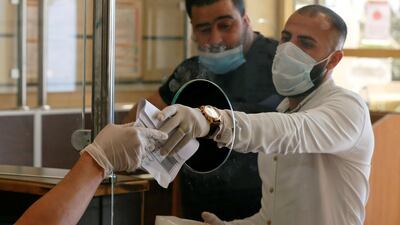
People complete their transactions in the civil status department after Jordan's public sector employees returned gradually to work in Amman. Reuters -

Iraqi security forces deployed during the Eid Al Fitr holidays in Baghdad. AP Photo -

A woman uses a phone to film a man playing with a girl by a statue of a lion in the centre of the West Bank city of Ramallah, after the Palestinian Authority announced an end to its two-month coronavirus lockdown. AFP -

Employees from Fatih municipality disinfect the courtyard of the Suleymaniye Mosque on the last day of Eid Al Fitr in Istanbul, Turkey. Getty Images -

A dragon sculpture decorates an empty fish sandwich boat with the Galata Tower in the background in Istanbul, Turkey. AFP -

A Palestinian local zoo worker washes an ostrich with a hose at the premises in Rafah in the southern Gaza Strip. AFP -
A Palestinian local zoo worker handles Macaws at the premises in Rafah in the southern Gaza Strip. AFP -

A kite is being flown near the Jamal Abdel Nasser Great Mosque in the centre of the occupied West Bank city of Ramallah. AFP -

Iraqi security forces stand guard at a checkpoint in Baghdad. AFP -

Goods await sterilisation at the port of Umm Qasr, Basra, Iraq. AP Photo -
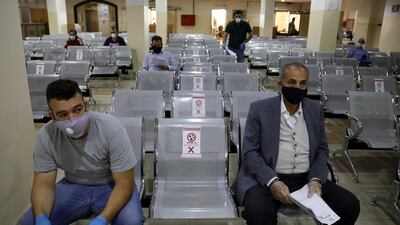
People complete their transactions in the Civil Status Department after Jordan's public sector employees returned gradually to work in Amman. Reuters -

A waiter prepares coffee at a cafe which reopened for take away only in Tunis, Tunisia. EPA -

Royal gendarmes patrol to prevent citizens from visiting the beach in Harhoura, near the capital Rabat, Morocco. EPA -

Health workers record taxi drivers' information prior to collecting swab samples from them in Rabat, Morocco. EPA


Another four had placental blood clots. Blood clots are a known complication of the virus.
“Most of these babies were delivered full-term after otherwise normal pregnancies, so you wouldn’t expect to find anything wrong with the placentas, but this virus appears to be inducing some injury in the placenta,” said Dr Goldstein.
“It doesn’t appear to be inducing negative outcomes in live-born infants, based on our limited data, but it does validate the idea that women with Covid should be monitored more closely.”
Dr Mehndiratta said other studies have shown the virus may result in preterm birth.
“In China, there was a little increase in preterm birth. It’s not clear whether they had to decide to carry out a preterm delivery due to Covid-19, so it’s still not very clear whether it increases preterm birth,” she said.
Can women pass the virus on to their babies in the womb?
No, there is no evidence to suggest a pregnant woman can pass on Covid-19 to her unborn child, according to doctors.
“There is no proof that the virus crosses the placenta,” said Dr Amit Majumdar, associate chief medical officer at King's College Hospital Dubai.
“The baby doesn’t get the virus while it is inside the mother’s tummy.”
Researchers involved in the Northwestern Medicine Prentice Women's Hospital in Chicago also agreed it is unlikely babies can contract the virus in the womb, even if it attacks the placenta.
None of the babies born in the study tested positive.

