
Researchers at Khalifa University are working to develop and produce cheaper ventilators at only 2 per cent of the cost of machines currently in the market.
The university estimates that the cost to produce, receive necessary approvals and distribute the machines will be in the range of $500 (Dh1,836) to $800 (Dh2,938).
In comparison, ventilators usually cost $30,000 (Dh110,191) for a basic model and $50,000 (Dh183,652) for an advanced machine.
The price point at which Khalifa University expects to make ventilators will only be possible if the machines are produced in bulk quantities every month.
Moreover, these machines will offer a temporary solution until the industrial ones can be rolled out at a cheaper price.
These ventilators will have the basic features of the ones used in clinical practice and will need to be routinely regenerated by changing some simple and economical disposable parts.
The experts aim to roll out a prototype in less than two weeks as they simultaneously work on a mass-production unit.
The team at Khalifa University's Healthcare Engineering Innovation Centre are now setting up the production plant to produce ventilators at scale to meet rising local and global demands.
They will use 3D printing easily available materials.
If a patient’s lungs become compromised and they cannot get enough oxygen, a ventilator is used to provide more oxygen to the body, such as in the current coronavirus crisis.
“One of the consequences for the healthcare system is the potential shortage of ventilators,” said Dr Cesare Stefanini, professor of biomedical engineering and director of HEIC.
“The number of intensive care beds and mechanical ventilators in hospitals is a fraction of what may be needed in the coming weeks as the situation develops worldwide.
“Our plan needs to be very aggressive. We aim to develop a working prototype in less than two weeks, alongside designing a mass-production unit. We have all the theoretical and design expertise in our team especially in the prototyping phase.”
The team of engineers and experts at Khalifa University are working to understand the requirements for a production plant in Abu Dhabi.
“Procuring new ventilators at the required scale represents quite the challenge,” said Dr Stefanini.
“This is due not only to the required expenditure, but also due to massive demand on a global scale in a pandemic situation.”
Prof Ashraf Alzaabi, head of the respiratory division at Zayed Military Hospital in Abu Dhabi, has tested the prototype being developed at the university.
"This crisis has highlighted the critical importance of maintaining a high-degree of self-reliance for essential needs," Prof Alzaabi said.
-
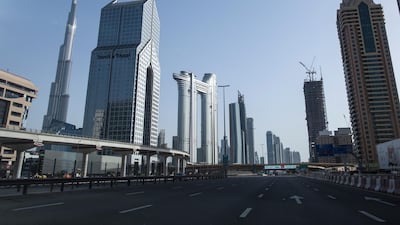
The deserted streets of Dubai with the Burj Khalifa in the background during April. EPA -
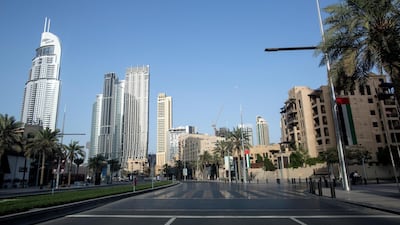
Authorities in Dubai announced intensified restrictions on the movement of people and vehicles during early April. Pictured, Downtown Dubai. EPA -

A road in Dubai is devoid of movement on April 5. AFP -
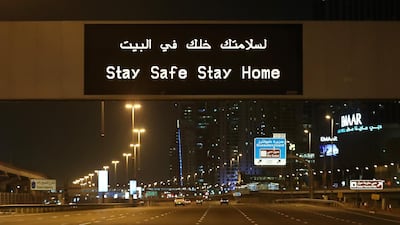
Stay Safe Stay Home message on Sheikh Zayed Road in Dubai. Pawan Singh / The National -

A man wearing a face mask gazes at the Dubai skyline from a window on April 5, 2020. AFP -
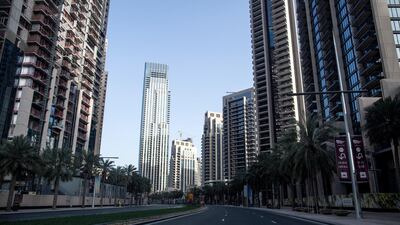
Normally busy roads are left empty in Dubai on April 5. EPA -
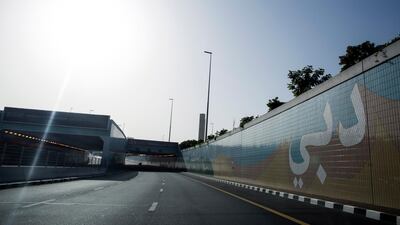
Dubai's streets fall silent. EPA -
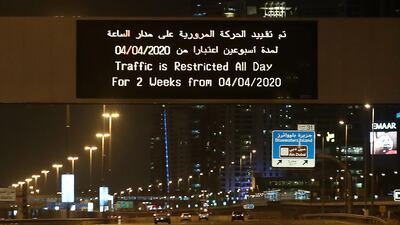
A traffic restriction message on Sheikh Zayed Road in Dubai. Pawan Singh / The National -
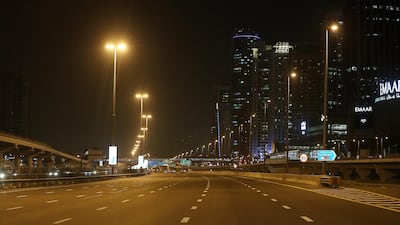
The almost empty Sheikh Zayed Road in Dubai. Pawan Singh / The National -
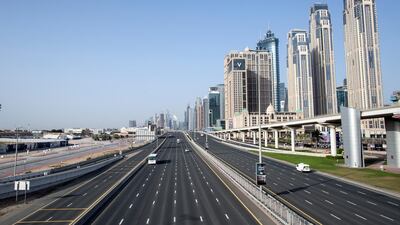
The almost deserted Sheikh Zayed Road in Dubai. EPA -

An empty car park in the Design District after Dubai imposed new restrictions on travel and shopping due to the coronavirus. Chris Whiteoak / The National -
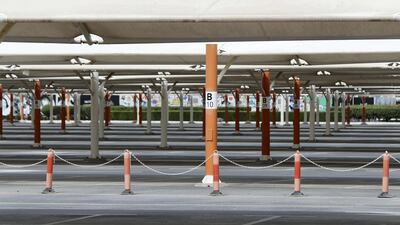
An empty car park in the Design District after Dubai imposed new restrictions on travel and shopping due to the coronavirus. Chris Whiteoak / The National -
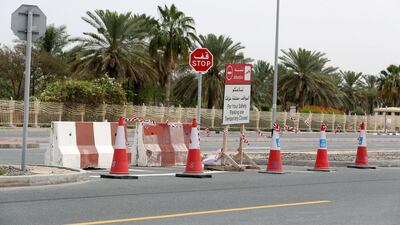
A car park is shut outside Al Barsha Park. Chris Whiteoak / The National -
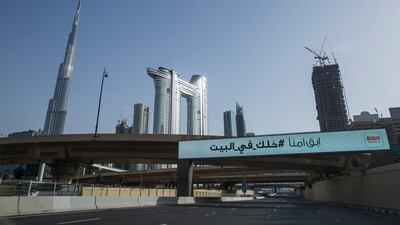
A sign reading in Arabic 'stay at home' is seen on the almost empty streets of Dubai. EPA -
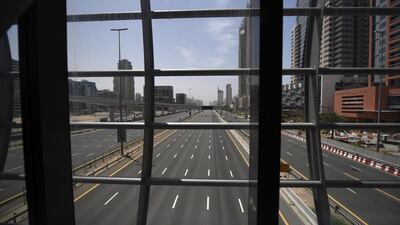
Dubai's Sheikh Zayed Road is deserted. AFP -
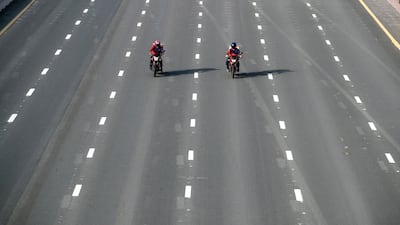
Two people ride motorcycles on the almost empty streets of Dubai. EPA -
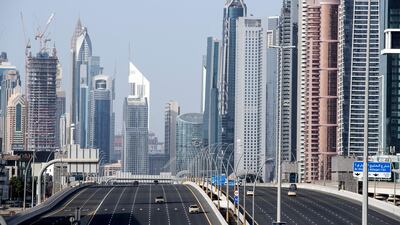
A deserted Sheikh Zayed Road in Dubai. EPA -
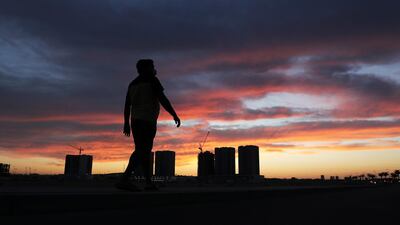
A person wearing protective face mask during the evening in Al Furjan area in Dubai. Pawan Singh / The National -

The Burj Khalifa without any visitors in Downtown Dubai in Dubai. Pawan Singh / The National -
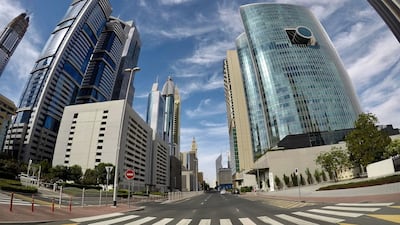
An empty road in DIFC area in Dubai on April 6. Pawan Singh / The National


According to the World Health Organisation, about 80 per cent of coronavirus patients recover without having to be admitted to hospital.
But one person in six becomes seriously ill and may need a ventilator.
A study published by Imperial College London in March predicted that 30 per cent of coronavirus patients who are admitted to hospital will need critical care.

