
Mouthwash compounds from high-street pharmacies may play a key role in slowing the spread of Covid-19, according to new research.
Lab tests by scientists have found that some over-the-counter products can inactivate the coronavirus in only 30 seconds.
Clinical trials are now under way to confirm their effectiveness in protecting people from becoming infected with the virus, which has so far claimed more than 750,000 lives worldwide.
The emergence of mouth-washing as a potential ally against Covid-19 looks set to mark another re-think by scientists on ways of stopping the pandemic.
Gargling with antiseptics was widely touted on social media as an means of combating infection, but the claims were swiftly rebutted by experts, who pointed out that there was no evidence for its effectiveness.
-
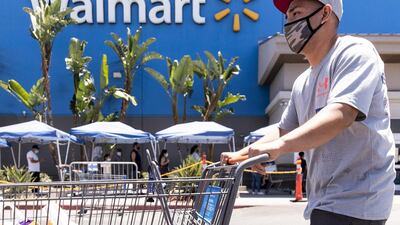
A Walmart shopper wears a mask as protection against the coronavirus as he leaves the supermarket in Burbank, California. The retailer announced it will require customers nationwide to wear face masks inside their stores from July20. EPA -

A woman wearing a face mask walks past graffiti that promotes social distancing amid the ongoing coronavirus pandemic, in Kibera, Nairobi. AFP -
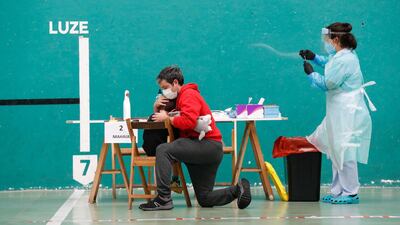
A man comforts his son after taking a coronavirus test in Getaria, Basque Country, Spain. The Basque health department has set up a text campaign in the town to try to control a possible coronavirus outbreak in the area. EPA -

A street musician wears a cloth over his face as protection amid the coronavirus pandemic as he plays his saxophone for tips in La Paz, Bolivia. AP Photo -

Passengers sit, separated from their neighbours by a curtain, on a bus amid the coronavirus pandemic, in Lima, Peru. Reuters -

People wearing face cover cast their vote at a polling station during the general election in Skopje. North Macedonia went to the polls on July 15, 2020 to elect a new parliament. AFP -
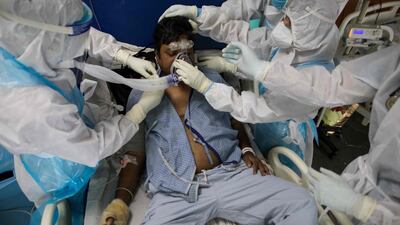
Doctors and nurses wearing personal protective equipment look after a coronavirus patient at the intensive care unit of the Sharda Hospital, in Greater Noida, in northern India. AFP -

Children attend a tele-learning class at their home displayed on Kalvi TV channel, an education tele-learning initiative set up by the department of school education, amid the coronavirus pandemic in India's southern city of Chennai. AFP -
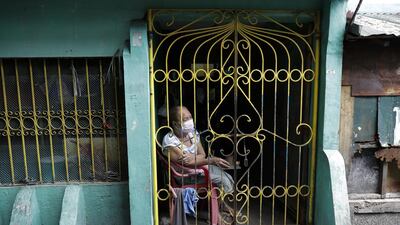
A resident sits inside her home in the city of Navotas, Manila, before a lockdown to contain the coronavirus pandemic in the Philippines got under way. The infections continue to rise in the country after reopening the economy suffering a twin blow of recession and the pandemic. AP Photo -

People spend the afternoon on Playa del Salado beach in Caimito, Artemisa province, Cuba. With government restrictions easing and a heatwave sweeping the island, Cubans are packing the beaches without face masks. The coronavirus infection rates in the country remain low. AP Photo -
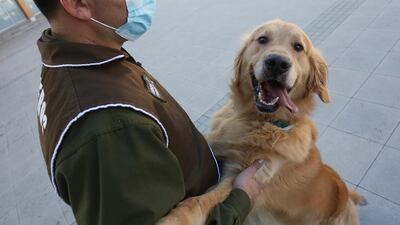
A canine training official shows a dog trained to detect Covid-19, during a demonstration to the press, in Santiago, Chile. EPA


However, as this newspaper pointed out, in Japan official health guidelines have long recommended the practice as a way of warding off respiratory diseases such as influenza. During the mid-2000s, studies by Japanese researchers suggested that even gargling with ordinary chlorinated tap-water may give significant protection.
While Japan has been relatively successful in combating Covid-19, the extent to which the practice of mouth-washing is responsible is unclear.
Even now, five months after the World Health Organisation declared Covid-19 a global pandemic, there has been very little research into whether this simple measure is effective against Sars-CoV-2, the coronavirus that causes Covid-19.
Now researchers from various universities in Germany have carried out the first study of the effectiveness of gargling with widely-available mouthwashes on the virus.
The researchers tested eight commercial products available in pharmacies against virus particles in throat-swabs taken from infected patients. To simulate real-life, the mouthwash was mixed with the virus and a substance to mimic saliva and shaken for 30 seconds.
Tests revealed that all the products reduced the amount of active virus to some extent. However, three proved especially effective, reducing the amount of virus by about 99.9 per cent.
The three are marketed in Germany under the trade names Dequonal, Iso-Betadine and Listerine Cool Mint. Their active compounds are, respectively, dequalinium chloride plus benzalkonium chloride, povidone-iodine, and ethanol plus essential oils.
The tests showed that each of the three was effective even with different strains of the virus.
Publishing their findings in the Journal of Infectious Diseases , the researchers conclude that the findings "provide evidence that Sars-CoV-2 can be efficiently inactivated by commercially available oral rinses within short exposure times of 30 seconds".
As gargling cannot stop the virus once it has invaded healthy cells, it is not a cure for anyone who has already developed Covid-19. However, it could play a role in blocking the main route of transmission. This is believed to be via contact with aerosols and droplets produced during sneezing, coughing or talking.
By attacking the virus in the mouths of both infected people and those around them, use of antiseptic gargling could be a simple and cheap additional safeguard alongside the wearing of masks and other measures such as social distancing.
Such measures are increasingly seen as critical to controlling the pandemic until effective vaccines become widely available. This still believed to be many months away.
The researchers believe their findings justify clinical studies of the effectiveness of mouthwashes on both patients and health-care workers. Such studies are also needed to determine the best method of using the compounds, and any potential side effects.
Research by The National suggests about a dozen studies involving various forms of mouthwashes have now been set up in hospitals in Europe, America and Asia. Results are expected over the coming months.
Robert Matthews is Visiting Professor of Science at Aston University, Birmingham, UK

