The UAE recorded 672 new coronavirus cases on Friday, pushing the country’s total to 50,141.
The new cases were identified after 54,000 further tests were conducted across the country, health officials said.
Officials confirmed another 489 patients had overcome Covid-19, taking the total number of recoveries to 39,153.
The number of recoveries now make up more than 78 per cent of the total number of infections.
The death toll in the Emirates now stands at 318 after one coronavirus patient died.
Earlier in the day, guidelines governing international travel were relaxed for citizens and residents of the UAE.
Places of worship across the country reopened and gyms in Abu Dhabi welcomed back customers this week as part of the gradual easing of safety restrictions.
_______________
-
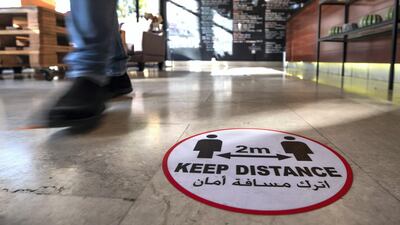
The Third Place Cafe on the Corniche in Abu Dhabi has a sticker to remind customers of Covid-19 precautions. Victor Besa / The National -

An 'X' reminds people of the need for physical distancing at the Third Place Cafe. Victor Besa / The National -

The Third Place Cafe in Abu Dhabi. Victor Besa / The National -
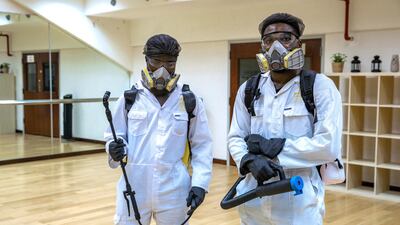
Sanitation workers at Haddins Fitness, Zayed Sports City. Victor Besa / The National -
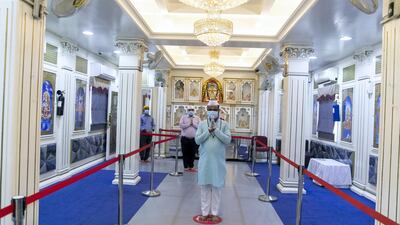
Places of worship, such as Shiva temple in Dubai, have been subject to restrictions during the pandemic. Reem Mohammed / The National -

Fitness buff Natalie Navikova exercises at Cobra Fitness Abu Dhabi at Al Bandar. Victor Besa / The National -

CrossFit class at Vogue Fitness Yas Marina, Abu Dhabi. Victor Besa / The National -

A worshipper at Shiva temple in Dubai follows safety precautions. Reem Mohammed / The National -

The floor of the main prayer hall at the Gurunanak Darbar in Jebel Ali, Dubai, is covered with plastic sheets to help tackle the spread of Covid-19. Pawan Singh / The National -
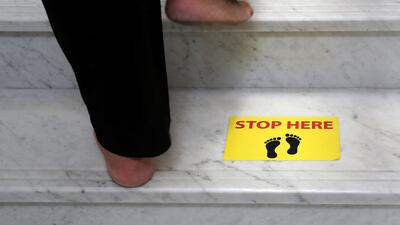
Safe distance marking stickers placed on the floor at Gurunanak Darbar in Jebel Ali, Dubai. Pawan Singh / The National -
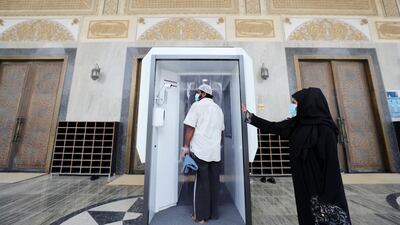
Midday prayers are performed at Al Farooq Omar Bin Al Khattab Mosque in Dubai. Chris Whiteoak / The National -
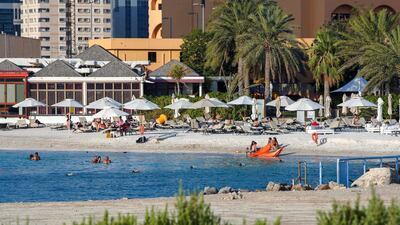
Hotel beaches are now open to guests at the Ramada Abu Dhabi Corniche after Covid-19 restrictions eased. Victor Besa / The National -
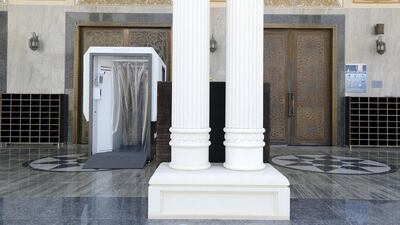
Al Farooq Omar Bin Al Khattab Mosque in Dubai has safety measures in place to help protect worshippers. Chris Whiteoak / The National -
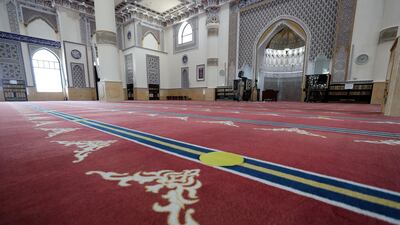
Al Farooq Omar Bin Al Khattab Mosque in Dubai. Chris Whiteoak / The National -
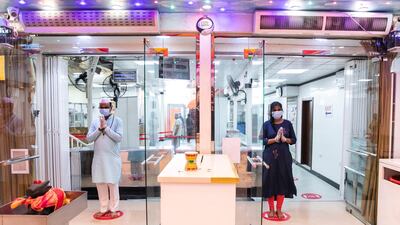
Shiva temple in Dubai put safety measures in place to protect worshippers. Reem Mohammed / The National -
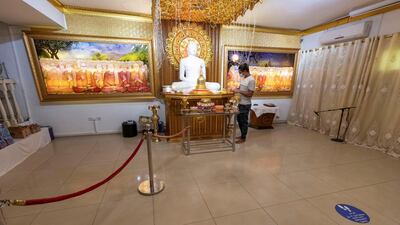
Covid-19 safety measures are put in place at Mahamevnawa Buddhist Temple in Dubai. Chris Whiteoak / The National -

Residents wear face masks as they walk in Abu Dhabi city centre. Victor Besa / The National -
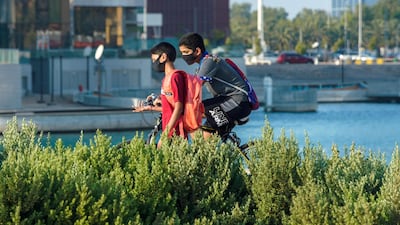
People walk along near the Ramada Hotel Abu Dhabi Corniche during the pandemic. Victor Besa / The National -

A visitor wears a protective face mask at Al Shindagha Museum in Dubai. EPA -
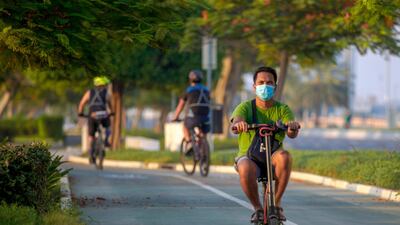
A man on his e-scooter travels along the Corniche in Abu Dhabi as the sun sets. Victor Besa / The National -

People wear face masks in Al Barsha, Dubai. Pawan Singh / The National
The biog
Name: Younis Al Balooshi
Nationality: Emirati
Education: Doctorate degree in forensic medicine at the University of Bonn
Hobbies: Drawing and reading books about graphic design
Ten tax points to be aware of in 2026
1. Domestic VAT refund amendments: request your refund within five years
If a business does not apply for the refund on time, they lose their credit.
2. E-invoicing in the UAE
Businesses should continue preparing for the implementation of e-invoicing in the UAE, with 2026 a preparation and transition period ahead of phased mandatory adoption.
3. More tax audits
Tax authorities are increasingly using data already available across multiple filings to identify audit risks.
4. More beneficial VAT and excise tax penalty regime
Tax disputes are expected to become more frequent and more structured, with clearer administrative objection and appeal processes. The UAE has adopted a new penalty regime for VAT and excise disputes, which now mirrors the penalty regime for corporate tax.
5. Greater emphasis on statutory audit
There is a greater need for the accuracy of financial statements. The International Financial Reporting Standards standards need to be strictly adhered to and, as a result, the quality of the audits will need to increase.
6. Further transfer pricing enforcement
Transfer pricing enforcement, which refers to the practice of establishing prices for internal transactions between related entities, is expected to broaden in scope. The UAE will shortly open the possibility to negotiate advance pricing agreements, or essentially rulings for transfer pricing purposes.
7. Limited time periods for audits
Recent amendments also introduce a default five-year limitation period for tax audits and assessments, subject to specific statutory exceptions. While the standard audit and assessment period is five years, this may be extended to up to 15 years in cases involving fraud or tax evasion.
8. Pillar 2 implementation
Many multinational groups will begin to feel the practical effect of the Domestic Minimum Top-Up Tax (DMTT), the UAE's implementation of the OECD’s global minimum tax under Pillar 2. While the rules apply for financial years starting on or after January 1, 2025, it is 2026 that marks the transition to an operational phase.
9. Reduced compliance obligations for imported goods and services
Businesses that apply the reverse-charge mechanism for VAT purposes in the UAE may benefit from reduced compliance obligations.
10. Substance and CbC reporting focus
Tax authorities are expected to continue strengthening the enforcement of economic substance and Country-by-Country (CbC) reporting frameworks. In the UAE, these regimes are increasingly being used as risk-assessment tools, providing tax authorities with a comprehensive view of multinational groups’ global footprints and enabling them to assess whether profits are aligned with real economic activity.
Contributed by Thomas Vanhee and Hend Rashwan, Aurifer
Zayed Sustainability Prize
SPECS
The specs
Engine: 2.0-litre 4cyl turbo
Power: 261hp at 5,500rpm
Torque: 405Nm at 1,750-3,500rpm
Transmission: 9-speed auto
Fuel consumption: 6.9L/100km
On sale: Now
Price: From Dh117,059
Business Insights
- As per the document, there are six filing options, including choosing to report on a realisation basis and transitional rules for pre-tax period gains or losses.
- SMEs with revenue below Dh3 million per annum can opt for transitional relief until 2026, treating them as having no taxable income.
- Larger entities have specific provisions for asset and liability movements, business restructuring, and handling foreign permanent establishments.
Kibsons%20Cares
Five famous companies founded by teens
There are numerous success stories of teen businesses that were created in college dorm rooms and other modest circumstances. Below are some of the most recognisable names in the industry:
- Facebook: Mark Zuckerberg and his friends started Facebook when he was a 19-year-old Harvard undergraduate.
- Dell: When Michael Dell was an undergraduate student at Texas University in 1984, he started upgrading computers for profit. He starting working full-time on his business when he was 19. Eventually, his company became the Dell Computer Corporation and then Dell Inc.
- Subway: Fred DeLuca opened the first Subway restaurant when he was 17. In 1965, Mr DeLuca needed extra money for college, so he decided to open his own business. Peter Buck, a family friend, lent him $1,000 and together, they opened Pete’s Super Submarines. A few years later, the company was rebranded and called Subway.
- Mashable: In 2005, Pete Cashmore created Mashable in Scotland when he was a teenager. The site was then a technology blog. Over the next few decades, Mr Cashmore has turned Mashable into a global media company.
- Oculus VR: Palmer Luckey founded Oculus VR in June 2012, when he was 19. In August that year, Oculus launched its Kickstarter campaign and raised more than $1 million in three days. Facebook bought Oculus for $2 billion two years later.

