The IBM Simon, released nearly 30 years ago, was the forerunner to today's high-tech phones. PA Images via Reuters

Upwardly mobile: The $100 million 'brick' that changed the way we talk


James Langton
  • English
  • Arabic

Fifty years ago, bemused New Yorkers watched a middle-aged man walking the streets of Manhattan, talking to a large plastic brick about the thickness of a hardback book which he was holding to his right ear.

In fact Martin Cooper had just won the race for the first public phone call on a mobile device.

Now 94, he cannot recall many of the details of that first call, to a competitor’s land line, except to check its clarity.

Most likely it was some version of a phrase all of us have used many times since. “Hello, can you hear me ?”

Mr Cooper, a senior engineer at Motorola at the time, is now widely regarded as the father of mobile phone.

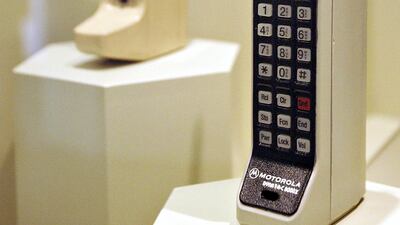
The device Cooper used on April 3, 1973, was a prototype by Motorola, a US company based in Illinois. The DynaTAC 8000X had already cost around $100 million to develop and would not be ready to market for another 10 years.

  • A 1984 Motorola DynaTAC 8000X, the world's first commercially available portable phone, right, and a 1973 DynaTAC prototype, left. Bloomberg
    A 1984 Motorola DynaTAC 8000X, the world's first commercially available portable phone, right, and a 1973 DynaTAC prototype, left. Bloomberg
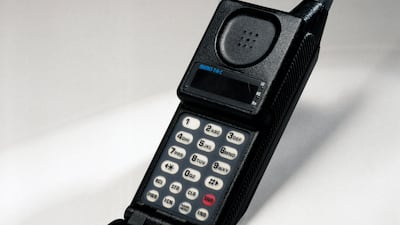
  • A mobile phone with nickel cadmium battery, made by Motorola in 1989. At the time the company was the biggest worldwide supplier of cellular telephones. Getty Images
    A mobile phone with nickel cadmium battery, made by Motorola in 1989. At the time the company was the biggest worldwide supplier of cellular telephones. Getty Images
  • Charlotte Connelly of the Science Museum with an IBM Simon mobile phone, the first smartphone and the forerunner of today's high-tech phones. Reuters
    Charlotte Connelly of the Science Museum with an IBM Simon mobile phone, the first smartphone and the forerunner of today's high-tech phones. Reuters
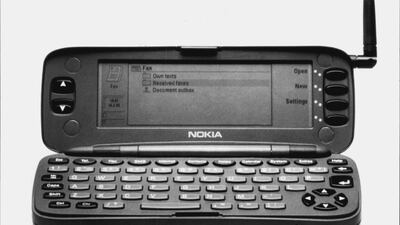
  • The Nokia 9000 Communicator combined digital voice, data services and personal organiser functions in a single unit. Getty Images
    The Nokia 9000 Communicator combined digital voice, data services and personal organiser functions in a single unit. Getty Images
  • Kyocera introduced the Visual Phone VP-210 in 1999, which was able to transmit and receive colour images. Reuters
    Kyocera introduced the Visual Phone VP-210 in 1999, which was able to transmit and receive colour images. Reuters
  • Motorola's new tri-band cellular phone in 1999. The Timeport could be used in Europe, Asia, Africa and the US. Reuters
    Motorola's new tri-band cellular phone in 1999. The Timeport could be used in Europe, Asia, Africa and the US. Reuters
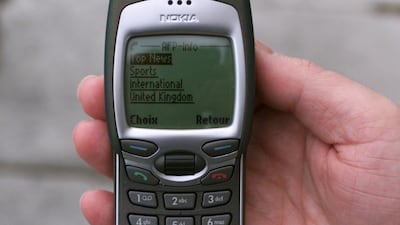
  • Nokia's 7110 in 1999 was able to access the internet. AFP
    Nokia's 7110 in 1999 was able to access the internet. AFP
  • The Nokia 3310 had numerous features and became one of the world's most popular and recognisable mobile phones. Getty Images
    The Nokia 3310 had numerous features and became one of the world's most popular and recognisable mobile phones. Getty Images
  • Apple's Steve Jobs with the new iPhone in January, 2007. The iPod mobile phone had a touch-screen, eight gigabytes of memory and cost $599. Reuters
    Apple's Steve Jobs with the new iPhone in January, 2007. The iPod mobile phone had a touch-screen, eight gigabytes of memory and cost $599. Reuters
  • An HTC Dream phone, which runs Google's Android operating system, at a preview in Singapore in 2009. Reuters
    An HTC Dream phone, which runs Google's Android operating system, at a preview in Singapore in 2009. Reuters
  • A racing game on an Android-based Motorola Atrix smartphone in Las Vegas, January 6, 2011. Reuters
    A racing game on an Android-based Motorola Atrix smartphone in Las Vegas, January 6, 2011. Reuters
  • A 2011 demonstration of Siri, an application that uses voice recognition and detection on the iPhone 4S. Reuters
    A 2011 demonstration of Siri, an application that uses voice recognition and detection on the iPhone 4S. Reuters
  • The new Samsung Galaxy S5 smartphone in 2014 was the first to feature a heart-rate monitor. EPA
    The new Samsung Galaxy S5 smartphone in 2014 was the first to feature a heart-rate monitor. EPA
  • The new iPhone 7 Plus in 2016 had no headphone jack and was the first officially waterproof iPhone. Reuters
    The new iPhone 7 Plus in 2016 had no headphone jack and was the first officially waterproof iPhone. Reuters
  • A woman setting up facial recognition on her Apple iPhone X in New York in 2017. Reuters
    A woman setting up facial recognition on her Apple iPhone X in New York in 2017. Reuters
  • A ZTE Axon M Dual Screens at the Mobile World Congress in Barcelona, Spain, in 2018. Reuters
    A ZTE Axon M Dual Screens at the Mobile World Congress in Barcelona, Spain, in 2018. Reuters
  • A Samsung Galaxy Z Flip foldable smartphone, February 2020. Reuters
    A Samsung Galaxy Z Flip foldable smartphone, February 2020. Reuters

Ring in the changes

Weighing about a kilo, it took ten hours to charge for half an hour’s talk time and could store just 30 numbers. The price, in 1984, was nearly $4,000, the equivalent of $11,500 today, or about Dh42,000.

Most were bought by companies to share among essential staff when they left town on business. Personal ownership of a mobile phone was only for the very rich and, given the charging time, the very patient.

Today’s cheapest mobile phone costs less than Dh90, weighs 73 grams and will last on standby mode for almost a month. Most prefer more sophisticated models from Apple, Samsung and Google — who bought Motorola in 2012.

The devices of 2023 can access the internet, send and receive instant messages, capture and edit high quality photos and video, play unlimited music, films and TV programmes, make payments and even store digital versions of your airline boarding pass. About the last thing they are used for is making phone calls.

It is a remarkable progression from the first model, and even more so in the UAE, where there are an astonishing 187 mobile phone subscriptions for every 100 people, one of the highest in the world.

New industry takes off

As an achievement it is all the more impressive when you consider the first direct dial landline phone call was made in Dubai in 1960, and in Abu Dhabi in 1963, just ten years before the mobile phone made its debut in New York.

By 1983, the first cell phone networks were sufficiently advanced for Motorola to launch the DynaTAC 8000X as a commercial product. Etisalat, the Emirates Telecommunication Company, was formed in 1976 and within seven years was offering the Middle East’s first mobile network.

Etisalat also offered phones, with the NEC TR5E1000-9A marketed in 1987 as the “Anis”, Arabic for a companion who brings happiness.

The Anis was a significant upgrade from devices like the Motorola DynaTAC.

It was less than a quarter of the price, at Dh8,500, weighed half as much and had 80 minutes talk time, with an LED display and hands-free operation.

The flash of camera bulbs has been replaced by the glare of mobile phone screens at sporting events. Photo: Getty Images

Crucially, along with Michael Douglas and Charlie Sheen, the mobile phone was one of the stars of Oliver Stone’s Wall Street, released that year and the epitome of yuppie ambition.

One of the first customers for the Anis was Mohammed Al Fahim, the Emirati businessman and the author of the best selling memoir Rags to Riches.

The handset is now an exhibit in his private collection. “It's very heavy, you cannot carry it in your pocket, and talk time would be about 45 minutes. Then you would have to recharge it for about 2 hours. So you used it only when necessary,” he told The National in an interview in 2011.

Even before Etisalat, Sheikh Zayed, as Ruler of Abu Dhabi, had invested in a communication system of car phones, given to sheikhs and senior officials assist negotiations leading to the formation of the UAE in 1971.

The enthusiasm for mobile phones has only intensified in the UAE, with the vast majority of the population estimated to own at least one — with many having two or three.

Queues continue to form outside stores for the release of the latest Apple or Samsung models. The iPhone 3G was the first to be officially released in February 2009, available in 8GB and 16GB models and with a price tag of Dh2,646 plus a monthly fee of Dh199 for 125 minutes of calls and 500 MB of data.

For less than Dh25, today customers can buy the same amount, although most will need much more. The latest iPhone 14 retails at just under Dh3,200 — not much more than 14 years ago and infinitely more sophisticated.

In recent interviews, Cooper said laments the loss of privacy to the risk of internet addiction and spread of harmful content especially among kids.

How tumultuous protests grew
  • A fuel tax protest by French drivers appealed to wider anti-government sentiment
  • Unlike previous French demonstrations there was no trade union or organised movement involved 
  • Demonstrators responded to online petitions and flooded squares to block traffic
  • At its height there were almost 300,000 on the streets in support
  • Named after the high visibility jackets that drivers must keep in cars 
  • Clashes soon turned violent as thousands fought with police at cordons
  • An estimated two dozen people lost eyes and many others were admitted to hospital 

SM Town Live is on Friday, April 6 at Autism Rocks Arena, Dubai. Tickets are Dh375 at www.platinumlist.net

THE%20HOLDOVERS
%3Cp%3E%3Cstrong%3EDirector%3A%20%3C%2Fstrong%3EAlexander%20Payne%3C%2Fp%3E%0A%3Cp%3E%3Cstrong%3EStarring%3A%3C%2Fstrong%3E%20Paul%20Giamatti%2C%20Da'Vine%20Joy%20Randolph%2C%20Dominic%20Sessa%3C%2Fp%3E%0A%3Cp%3E%3Cstrong%3ERating%3A%3C%2Fstrong%3E%204.5%2F5%3C%2Fp%3E%0A
PROFILE BOX

Company name: Overwrite.ai

Founder: Ayman Alashkar

Started: Established in 2020

Based: Dubai International Financial Centre, Dubai

Sector: PropTech

Initial investment: Self-funded by founder

Funding stage: Seed funding, in talks with angel investors

Mercer, the investment consulting arm of US services company Marsh & McLennan, expects its wealth division to at least double its assets under management (AUM) in the Middle East as wealth in the region continues to grow despite economic headwinds, a company official said.

Mercer Wealth, which globally has $160 billion in AUM, plans to boost its AUM in the region to $2-$3bn in the next 2-3 years from the present $1bn, said Yasir AbuShaban, a Dubai-based principal with Mercer Wealth.

Within the next two to three years, we are looking at reaching $2 to $3 billion as a conservative estimate and we do see an opportunity to do so,” said Mr AbuShaban.

Mercer does not directly make investments, but allocates clients’ money they have discretion to, to professional asset managers. They also provide advice to clients.

“We have buying power. We can negotiate on their (client’s) behalf with asset managers to provide them lower fees than they otherwise would have to get on their own,” he added.

Mercer Wealth’s clients include sovereign wealth funds, family offices, and insurance companies among others.

From its office in Dubai, Mercer also looks after Africa, India and Turkey, where they also see opportunity for growth.

Wealth creation in Middle East and Africa (MEA) grew 8.5 per cent to $8.1 trillion last year from $7.5tn in 2015, higher than last year’s global average of 6 per cent and the second-highest growth in a region after Asia-Pacific which grew 9.9 per cent, according to consultancy Boston Consulting Group (BCG). In the region, where wealth grew just 1.9 per cent in 2015 compared with 2014, a pickup in oil prices has helped in wealth generation.

BCG is forecasting MEA wealth will rise to $12tn by 2021, growing at an annual average of 8 per cent.

Drivers of wealth generation in the region will be split evenly between new wealth creation and growth of performance of existing assets, according to BCG.

Another general trend in the region is clients’ looking for a comprehensive approach to investing, according to Mr AbuShaban.

“Institutional investors or some of the families are seeing a slowdown in the available capital they have to invest and in that sense they are looking at optimizing the way they manage their portfolios and making sure they are not investing haphazardly and different parts of their investment are working together,” said Mr AbuShaban.

Some clients also have a higher appetite for risk, given the low interest-rate environment that does not provide enough yield for some institutional investors. These clients are keen to invest in illiquid assets, such as private equity and infrastructure.

“What we have seen is a desire for higher returns in what has been a low-return environment specifically in various fixed income or bonds,” he said.

“In this environment, we have seen a de facto increase in the risk that clients are taking in things like illiquid investments, private equity investments, infrastructure and private debt, those kind of investments were higher illiquidity results in incrementally higher returns.”

The Abu Dhabi Investment Authority, one of the largest sovereign wealth funds, said in its 2016 report that has gradually increased its exposure in direct private equity and private credit transactions, mainly in Asian markets and especially in China and India. The authority’s private equity department focused on structured equities owing to “their defensive characteristics.”

Zimbabwe v UAE, ODI series

All matches at the Harare Sports Club:

1st ODI, Wednesday, April 10

2nd ODI, Friday, April 12

3rd ODI, Sunday, April 14

4th ODI, Tuesday, April 16

UAE squad: Mohammed Naveed (captain), Rohan Mustafa, Ashfaq Ahmed, Shaiman Anwar, Mohammed Usman, CP Rizwan, Chirag Suri, Mohammed Boota, Ghulam Shabber, Sultan Ahmed, Imran Haider, Amir Hayat, Zahoor Khan, Qadeer Ahmed

The biog

Date of birth: 27 May, 1995

Place of birth: Dubai, UAE

Status: Single

School: Al Ittihad private school in Al Mamzar

University: University of Sharjah

Degree: Renewable and Sustainable Energy

Hobby: I enjoy travelling a lot, not just for fun, but I like to cross things off my bucket list and the map and do something there like a 'green project'.

The five pillars of Islam

1. Fasting 

2. Prayer 

3. Hajj 

4. Shahada 

5. Zakat 

Sukuk explained

Sukuk are Sharia-compliant financial certificates issued by governments, corporates and other entities. While as an asset class they resemble conventional bonds, there are some significant differences. As interest is prohibited under Sharia, sukuk must contain an underlying transaction, for example a leaseback agreement, and the income that is paid to investors is generated by the underlying asset. Investors must also be prepared to share in both the profits and losses of an enterprise. Nevertheless, sukuk are similar to conventional bonds in that they provide regular payments, and are considered less risky than equities. Most investors would not buy sukuk directly due to high minimum subscriptions, but invest via funds.

Updated: April 03, 2023, 1:27 PM