

Related: How Abu Dhabi's InterContinental Hotel became the birthplace of the Gulf union
One by one, the aircraft arrived, each carrying a head of state. Waiting at Abu Dhabi's international airport on that warm May afternoon about 42 years ago was another leader, the President of the United Arab Emirates.
Sheikh Zayed, the Founding Father, greeted them in turn – the leaders of Saudi Arabia, Kuwait, Bahrain, Qatar and Oman.
From what is now Al Bateen Airport, convoys sped to the city's newest and most luxurious hotel, the InterContinental. In the middle of the ballroom, a round table had been set, ringed with large leather chairs.

It was there, at 7.55pm on Monday, May 25, 1981, that the charter was signed creating the Gulf Co-operation Council.
Sheikh Zayed opened that first 40-minute summit of the GCC. “What the Arab world expects of us is serious solidarity, co-operation and loyalty,” he told his fellow leaders.
It was a declaration of intent but also of identity. The new symbol of the GCC, hanging on the wall of the InterContinental ballroom, showed the six nations united together in a map without boundaries.
Beyond those borders there was much disunity. Iraq and Iran were locked in a bloody war that would last for eight years. Within six months of the summit, Egypt's Anwar Sadat would be assassinated by army officers linked to the Muslim Brotherhood.
Two years earlier, other extremists had seized the Grand Mosque in Makkah and the Iranian Revolution swept aside the monarchy of the Shah and replaced him with supreme leader Ayatollah Ruhollah Khomeini.
Despite the region's vast oil and gas wealth, the GCC six were no match for the military power of the US and the Soviet Union, both of which saw the Gulf as strategically important to their own interests.
As the Kuwaiti newspaper Al Rai Al Aam reported: “The Gulf leaders know we live in a wild world, one in which oil attracts sharks in the manner of blood.”
Sheikh Zayed put the position of the GCC in more detail in an interview with Al Khaleej newspaper a few days later.
“We are entitled to our lands and properties and we shall combine all our efforts to protect our countries, our peoples and our security,” he said.
“We don’t want any country, big or small, interfering in our affairs or conducting their conflicts on our soil, air and seas.”

Even as Ruler of Abu Dhabi in the 1960s, Sheikh Zayed had been aware of how vulnerable his country was. Negotiations that would eventually create the UAE in 1971 originally included Bahrain and Qatar in the federation, until both countries decided to seek independence.
The seven emirates of the UAE were a powerful message that unity is strength. The creation of the GCC would take this a step further.
The first moves towards a union of Gulf states began in 1977, with an approach to Sheikh Zayed by Sheikh Jaber, then Ruler of Kuwait. Together, the two countries shared the idea with Saudi Arabia, Bahrain, Oman and Qatar.
All six leaders who sat together in the ballroom of the InterContinental are now gone, the last being Sultan Qaboos of Oman, who died in 2020.
The organisation they created continues, with the 43rd summit held in the Saudi capital of Riyadh in December.

Since 1981, the GCC has endured testing times, with the Iran-Iraq War followed two years later by Saddam Hussein's invasion of Kuwait, a GCC member. Both the UAE and Saudi Arabia participated in its liberation.
The business of the GCC was dominated by security concerns in its first two decades. Peninsula Shield, a joint military force to deter aggression against member states, was created in 1984.
The council has increasingly moved forward in economic areas, including projects to link electricity grids and water supplies, and a Gulf railway.
Citizens of the six member countries also benefit from a single market that gives common access rights for employment, health care, retirement benefits, property ownership and education.
At a summit in 2021, Secretary General Nayef Al Hajraf, from Saudi Arabia, underlined the organisation's economic power – a GDP of $1.6 trillion, and the sixth-largest export market in the world at about $610 billion annually.
The most significant achievement of the GCC, though, may be that it gave a common voice to a corner of the Arab world once considered to be on the margin of the Middle East.
As Abdullah Bishara, the Kuwaiti diplomat and first GCC Secretary General, put it: “We strengthened the identity, the Gulf identity. There are now ‘Gulf’ people.
“We don’t make sweeping statements about being ‘Arabs’. There are Egyptians, there are Sudanese and there is the Gulf.”
Who were the leaders at the first GCC summit?
The first GCC summit – in pictures
-

Sheikh Zayed welcomes the heads of state at the first GCC summit on May 25, 1981. The meeting was held at the InterContinental hotel in Abu Dhabi. Photos by Khushnum Bhandari / The National and courtesy InterContinental -

Sheikh Zayed, left, walks through the hallway of the InterContinental hotel in Abu Dhabi with Khalid bin Abdulaziz, the King of Saudi Arabia. -
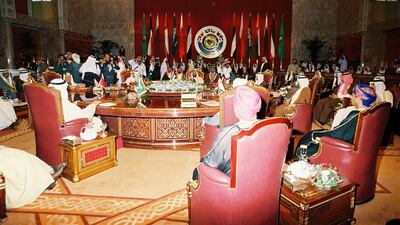
The six heads of state of the Gulf countries sit around a handcrafted table in the Dar El Istiqbal ballroom during the first GCC summit in 1981. -
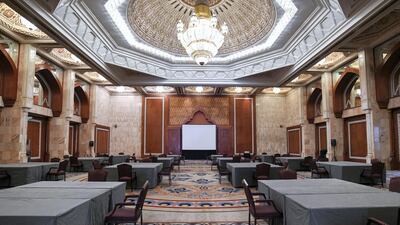
Despite undergoing a full renovation in 2007, the Dar El Istiqbal ballroom at the InterContinental hotel in Abu Dhabi remains almost the same today as it did 40 years ago. -
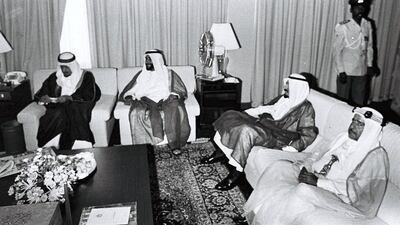
Heads of GCC states held formal and informal discussions at the two-day event to strengthen the bilateral relations among six countries. -
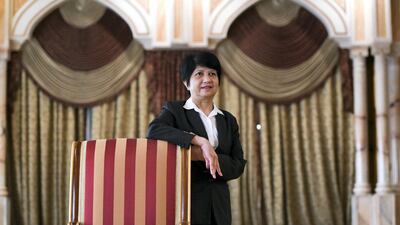
Jiraporn Wattanasuntranon, 62, from Thailand, started working at the hotel in 1980 and remembers the buzz around hosting the first GCC Summit. -

Framed photographs from the first GCC summit hung on the walls of the hotel lobby offer a snapshot of the historic meeting. -

A table being flown into the hotel for the first GCC summit in 1981. This is the table where the six heads of state signed a document to form the GCC. -
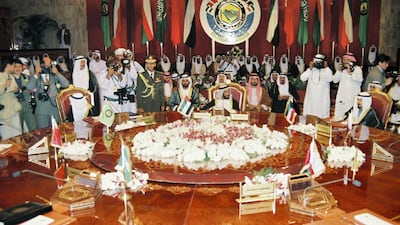
Over the past four decades, the InterContinental hotel in Abu Dhabi has hosted five GCC summits - 1981, 1986, 1992, 1998 and 2004. -

Sheikh Zayed and Sultan Qaboos of Oman during a meeting at the GCC summit in 1981. -
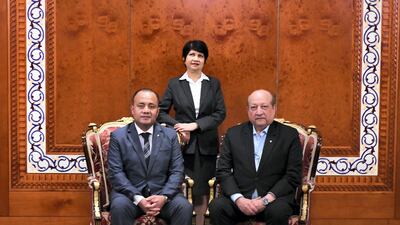
From left, Wael Sami, director of sales and marketing, Jiraporn Wattanasuntranon, pay master and Marwan Naser, chief security manager at the InterContinental hotel in Abu Dhabi. -
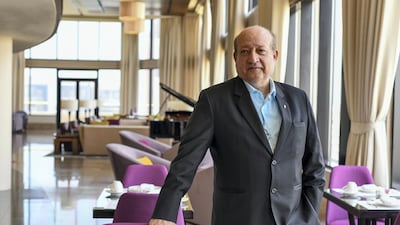
Marwan Naser, chief security manager at the InterContinental hotel was present during the second GCC summit hosted by the UAE in 1986. -
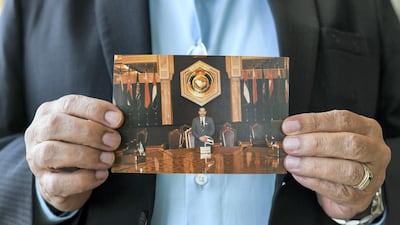
Marwan Naser shows a throwback image of himself from the 1986 GCC summit in the Dar El Istiqbal ballroom at the InterContinental hotel. -
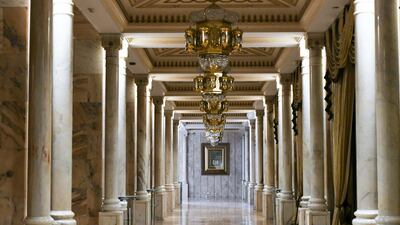
The banquet corridor leading to the Liwa Majlis and Dar El Istiqbal ballroom at the hotel. -
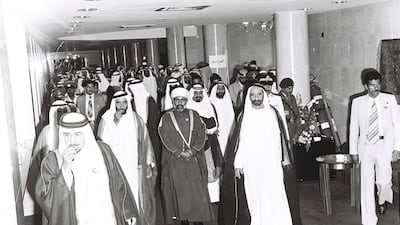
Sheikh Zayed and the heads of state walk through a corridor of the hotel. -
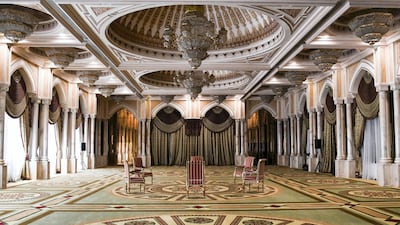
The Liwa Majlis hosted several side meetings during the first GCC summit in 1981. -
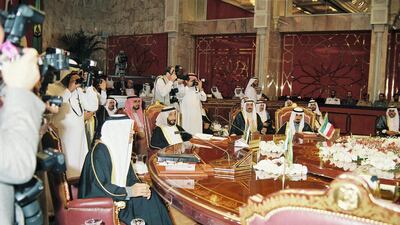
Sheikh Zayed, who addresses GCC heads of state as his brothers, said the meeting would pave the way for 'security, development and solidarity' in the region.


*A version of this story first appeared in The National in 2021, to mark the 40th anniversary of the GCC

