Ramadan is an opportunity to learn something new and reflect. EPA

How tech is enabling new Ramadan traditions beyond Zoom iftars


  • English
  • Arabic

Technology is enabling new Ramadan traditions beyond breaking the fast with friends and family on Zoom, with many UAE organisations offering programmes to deepen religious knowledge and faith during an unprecedented time.

Some 1.8 billion Muslims worldwide are observing the holy month amid strict social distancing restrictions to tackle the Covid-19 crisis.

Almir Smajlovic, a volunteer khateeb, the reader of the sermon, and a speaker on religious issues in Dubai, said Muslims around the world turn to learning about their faith during Ramadan.

He said technology has enabled people to continue their journey of learning about their faith, even as the coronavirus pandemic has meant in-person lectures or prayers are not possible this month.

"There are so many reminders for people through webinars, lectures or online sessions. There are things geared towards people of all ages," said Mr Smajlovic.

During these testing times, the tradition of reflection and knowledge sharing continues, thanks to digital and emerging technologies

He advised people to research, listen to question and answer sessions, and increase their knowledge.

Dubai Future Academy, an initiative of the Dubai Future Foundation, has moved online for its Ramadan Pioneer Series, now in its third year, under the title ‘Life after the coronavirus (Covid-19)’. The interactive series is convening futurists and experts to test and share their ideas on how to tackle the pandemic, while allowing the public to interact with pioneers in the UAE and globally.

“During these testing times, the tradition of reflection and knowledge sharing continues, thanks to digital and emerging technologies – a powerful reminder of just how connected we are to one another,” Saeed Al Gergawi, head of Dubai Future Academy, said.

Speakers range from ministers and academics including Sheikha Shamma bint Sultan bin Khalifa Al Nahyan, chief executive of Alliances for Global Sustainability, Sara Al Amiri, Minister of State for Advanced Sciences, and Dr Shaikha Al Dhaheri, secretary general at the Environment Agency in Abu Dhabi.

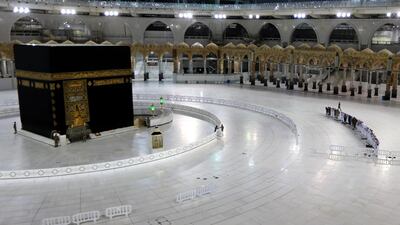
  • Worshippers perform taraweeh prayer in front of the Kaaba in the Grand Mosque on the first day of Ramadan in Makkah, Saudi Arabia. While the general public are not allowed to enter because of the coronavirus pandemic, imams at Islam’s holiest site still lead the daily prayers with staff and workers. AFP
    Worshippers perform taraweeh prayer in front of the Kaaba in the Grand Mosque on the first day of Ramadan in Makkah, Saudi Arabia. While the general public are not allowed to enter because of the coronavirus pandemic, imams at Islam’s holiest site still lead the daily prayers with staff and workers. AFP
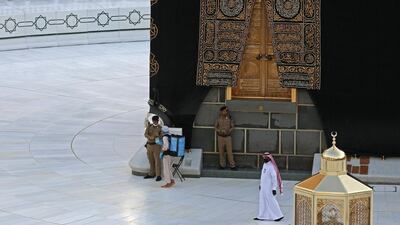
  • Saudi policemen stand guard next to the Kaaba in Makkah's Grand Mosque on the first day of Ramadan. AFP
    Saudi policemen stand guard next to the Kaaba in Makkah's Grand Mosque on the first day of Ramadan. AFP
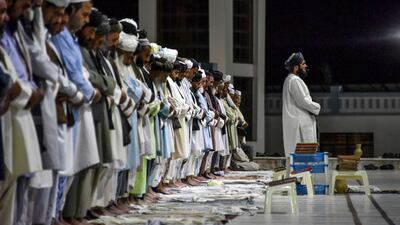
  • Muslims offer Taraweeh evening prayers on the first day of the Muslim holy month of Ramadan at a mosque in Kandahar city. AFP
    Muslims offer Taraweeh evening prayers on the first day of the Muslim holy month of Ramadan at a mosque in Kandahar city. AFP
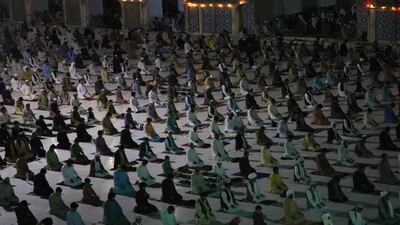
  • Muslims offer special taraveeh prayers during the Muslim holy month of Ramadan amid lockdown due to the ongoing coronavirus COVID-19 pandemic, in Herat, Afghanistan. EPA
    Muslims offer special taraveeh prayers during the Muslim holy month of Ramadan amid lockdown due to the ongoing coronavirus COVID-19 pandemic, in Herat, Afghanistan. EPA
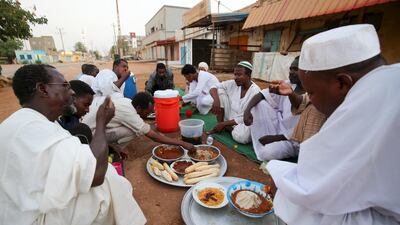
  • Sudanese men break their fast in a street in the capital Khartoum during the Muslim holy month of Ramadan amid a curfew due to the COVID-19 coronavirus pandemic. AFP
    Sudanese men break their fast in a street in the capital Khartoum during the Muslim holy month of Ramadan amid a curfew due to the COVID-19 coronavirus pandemic. AFP
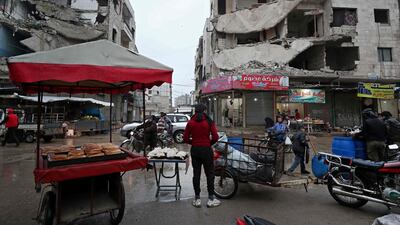
  • A peddlar sells bread and pastries from a cart in the rain in a square in Syria's northwestern city of Idlib on the first day of Ramadan. AFP
    A peddlar sells bread and pastries from a cart in the rain in a square in Syria's northwestern city of Idlib on the first day of Ramadan. AFP
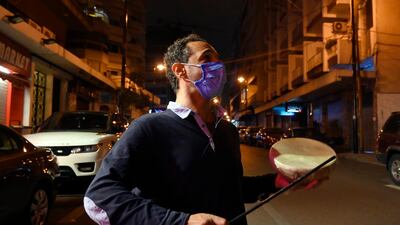
  • A Lebanese drummer (Musaharati) wears a protective mask and carries a small drum as he makes his rounds waking Muslims for Suhor, the meal taken during Ramadan before sunrise prayers, amid the coronavirus lockdown in Beirut, Lebanon, 25 April 2020. EPA
    A Lebanese drummer (Musaharati) wears a protective mask and carries a small drum as he makes his rounds waking Muslims for Suhor, the meal taken during Ramadan before sunrise prayers, amid the coronavirus lockdown in Beirut, Lebanon, 25 April 2020. EPA
  • A Lebanese supporter of the Jemaah Islamiyah wears a medical mask, drives his ATV to celebrate in the first day of Ramadan in Beirut, Lebanon, 24 April 2020. EPA
    A Lebanese supporter of the Jemaah Islamiyah wears a medical mask, drives his ATV to celebrate in the first day of Ramadan in Beirut, Lebanon, 24 April 2020. EPA
  • Palestinian Walid al-Hattab prepares soup for the poor during the first day of Ramadan in Gaza City on April 24, 2020. AFP
    Palestinian Walid al-Hattab prepares soup for the poor during the first day of Ramadan in Gaza City on April 24, 2020. AFP
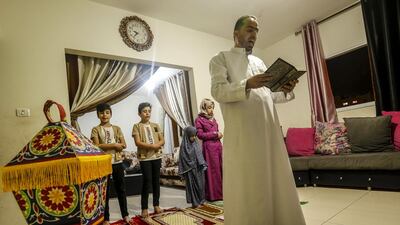
  • A Palestinian family perform the tarawih special prayer during the first day of Ramadan in their home in Khan Yunis in the southern Gaza Strip on April 24, 2020. AFP
    A Palestinian family perform the tarawih special prayer during the first day of Ramadan in their home in Khan Yunis in the southern Gaza Strip on April 24, 2020. AFP
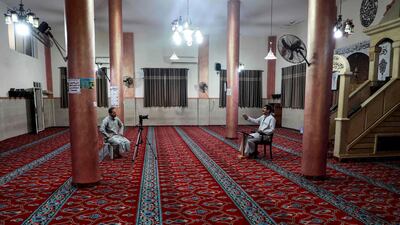
  • A Palestinian preacher speaks before a camera while recording a sermon and broadcasting the audio onto loudspeakers inside an empty mosque in the village of Salem east of Nablus in the occupied West Bank on the first day of Ramadan on April 24, 2020. AFP
    A Palestinian preacher speaks before a camera while recording a sermon and broadcasting the audio onto loudspeakers inside an empty mosque in the village of Salem east of Nablus in the occupied West Bank on the first day of Ramadan on April 24, 2020. AFP
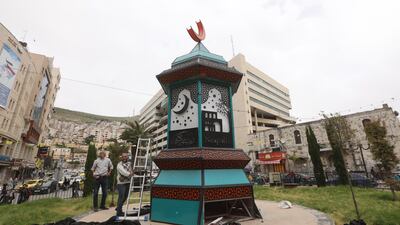
  • A Palestinian worker prepares a lantern on the first day of Ramadan, in the west bank city of Nablus, 24 April 2020. EPA
    A Palestinian worker prepares a lantern on the first day of Ramadan, in the west bank city of Nablus, 24 April 2020. EPA
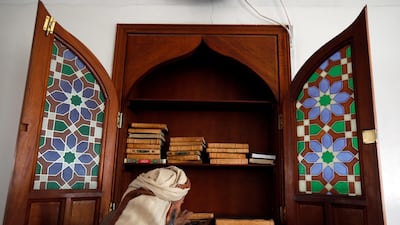
  • A Yemeni collects the copies of the Koran on the first day of the Muslim holy month of Ramadan at a mosque in Sana'a, Yemen, 24 April 2020. EPA
    A Yemeni collects the copies of the Koran on the first day of the Muslim holy month of Ramadan at a mosque in Sana'a, Yemen, 24 April 2020. EPA
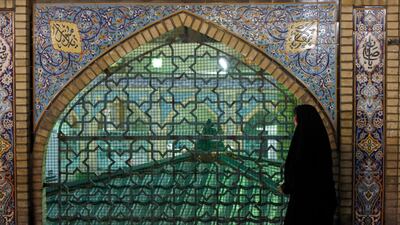
  • An Iranian woman prays outside of the Saleh Shrine on the eve of the holy month of Ramadan, in Tehran, Iran, 24 April 2020. EPA
    An Iranian woman prays outside of the Saleh Shrine on the eve of the holy month of Ramadan, in Tehran, Iran, 24 April 2020. EPA
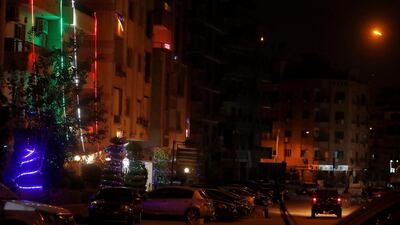
  • A car travels in front of closed shops, and light decorations during the first night of Ramadan, in the Cairo suburb of Maadi, Egypt, April 24, 2020. Reuters
    A car travels in front of closed shops, and light decorations during the first night of Ramadan, in the Cairo suburb of Maadi, Egypt, April 24, 2020. Reuters
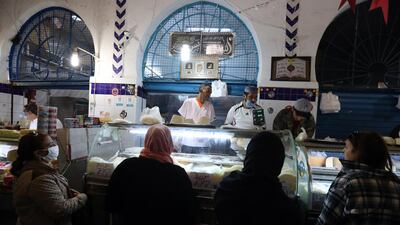
  • Tunisians buy cheese on the first day of Ramadan at a market in Tunis, Tunisia, 24 April 2020. EPA
    Tunisians buy cheese on the first day of Ramadan at a market in Tunis, Tunisia, 24 April 2020. EPA
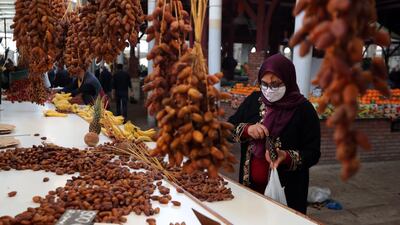
  • A Tunisian woman sells dates on the first day of Ramadan at a market in Tunis, Tunisia, 24 April 2020. EPA
    A Tunisian woman sells dates on the first day of Ramadan at a market in Tunis, Tunisia, 24 April 2020. EPA
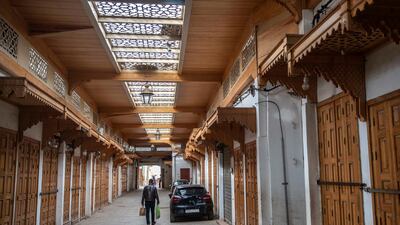
  • A man walks past closed shops before the start of Ramadan in the usually bustling Medina of Rabat, Morocco, Thursday, April 23, 2020. AP Photo
    A man walks past closed shops before the start of Ramadan in the usually bustling Medina of Rabat, Morocco, Thursday, April 23, 2020. AP Photo

Or worshippers can tune in to NYU Abu Dhabi Institute’s past talks, which it posted on YouTube just in time for Ramadan “in the spirit of fraternity”.  Several lectures delve deeper into Islamic tradition, Arabic philosophy or a better understanding of the natural world.

Ahmed Hamed, a spokesperson at Al Manar Centre, a nonprofit in Dubai, said technology had ensured they could bring together speakers from different corners of the globe for lectures.

The centre will organise sessions on Zoom through Ramadan on weekends where scholars will discuss messages of hope and positivity.

While they have reached 60,000 viewers in the first weekend, they aim to reach 200,000 people by the end of the month.

Al Salam Islamic Centre, a private, non-profit Islamic Centre for women based in Dubai, is running several e-learning courses aimed at women.

"With the help and favour of God, technology has kept the classes possible and people are interested in the online lessons,” a spokesperson at Al Salam Islamic Centre said.

The centre has organised a programme called ‘Ramadan with Joy’ with classes held on different topics such as the names of Allah, the Quran and prayers every day of the week.

Sessions are held in Arabic and in English, with students having the option of live or recorded lessons.

"Technology has helped us as people across the world, even former students who may have moved out of Dubai, have come closer through these channels.

"There is a lot of bonding and sisterhood, with people coming together through these mediums."

The Outsider

Stephen King, Penguin

The National Archives, Abu Dhabi

Founded over 50 years ago, the National Archives collects valuable historical material relating to the UAE, and is the oldest and richest archive relating to the Arabian Gulf.

Much of the material can be viewed on line at the Arabian Gulf Digital Archive - https://www.agda.ae/en

The%20pillars%20of%20the%20Dubai%20Metaverse%20Strategy
%3Cp%3EEncourage%20innovation%20in%20the%20metaverse%20field%20and%20boost%20economic%20contribution%3C%2Fp%3E%0A%3Cp%3EDevelop%20outstanding%20talents%20through%20education%20and%20training%3C%2Fp%3E%0A%3Cp%3EDevelop%20applications%20and%20the%20way%20they%20are%20used%20in%20Dubai's%20government%20institutions%3C%2Fp%3E%0A%3Cp%3EAdopt%2C%20expand%20and%20promote%20secure%20platforms%20globally%3C%2Fp%3E%0A%3Cp%3EDevelop%20the%20infrastructure%20and%20regulations%3C%2Fp%3E%0A
Citizenship-by-investment programmes

United Kingdom

The UK offers three programmes for residency. The UK Overseas Business Representative Visa lets you open an overseas branch office of your existing company in the country at no extra investment. For the UK Tier 1 Innovator Visa, you are required to invest £50,000 (Dh238,000) into a business. You can also get a UK Tier 1 Investor Visa if you invest £2 million, £5m or £10m (the higher the investment, the sooner you obtain your permanent residency).

All UK residency visas get approved in 90 to 120 days and are valid for 3 years. After 3 years, the applicant can apply for extension of another 2 years. Once they have lived in the UK for a minimum of 6 months every year, they are eligible to apply for permanent residency (called Indefinite Leave to Remain). After one year of ILR, the applicant can apply for UK passport.

The Caribbean

Depending on the country, the investment amount starts from $100,000 (Dh367,250) and can go up to $400,000 in real estate. From the date of purchase, it will take between four to five months to receive a passport. 

Portugal

The investment amount ranges from €350,000 to €500,000 (Dh1.5m to Dh2.16m) in real estate. From the date of purchase, it will take a maximum of six months to receive a Golden Visa. Applicants can apply for permanent residency after five years and Portuguese citizenship after six years.

“Among European countries with residency programmes, Portugal has been the most popular because it offers the most cost-effective programme to eventually acquire citizenship of the European Union without ever residing in Portugal,” states Veronica Cotdemiey of Citizenship Invest.

Greece

The real estate investment threshold to acquire residency for Greece is €250,000, making it the cheapest real estate residency visa scheme in Europe. You can apply for residency in four months and citizenship after seven years.

Spain

The real estate investment threshold to acquire residency for Spain is €500,000. You can apply for permanent residency after five years and citizenship after 10 years. It is not necessary to live in Spain to retain and renew the residency visa permit.

Cyprus

Cyprus offers the quickest route to citizenship of a European country in only six months. An investment of €2m in real estate is required, making it the highest priced programme in Europe.

Malta

The Malta citizenship by investment programme is lengthy and investors are required to contribute sums as donations to the Maltese government. The applicant must either contribute at least €650,000 to the National Development & Social Fund. Spouses and children are required to contribute €25,000; unmarried children between 18 and 25 and dependent parents must contribute €50,000 each.

The second step is to make an investment in property of at least €350,000 or enter a property rental contract for at least €16,000 per annum for five years. The third step is to invest at least €150,000 in bonds or shares approved by the Maltese government to be kept for at least five years.

Candidates must commit to a minimum physical presence in Malta before citizenship is granted. While you get residency in two months, you can apply for citizenship after a year.

Egypt 

A one-year residency permit can be bought if you purchase property in Egypt worth $100,000. A three-year residency is available for those who invest $200,000 in property, and five years for those who purchase property worth $400,000.

Source: Citizenship Invest and Aqua Properties