

Nasa is set to launch a spacecraft that will visit eight asteroids over 12 years to study the evolution of the solar system.
Called Lucy, it will fly by one Main Belt asteroid and seven Trojan asteroids. These are leftover parts of planets that are travelling in an orbit before and behind Jupiter.
A launch is scheduled for October 16 aboard a United Launch Alliance Atlas V 401 rocket from Cape Canaveral in Florida.
About 40 per cent of the spacecraft’s mass consists of liquid fuel that would allow for precise manoeuvres required for the lengthy trip.
“Lucy is an amazing spacecraft, but I’m always looking forward to the day when we start getting data from these never-before-seen fossils of the solar system,” said Hal Levison, principal investigator of the mission.
Studying these asteroids will help in understanding how the solar system’s planets were formed 4.5 billion years ago and why they ended up in this alignment.
The asteroids are pieces left over from when the planets were formed and are trapped in a stable orbit near Jupiter.
Lucy will fly by the Main Belt asteroid first in 2025. This will be followed by visits to Trojan asteroids from 2027 to 2033.
Scientists will study their sizes, colours and compositions to understand the physical conditions of the early solar system and the evolution of the planets.
The findings will help to form a detailed picture of the asteroids' surfaces and properties.
Several scientific instruments aboard the spacecraft will capture data, including a high-resolution camera that will photograph craters clearly from 1,000 kilometres away.
Another scientific camera will search the asteroids' surfaces for organic compounds, ice, and hydrated minerals.
A 2-metre-wide antenna will secure communication between the spacecraft and Earth, and a tracking camera will navigate the spacecraft and track the asteroids during encounters.
“Understanding more about Trojan asteroids is going to help us validate some of our assumptions about what primordial material looks like, as well as help us understand better about the composition of the earliest parts of the solar system,” said Roger Harris, the mission’s project manager.
“The deeper into the solar system that we go, the more you’re going to see these generational type missions happen. It’s going to be our legacy.”
The Lucy mission craft was named after a fossilised human that was found in Ethiopia in 1974, which provided insight into humanity's evolution. The findings included 3.2 million-years-old fossilised bones that made up at least 40 per cent of the human skeleton.
Scientists are hoping Lucy, the spacecraft, will also help advance scientific research.
Other asteroid missions by Nasa will add to the research on the evolution of the solar system.
In 2023, the Osiris-Rex spacecraft will bring back samples of the asteroid Bennu, which it collected last year after a successful impact.
The near-Earth asteroid is from the early solar system and could hold clues on the building blocks of the solar system.
The first mission to return samples of a near-Earth object was by Japan’s space agency Jaxa, when the Hayabusa spacecraft brought back pieces from asteroid Itokawa in 2010.
Jaxa’s Hayabusa2 brought back samples from asteroid Ryugu in 2020.
World Asteroid Day — in pictures
-
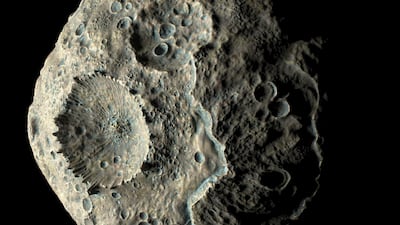
A rendering of the Psyche asteroid -

Hills are covered with fallen and burnt trees after a meteorite hit in 1908. Getty -
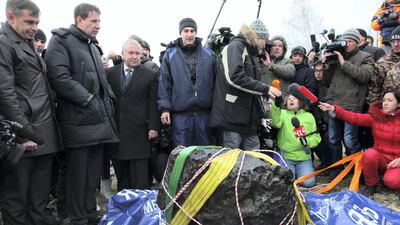
People look at what scientists believe to be a chunk of the Chelyabinsk meteor in 2013. AP -
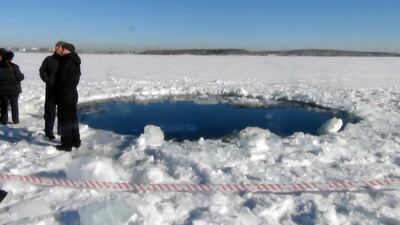
People standing near a six-metre hole in the ice of a frozen lake, reportedly the site of a meteor fall, outside the town of Chebakul in central Russia. AFP -
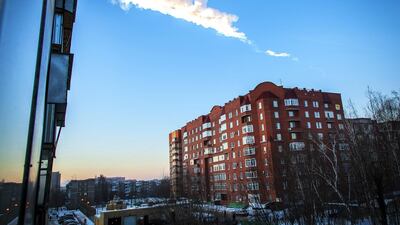
A meteorite trail is seen above a residential apartment block in the Urals city of Chelyabinsk in 2013. AFP -
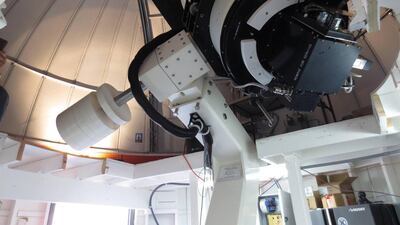
The Asteroid Terrestrial-impact Last Alert System (Atlas), pictured in Hawaii. -
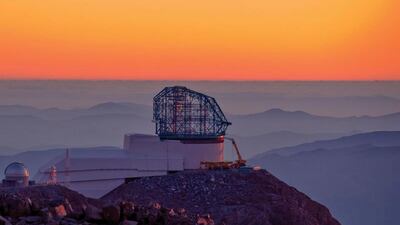
The Vera C. Rubin Observatory, under construction in 2019, promises to reveal more objects faster than any previous telescope. Photo: LSST -
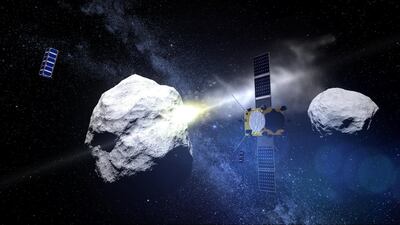
A computer-generated image shows the impact of the Dart projectile on the binary asteroid system, Didymos. ESA/AFP -
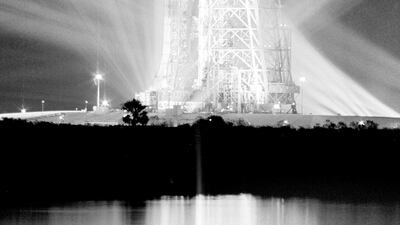
Spotlights illuminate the Saturn V booster rocket on the launch pad at the Kennedy Space Centre in Florida carrying the Apollo 8 spacecraft and its crew of three astronauts, on December 19, 1968. AP



