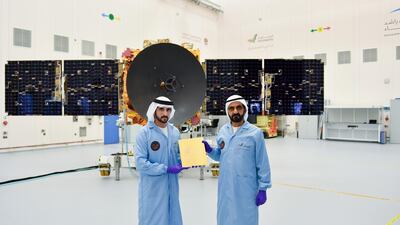
Emirati engineers have told of their remarkable six-year journey to lift-off for the UAE's momentous mission to Mars - from living on a remote Japanese island to facing up to the challenges of a pandemic.
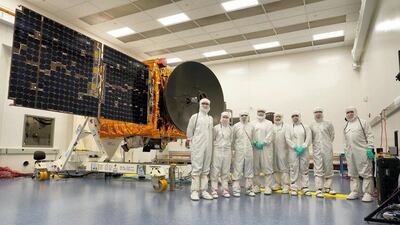
An intrepid team of eight engineers have been based in Japan since early April to prepare the Hope spacecraft for its historic launch on July 15.
The majority of the group have been working on the project since its inception in 2014 but never imagined they would have to grapple with the impact of the Covid-19 crisis.
With most of the spacecraft tests now completed, two of the engineers spoke to The National about their remarkable experience working on the mission so far.
Challenges posed by Covid-19
Omar Al Shehhi, the lead for integration and testing of the spacecraft, is one of the engineers who has been working on the mission since the start.
“We never thought a pandemic would break out in the world and we’d have to rethink about if we would be launching the Emirates Mars Mission on time,” said Mr Shehhi, 31.
When concerns about a possible delay of the mission started to surface, the team held a meeting to decide on the future of the project.
Every two years, there is a narrow window to launch missions to Mars because of a rare alignment of Earth and the Red Planet.
“We sat together with the project manager and we said we have to launch now or else we’d be waiting for two years. We said we worked hard, and we’d like to launch it on time,” he said.
So, the engineers were sent to Japan on April 5 and were required to quarantine in Tokyo for two weeks.
The strict measures were taken to ensure that the launch site on Tanegashima Island was kept virus-free.
Mr Shehhi said the new safety measures have created memories during this project that he will “always remember”.
“The new lifestyle is one of the more memorable things in the project. We have to be extra careful, not just because of the technical risk but also because of the pandemic,” he said.
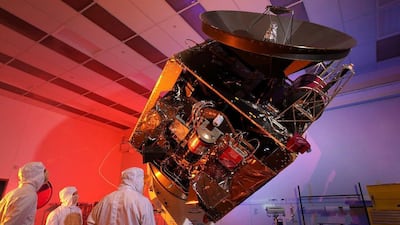
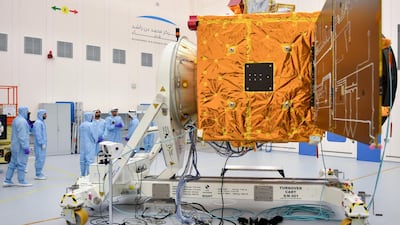
Another memorable moment for him was when they completed the probe’s testing with the ground station in Dubai, which meant the spacecraft was ready to be shipped to the launch site in Japan.
Life on a remote island
The launch site is located on the Tanegashima island, which is situated south of the Kagoshima prefecture.
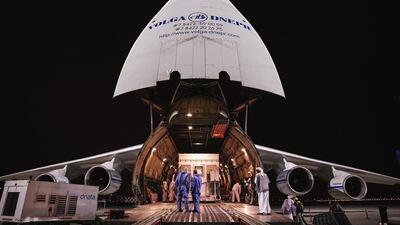
Travelling there is complicated and can include different modes of transport. It took an 83-hour mission to ship the spacecraft there in April.
Suhail Al Dhafri, the deputy project manager and spacecraft lead, said all engineers are required to keep a daily log of their temperatures to ensure their safety and that of the launch site.
The team’s work shift is from 7.30am to 5.30pm and they use their free time to exercise or watch movies.
“On the island everything has been closed. A few restaurants started to open up about three weeks ago, but only for take-out,” he said.
“During our free time, we walk on the beach or the streets. We stay away from crowded places. Most of the time we get take-outs and we spend our time in the hotel.”
A lonely launch with thousands watching virtually
Mr Al Dhafri and Mr Al Shehhi had hoped to bring their young children along, so they could watch the historic launch taking place.
Due to travel restrictions, only a small team on ground in Japan will be present for the launch.
“When your kids watch this moment, it is something that will change their lives,” said Mr Al Dhafri.
“Kids don’t have limits – they dream of being astronauts. It would have been nice to see them experience a moment that would spark their interest in space.”
However, the engineers' families will be watching the live stream of the launch.
Mr Al Shehhi said it is safer for them to be at home because of the pandemic.
“We would’ve wanted them here, as this was a rare opportunity, but with the pandemic things has changed,” he said.
The event will be live streamed and hundreds of thousands of people are expected to watch on as the first Arab mission to the Red Planet blasts off into space.
GAC GS8 Specs
Engine: 2.0-litre 4cyl turbo
Power: 248hp at 5,200rpm
Torque: 400Nm at 1,750-4,000rpm
Transmission: 8-speed auto
Fuel consumption: 9.1L/100km
On sale: Now
Price: From Dh149,900
PROFILE OF CURE.FIT
Started: July 2016
Founders: Mukesh Bansal and Ankit Nagori
Based: Bangalore, India
Sector: Health & wellness
Size: 500 employees
Investment: $250 million
Investors: Accel, Oaktree Capital (US); Chiratae Ventures, Epiq Capital, Innoven Capital, Kalaari Capital, Kotak Mahindra Bank, Piramal Group’s Anand Piramal, Pratithi Investment Trust, Ratan Tata (India); and Unilever Ventures (Unilever’s global venture capital arm)
The years Ramadan fell in May
SUNDAY'S ABU DHABI T10 MATCHES
Northern Warriors v Team Abu Dhabi, 3.30pm
Bangla Tigers v Karnataka Tuskers, 5.45pm
Qalandars v Maratha Arabians, 8pm
Three ways to limit your social media use
Clinical psychologist, Dr Saliha Afridi at The Lighthouse Arabia suggests three easy things you can do every day to cut back on the time you spend online.
1. Put the social media app in a folder on the second or third screen of your phone so it has to remain a conscious decision to open, rather than something your fingers gravitate towards without consideration.
2. Schedule a time to use social media instead of consistently throughout the day. I recommend setting aside certain times of the day or week when you upload pictures or share information.
3. Take a mental snapshot rather than a photo on your phone. Instead of sharing it with your social world, try to absorb the moment, connect with your feeling, experience the moment with all five of your senses. You will have a memory of that moment more vividly and for far longer than if you take a picture of it.
The specs
Price, base / as tested Dh960,000
Engine 3.9L twin-turbo V8
Transmission Seven-speed dual-clutch automatic
Power 661hp @8,000rpm
Torque 760Nm @ 3,000rpm
Fuel economy, combined 11.4L / 100k
Our legal consultant
Name: Hassan Mohsen Elhais
Position: legal consultant with Al Rowaad Advocates and Legal Consultants.
World Test Championship table
1 India 71 per cent
2 New Zealand 70 per cent
3 Australia 69.2 per cent
4 England 64.1 per cent
5 Pakistan 43.3 per cent
6 West Indies 33.3 per cent
7 South Africa 30 per cent
8 Sri Lanka 16.7 per cent
9 Bangladesh 0
Mercer, the investment consulting arm of US services company Marsh & McLennan, expects its wealth division to at least double its assets under management (AUM) in the Middle East as wealth in the region continues to grow despite economic headwinds, a company official said.
Mercer Wealth, which globally has $160 billion in AUM, plans to boost its AUM in the region to $2-$3bn in the next 2-3 years from the present $1bn, said Yasir AbuShaban, a Dubai-based principal with Mercer Wealth.
“Within the next two to three years, we are looking at reaching $2 to $3 billion as a conservative estimate and we do see an opportunity to do so,” said Mr AbuShaban.
Mercer does not directly make investments, but allocates clients’ money they have discretion to, to professional asset managers. They also provide advice to clients.
“We have buying power. We can negotiate on their (client’s) behalf with asset managers to provide them lower fees than they otherwise would have to get on their own,” he added.
Mercer Wealth’s clients include sovereign wealth funds, family offices, and insurance companies among others.
From its office in Dubai, Mercer also looks after Africa, India and Turkey, where they also see opportunity for growth.
Wealth creation in Middle East and Africa (MEA) grew 8.5 per cent to $8.1 trillion last year from $7.5tn in 2015, higher than last year’s global average of 6 per cent and the second-highest growth in a region after Asia-Pacific which grew 9.9 per cent, according to consultancy Boston Consulting Group (BCG). In the region, where wealth grew just 1.9 per cent in 2015 compared with 2014, a pickup in oil prices has helped in wealth generation.
BCG is forecasting MEA wealth will rise to $12tn by 2021, growing at an annual average of 8 per cent.
Drivers of wealth generation in the region will be split evenly between new wealth creation and growth of performance of existing assets, according to BCG.
Another general trend in the region is clients’ looking for a comprehensive approach to investing, according to Mr AbuShaban.
“Institutional investors or some of the families are seeing a slowdown in the available capital they have to invest and in that sense they are looking at optimizing the way they manage their portfolios and making sure they are not investing haphazardly and different parts of their investment are working together,” said Mr AbuShaban.
Some clients also have a higher appetite for risk, given the low interest-rate environment that does not provide enough yield for some institutional investors. These clients are keen to invest in illiquid assets, such as private equity and infrastructure.
“What we have seen is a desire for higher returns in what has been a low-return environment specifically in various fixed income or bonds,” he said.
“In this environment, we have seen a de facto increase in the risk that clients are taking in things like illiquid investments, private equity investments, infrastructure and private debt, those kind of investments were higher illiquidity results in incrementally higher returns.”
The Abu Dhabi Investment Authority, one of the largest sovereign wealth funds, said in its 2016 report that has gradually increased its exposure in direct private equity and private credit transactions, mainly in Asian markets and especially in China and India. The authority’s private equity department focused on structured equities owing to “their defensive characteristics.”
THE BIO: Mohammed Ashiq Ali
Proudest achievement: “I came to a new country and started this shop”
Favourite TV programme: the news
Favourite place in Dubai: Al Fahidi. “They started the metro in 2009 and I didn’t take it yet.”
Family: six sons in Dubai and a daughter in Faisalabad
First Person
Richard Flanagan
Chatto & Windus
Tightening the screw on rogue recruiters
The UAE overhauled the procedure to recruit housemaids and domestic workers with a law in 2017 to protect low-income labour from being exploited.
Only recruitment companies authorised by the government are permitted as part of Tadbeer, a network of labour ministry-regulated centres.
A contract must be drawn up for domestic workers, the wages and job offer clearly stating the nature of work.
The contract stating the wages, work entailed and accommodation must be sent to the employee in their home country before they depart for the UAE.
The contract will be signed by the employer and employee when the domestic worker arrives in the UAE.
Only recruitment agencies registered with the ministry can undertake recruitment and employment applications for domestic workers.
Penalties for illegal recruitment in the UAE include fines of up to Dh100,000 and imprisonment
But agents not authorised by the government sidestep the law by illegally getting women into the country on visit visas.
The specs: Lamborghini Aventador SVJ
Price, base: Dh1,731,672
Engine: 6.5-litre V12
Gearbox: Seven-speed automatic
Power: 770hp @ 8,500rpm
Torque: 720Nm @ 6,750rpm
Fuel economy: 19.6L / 100km