


Travelling faster than the speed of light has forever been a fantasy, achieved only by characters in sci-fi television shows. But a flurry of new findings about the nature of space and time suggest it may be possible to break Einstein's supposedly inviolable speed limit after all.
So has Einstein been proved wrong?
It is inaccurate to argue that Einstein proved that no object could travel either at or faster than the speed of light.
The scientist showed that this ultimate speed limit – 300,000 kilometres per second, or about one billion kph – applies only if space and time are not distorted in any way.
If you warp space-time around a spacecraft, Einstein’s equations suggest, there is no limit to how fast we could travel through the galaxy.

How do you ‘warp’ space-time?
If you were Scotty on the USS Enterprise, you would do it using a mixture of matter, antimatter and fictional dilithium crystals. Exactly how the Star Trek engineer used these to bend space-time is unclear, but in the real world it can be done using certain types of matter and energy.
In the mid-1990s, theorist Dr Miguel Alcubierre at Cardiff University in Wales showed it is possible to outpace light by warping space-time so it shrinks in front of a spacecraft, thus bringing its destination closer, while pushing it away from its rear.
But calculations showed that doing this would need vast quantities of strange material with anti-gravitational powers, which no one knows how to make.
Now an astrophysicist has revived this warp engine idea by finding new ways of bending space-time.
-
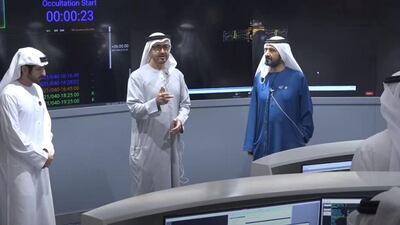
Sheikh Mohamed bin Zayed and Sheikh Mohammed bin Rashid personally thank staff from mission control in Dubai after Hope probe's successful orbit entry on February 9. The National -
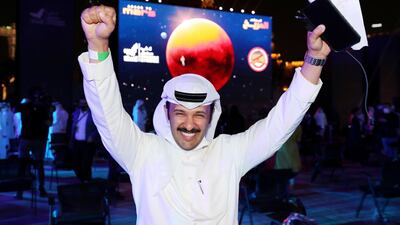
A man celebrates at an event at Burj Park in Dubai to celebrate the Hope probe going into orbit around Mars. Chris Whiteoak / The National -
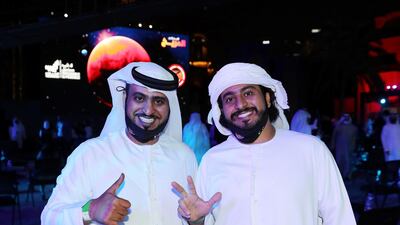
People celebrate at an event at Burj Park to celebrate the Hope probe going into orbit around Mars. Chris Whiteoak / The National -

An event at Burj Park to celebrate the Hope probe going into orbit around Mars. Chris Whiteoak / The National -

People celebrate at an event at Burj Park to celebrate the Hope probe going into orbit around Mars. Chris Whiteoak / The National -
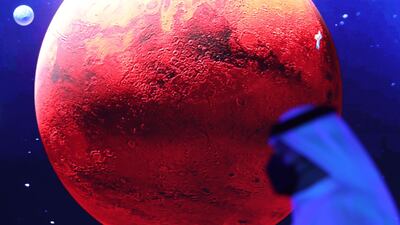
Guests arrive at the Burj Park event to mark the arrival of the Hope probe to Mars. Chris Whiteoak / The National -
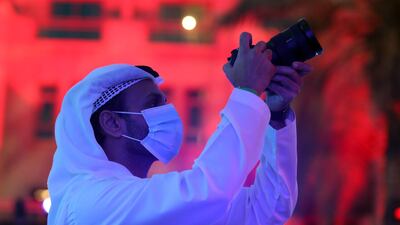
A guest attending the Burj Park event to mark the arrival of the Hope probe to Mars. Chris Whiteoak / The National -
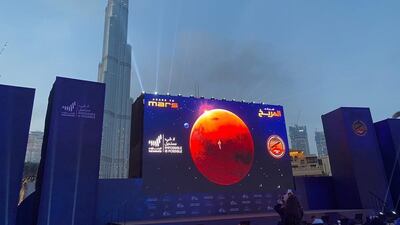
Burj Park was set up for people to watch the Hope probe attempt its Mars orbit insertion. Courtesy: UAE Government Twitter -
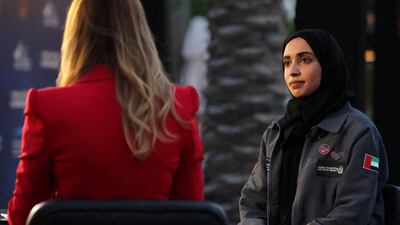
UAE Mars Mission engineer, Hessa Al Matroushi, was interviewed at a Burj Park event to mark the arrival of the Hope probe to Mars. Chris Whiteoak / The National -
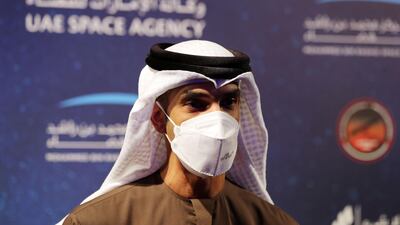
Dr Thani Al Zeyoudi, Minister of State for Foreign Trade, attended the event at Burj Park to mark the arrival of the Hope probe to Mars. Chris Whiteoak / The National -

Engineer Hessa Al Matroushi attended the event at Burj Park to mark the arrival of the Hope probe to Mars. Chris Whiteoak / The National -
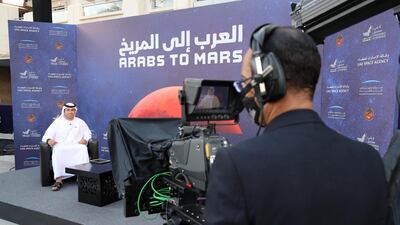
TV crews get ready at an event at Burj Park in Dubai to celebrate the Hope probe going into orbit around Mars. Chris Whiteoak / The National -
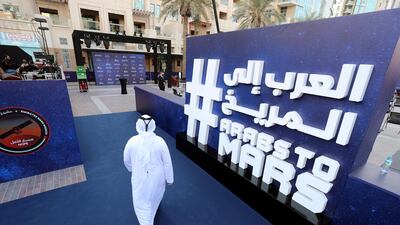
An event at Dubai's Burj Park to celebrate the Hope probe's Mars orbit insertion attempt. Chris Whiteoak / The National -
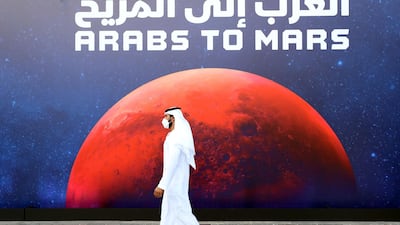
Guests arrive at an event at Burj Park to mark the Hope probe's Mars orbit insertion attempt. Chris Whiteoak / The National -
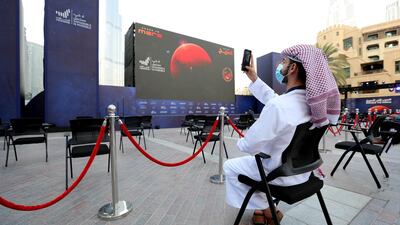
Guests and media arrive at an event at Burj Park to witness Hope probe's Mars orbit insertion attempt. Chris Whiteoak / The National -
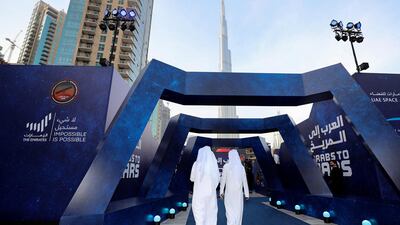
Guests arrive at an event at Burj Park to mark the Hope probe's Mars orbit insertion attempt. Chris Whiteoak / The National -
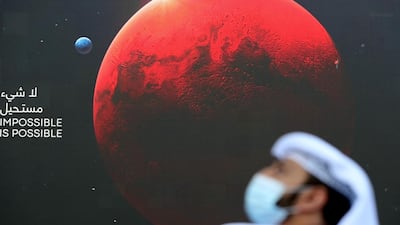
Guests arrive at an event at Burj Park to mark the Hope probe's Mars orbit insertion attempt. Chris Whiteoak / The National -
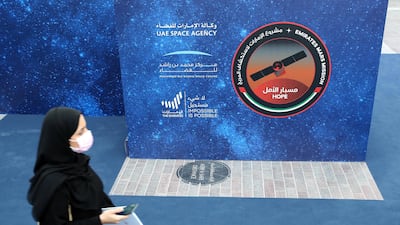
Guests arrive at an event at Burj Park to mark the Hope probe's Mars orbit insertion attempt. Chris Whiteoak / The National -
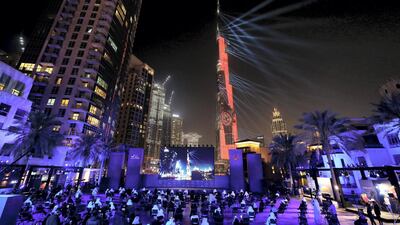
The Burj Khalifa lights up at an event at Burj Park in Dubai to celebrate the Hope probe going into orbit around Mars. Chris Whiteoak / The National -
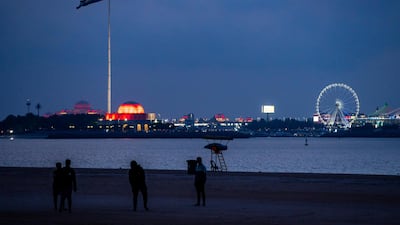
The UAE Flag area on the Corniche in Abu Dhabi lights up in red to celebrate the success of the Hope probe going into orbit around Mars. Victor Besa / The National -
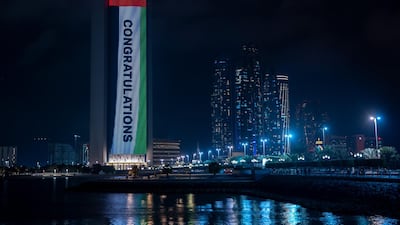
The ADNOC Headquarters lights up in Abu Dhabi to celebrate the success of the Hope probe going into orbit around Mars. Victor Besa / The National -
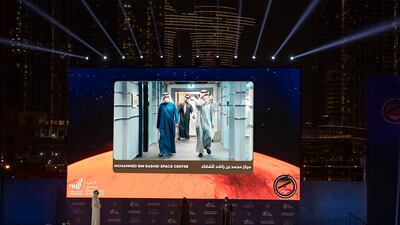
Sheikh Mohamed bin Zayed celebrates with Sheikh Mohammed bin Rashid at an event at Burj Park in Dubai to celebrate the Hope probe going into orbit around Mars. Chris Whiteoak / The National -
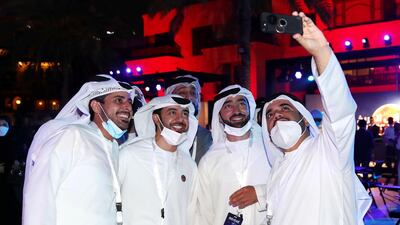
People celebrate at an event at Burj Park in Dubai to mark the Hope probe going into orbit around Mars. Chris Whiteoak / The National


What’s the trick?
By digging deeper in to Einstein’s complex theory, Dr Erik Lentz, a physicist at the University of Goettingen in Germany, has found ways of travelling faster than light by creating new types of space-time “bubbles” around a spacecraft.
Known as “solitons”, they are similar to those proposed by Dr Alcubierre.
Crucially, however, Dr Lentz has discovered that some of these bubbles can be formed using ordinary matter.
"This is the first known solution of its kind," said Dr Lentz, who reported his breakthrough in the journal Classical and Quantum Gravity.
His calculations suggested that a standard type of matter known as plasma – a kind of gas of positive and negative charges – could do the trick of warping space-time around a spacecraft.
When will we see the first real starship?
There are a few technical hitches to be resolved. Dr Lentz estimates that making a spacecraft such as the Enterprise travel faster than light would require the amount of energy equivalent to that needed to destroy a small star.
Even so, he believes technological advances will drastically reduce this figure, perhaps in a matter of decades.
The pay-off would be huge. Using current rocket propulsion it would take more than 50,000 years to reach the nearest star, Proxima Centauri. Travelling at light-speed, the journey time would be cut to about four years.
What about tunnelling through space?
When it comes to zooming around the cosmos, space-time bubbles are not the only possibility. Einstein himself worked on the idea of using so-called wormholes to tunnel through the fabric of space-time.
Until now, these were also thought to need bizarre forms of matter in order to work. But earlier this month, a team of theorists said they had found clues that ordinary matter again might do the trick. If confirmed, these could make wormholes the ultimate form of cosmic travel.
Calculations published by another team of theorists this month suggest it might be possible to use them to travel across the galaxy in less than a second.

