New Covid-19 strain: what we know about the highly infectious variant


Daniel Bardsley
  • English
  • Arabic

The emergence of a new and more easily spread strain of coronavirus is being blamed for a surge in cases in parts of the UK.
Here we look at how this new strain emerged and what it means for treatments and vaccines.

What is different about the new strain? 

Named VUI-202012/01, the new strain has 23 genetic changes, a key one of which is associated with the spike protein, which the coronavirus uses to attach itself to a receptor on human cells. British Prime Minister Boris Johnson said the new strain is up to 70 per cent more transmissible than other strains.

Where did the new strain originate? 

UK medical officials think it could have appeared first in London or Kent, a county south-east of London, in September.
But this is not confirmed and it is not even certain that it evolved in the UK. The UK has been particularly good at tracking the evolution of the coronavirus, with figures from late October indicating that it accounted for about half of all coronavirus samples sequenced globally.

This could be why the new strain was identified first in the UK.

Where is it found now? 

The new strain is linked to about half or more than half of new infections in London and parts of east and south-east England. It may be why these regions – which now face tougher restrictions to prevent coronavirus spread – have had a surge in cases and hospital admissions.
The strain has, however, also been found in other parts of the UK, albeit at a lower prevalence, including as far afield as Scotland and Wales.

Is it more dangerous? 

Prof Chris Whitty, the chief medical officer for England and chief medical adviser to the UK government, said "there is no current evidence" to indicate the new strain causes more serious illness or is more resistant to existing treatments for Covid-19.

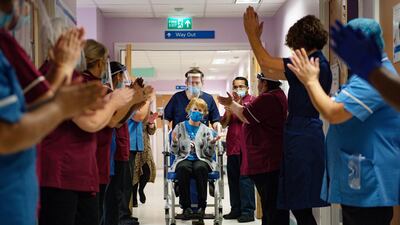
  • Margaret Keenan, 90, is applauded by staff as she returns to her ward after becoming the first person in the United Kingdom to receive the Pfizer-BioNtech Covid-19 vaccine at University Hospital, Coventry. EPA
    Margaret Keenan, 90, is applauded by staff as she returns to her ward after becoming the first person in the United Kingdom to receive the Pfizer-BioNtech Covid-19 vaccine at University Hospital, Coventry. EPA
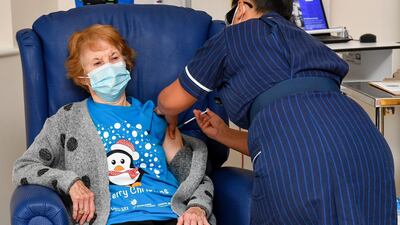
  • Margaret Keenan receives the vaccine, administered by nurse May Parson. EPA
    Margaret Keenan receives the vaccine, administered by nurse May Parson. EPA
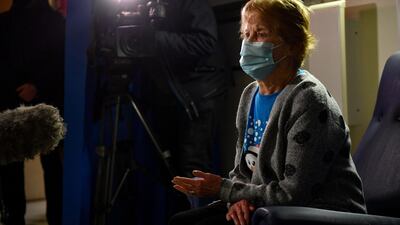
  • Margaret Keenan speaks to the media at University Hospital in Coventry. AFP
    Margaret Keenan speaks to the media at University Hospital in Coventry. AFP
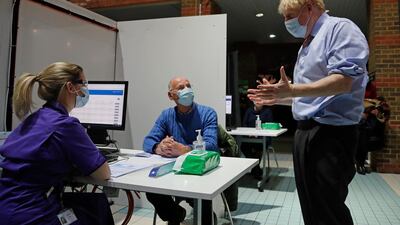
  • British Prime Minister Boris Johnson gestures as he speaks to staff at Guy's Hospital in London. AP Photo
    British Prime Minister Boris Johnson gestures as he speaks to staff at Guy's Hospital in London. AP Photo
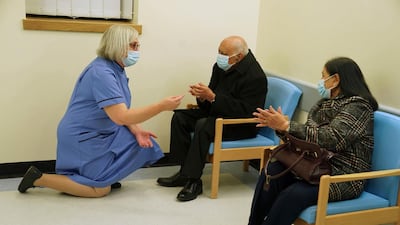
  • Retired nurse Suzanne Medows speaks to race relations campaigner Dr Hari Shukla, 87, and his wife Ranju, before he receives the Pfizer-BioNTech Covid-19 vaccine at the Royal Victoria Infirmary in Newcastle. AP Photo
    Retired nurse Suzanne Medows speaks to race relations campaigner Dr Hari Shukla, 87, and his wife Ranju, before he receives the Pfizer-BioNTech Covid-19 vaccine at the Royal Victoria Infirmary in Newcastle. AP Photo
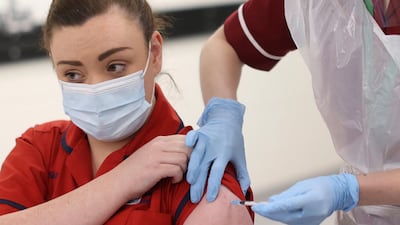
  • Sister Joanna Sloan receives the Pfizer-BioNTech Covid-19 vaccine, as the first person in Northern Ireland at the Royal Victoria Hospital, in Belfast. AP Photo
    Sister Joanna Sloan receives the Pfizer-BioNTech Covid-19 vaccine, as the first person in Northern Ireland at the Royal Victoria Hospital, in Belfast. AP Photo
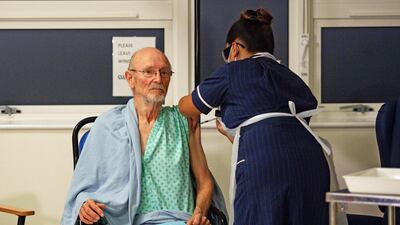
  • "Bill" William Shakespeare, 81, receives the Pfizer-BioNTech Covid-19 vaccine, at University Hospital, Coventry. AP Photo
    "Bill" William Shakespeare, 81, receives the Pfizer-BioNTech Covid-19 vaccine, at University Hospital, Coventry. AP Photo
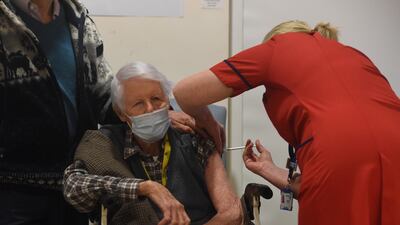
  • Michael Tibbs, 99 is given the Pfizer-BioNtech Covid-19 vaccine at Queen Alexandra Hospital in Portsmouth. Getty Images
    Michael Tibbs, 99 is given the Pfizer-BioNtech Covid-19 vaccine at Queen Alexandra Hospital in Portsmouth. Getty Images
  • Michael Tibbs and his son Philip enjoy a cup of tea after Michael received the Pfizer-BioNtech Covid-19 vaccine at Queen Alexandra Hospital. Getty Images
    Michael Tibbs and his son Philip enjoy a cup of tea after Michael received the Pfizer-BioNtech Covid-19 vaccine at Queen Alexandra Hospital. Getty Images
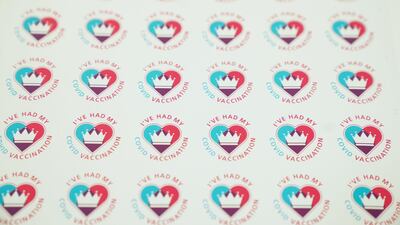
  • "I've had my covid vaccination" stickers at the Royal Victoria Infirmary in Newcastle. Getty Images
    "I've had my covid vaccination" stickers at the Royal Victoria Infirmary in Newcastle. Getty Images
  • A nurse holds a phial of the Pfizer-BioNTech Covid-19 vaccine at Guy's Hospital in London. Reuters
    A nurse holds a phial of the Pfizer-BioNTech Covid-19 vaccine at Guy's Hospital in London. Reuters
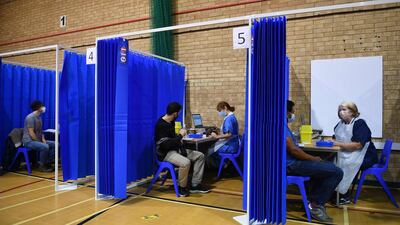
  • Medical personnel prepare to administer the Pfizer-BioNTech Covid-19 vaccine to recipients at a health centre in Cardiff. AFP
    Medical personnel prepare to administer the Pfizer-BioNTech Covid-19 vaccine to recipients at a health centre in Cardiff. AFP
  • A woman walks past graffiti with the words Victory to the NHS on a wall at the Royal Victoria Hospital in West Belfast, Northern Ireland. AP Photo
    A woman walks past graffiti with the words Victory to the NHS on a wall at the Royal Victoria Hospital in West Belfast, Northern Ireland. AP Photo

Will it render vaccines ineffective? 

The evolution of viruses is a key reason why vaccines against them become ineffective. For example, because of the evolution of influenza viruses, different influenza vaccines have to be used each year depending upon which strain is likely to be prevalent in the coming winter flu season.

Vaccines against the new coronavirus often aim to stimulate an immune response against the spike protein, but it is thought there would have to be several changes to the spike protein to make vaccines ineffective. Officials say there is no evidence, as yet, that vaccines being rolled out now will not be effective against the new strain, although further analysis will take place to look at this.

The chief scientific adviser to the UK government, Sir Patrick Vallance, said there were “theoretical reasons” why the new strain may be associated with a different immune response to that linked to other strains.

Why has the coronavirus changed? 

All living organisms (including viruses, which exist in a grey area between the living and the non-living) evolve. As they replicate their genetic material, mistakes are made, and these changes can be incorporated into later generations. Some of these genetic changes are inconsequential, but sometimes they result in changes to proteins (which are coded for by genetic material) that make an organism or virus better able to survive, spread or reproduce.

Such beneficial mutations tend to become more prevalent over time, as appears to be happening with the new strain. By contrast, mutations harmful to the organism or virus possessing them are usually weeded out by natural selection.

Is this the first new variant of the coronavirus detected? 

No, even before the new strain was identified, researchers had detected many thousands of mutations in the coronavirus’s genome (its complete set of genetic material), including 4,000 affecting the spike protein alone. Most of these changes are insignificant and do not affect the virus’s behaviour.

Another more easily spread variant, known as D614G, has been around for many months and is now the most prevalent form found globally but, like the new variant, is not linked to more severe illness.

Key facilities
  • Olympic-size swimming pool with a split bulkhead for multi-use configurations, including water polo and 50m/25m training lanes
  • Premier League-standard football pitch
  • 400m Olympic running track
  • NBA-spec basketball court with auditorium
  • 600-seat auditorium
  • Spaces for historical and cultural exploration
  • An elevated football field that doubles as a helipad
  • Specialist robotics and science laboratories
  • AR and VR-enabled learning centres
  • Disruption Lab and Research Centre for developing entrepreneurial skills
Specs

Engine: 2-litre

Transmission: Eight-speed automatic

Power: 255hp

Torque: 273Nm

Price: Dh240,000

The%20Roundup%20%3A%20No%20Way%20Out
%3Cp%3E%3Cstrong%3EDirector%3A%3C%2Fstrong%3E%20Lee%20Sang-yong%3Cbr%3E%3Cstrong%3EStars%3A%3C%2Fstrong%3E%20Don%20Lee%2C%20Lee%20Jun-hyuk%2C%20Munetaka%20Aoki%3Cbr%3E%3Cstrong%3ERating%3A%20%3C%2Fstrong%3E3%2F5%3Cbr%3E%3Cbr%3E%3C%2Fp%3E%0A
The specs
 
Engine: 3.0-litre six-cylinder turbo
Power: 398hp from 5,250rpm
Torque: 580Nm at 1,900-4,800rpm
Transmission: Eight-speed auto
Fuel economy, combined: 6.5L/100km
On sale: December
Price: From Dh330,000 (estimate)
Fixtures and results:

Wed, Aug 29:

  • Malaysia bt Hong Kong by 3 wickets
  • Oman bt Nepal by 7 wickets
  • UAE bt Singapore by 215 runs

Thu, Aug 30: UAE v Nepal; Hong Kong v Singapore; Malaysia v Oman

Sat, Sep 1: UAE v Hong Kong; Oman v Singapore; Malaysia v Nepal

Sun, Sep 2: Hong Kong v Oman; Malaysia v UAE; Nepal v Singapore

Tue, Sep 4: Malaysia v Singapore; UAE v Oman; Nepal v Hong Kong

Thu, Sep 6: Final

Griselda
%3Cp%3E%3Cstrong%3EDirector%3A%3C%2Fstrong%3E%C2%A0Andr%C3%A9s%20Baiz%3C%2Fp%3E%0A%3Cp%3E%3Cstrong%3EStarring%3A%C2%A0%3C%2Fstrong%3ESof%C3%ADa%20Vergara%2C%20Alberto%20Guerra%2C%20Juliana%20Aiden%20Martinez%3C%2Fp%3E%0A%3Cp%3E%3Cstrong%3ERating%3A%3C%2Fstrong%3E%204%2F5%3C%2Fp%3E%0A
Company%20profile
%3Cp%3E%3Cstrong%3ECompany%20name%3A%3C%2Fstrong%3E%20Fasset%0D%3Cbr%3E%3Cstrong%3EStarted%3A%20%3C%2Fstrong%3E2019%0D%3Cbr%3E%3Cstrong%3EFounders%3A%3C%2Fstrong%3E%20Mohammad%20Raafi%20Hossain%2C%20Daniel%20Ahmed%0D%3Cbr%3E%3Cstrong%3EBased%3A%3C%2Fstrong%3E%20Dubai%0D%3Cbr%3E%3Cstrong%3ESector%3A%20%3C%2Fstrong%3EFinTech%0D%3Cbr%3E%3Cstrong%3EInitial%20investment%3A%3C%2Fstrong%3E%20%242.45%20million%0D%3Cbr%3E%3Cstrong%3ECurrent%20number%20of%20staff%3A%3C%2Fstrong%3E%2086%0D%3Cbr%3E%3Cstrong%3EInvestment%20stage%3A%3C%2Fstrong%3E%20Pre-series%20B%0D%3Cbr%3E%3Cstrong%3EInvestors%3A%3C%2Fstrong%3E%20Investcorp%2C%20Liberty%20City%20Ventures%2C%20Fatima%20Gobi%20Ventures%2C%20Primal%20Capital%2C%20Wealthwell%20Ventures%2C%20FHS%20Capital%2C%20VN2%20Capital%2C%20local%20family%20offices%3C%2Fp%3E%0A
IPL 2018 FINAL

Sunrisers Hyderabad 178-6 (20 ovs)
Chennai Super Kings 181-2 (18.3 ovs)

Chennai win by eight wickets

Brown/Black belt finals

3pm: 49kg female: Mayssa Bastos (BRA) v Thamires Aquino (BRA)
3.07pm: 56kg male: Hiago George (BRA) v Carlos Alberto da Silva (BRA)
3.14pm: 55kg female: Amal Amjahid (BEL) v Bianca Basilio (BRA)
3.21pm: 62kg male: Gabriel de Sousa (BRA) v Joao Miyao (BRA)
3.28pm: 62kg female: Beatriz Mesquita (BRA) v Ffion Davies (GBR)
3.35pm: 69kg male: Isaac Doederlein (BRA) v Paulo Miyao (BRA)
3.42pm: 70kg female: Thamara Silva (BRA) v Alessandra Moss (AUS)
3.49pm: 77kg male: Oliver Lovell (GBR) v Tommy Langarkar (NOR)
3.56pm: 85kg male: Faisal Al Ketbi (UAE) v Rudson Mateus Teles (BRA)
4.03pm: 90kg female: Claire-France Thevenon (FRA) v Gabreili Passanha (BRA)
4.10pm: 94kg male: Adam Wardzinski (POL) v Kaynan Duarte (BRA)
4.17pm: 110kg male: Yahia Mansoor Al Hammadi (UAE) v Joao Rocha (BRA

Company Profile

Company name: NutriCal

Started: 2019

Founder: Soniya Ashar

Based: Dubai

Industry: Food Technology

Initial investment: Self-funded undisclosed amount

Future plan: Looking to raise fresh capital and expand in Saudi Arabia

Total Clients: Over 50