A miniature satellite that will monitor greenhouse gases over UAE was successfully launched into space on Monday.
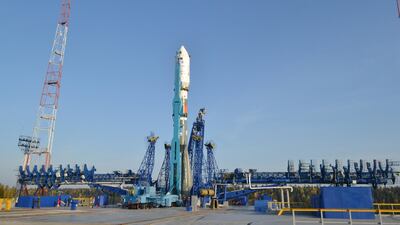
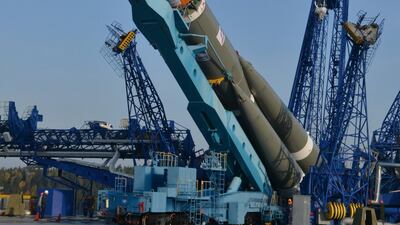
MeznSat lifted-off on board a Russian Soyuz 2.1b rocket from the Plesetsk Cosmodrome in Russia at 3.20pm Gulf Standard Time.
The nanosat, weighing 2.7 kilograms, will be carried to the low Earth orbit altitude of 575km and the first signal is expected to come about eight hours after launch if the nanosat remains 'healthy and alive'.
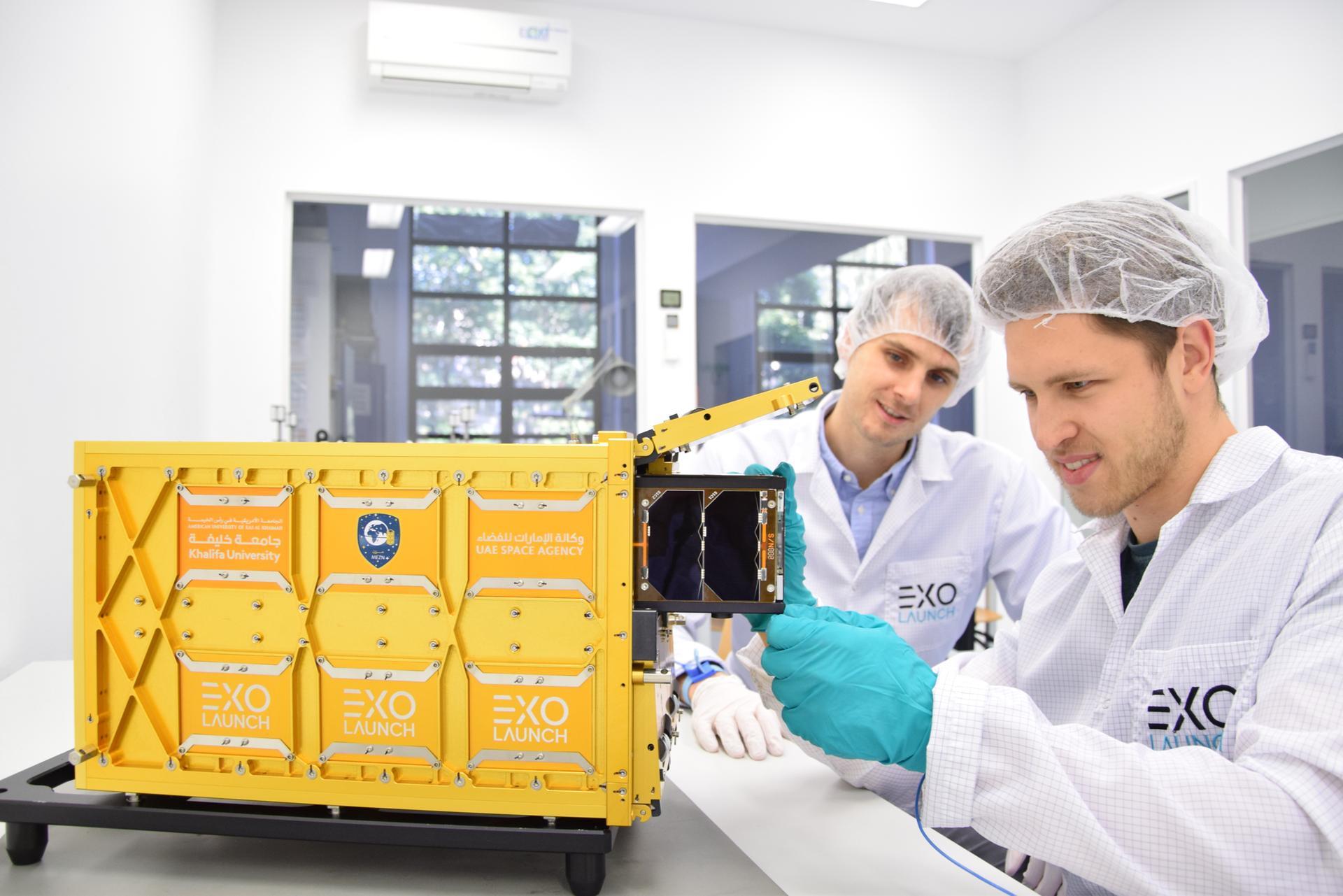
Developed by university students in the UAE, the nanosatellite will detect gases such as carbon dioxide and methane over the Emirates to help scientists reduce the impact of climate change.
The satellite was launched into the skies along with 18 other CubeSats.
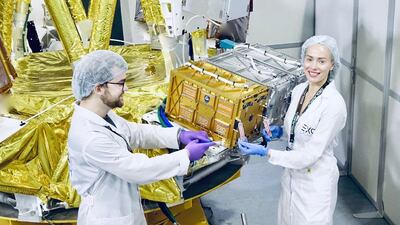
It was built by students at the Khalifa University and American University of Ras Al Khaimah (AURAK) and funded by the UAE Space Agency.
"It is an honour for me to be part of developing our national nanosatellite programme," Abdulla Almesmari, a PhD student in mechanical engineering at Khalifa University who assisted with the testing and integration of MeznSat, told The National.
“MeznSat is a remarkable achievement for us, since it is the first UAE CubeSat with a 3-unit platform, carrying the short-wave infrared spectrometre. Looking forward to receive the first beacon from MeznSat.”
Maryam Saeed Al Nuaimi, an AURAK student who worked on the CubeSat’s programming, said: ”I am happy and proud of the success of the launch. Finally, MeznSat in space. We are waiting for the first contact.”
Students will use the YahSat Space Lab in Khalifa University as the primary ground station to process and analyse the nanosat’s data, as well as the ground station in AURAK.
MeznSat is the third CubeSat to be launched by the UAE, after Nayif-1 in 2017 and MySat-1 in 2018.
This is the first 3-unit nanosat to be built by the UAE, meaning it features more systems than the previous one-unit versions. MeznSat has the Argus 2000 spectrometre and RGB (red, green, blue) camera.
Both of these will be used for greenhouse gas monitoring, as well as predicting algal bloom. It will estimate the concentration of total suspended matter in the coastal waters of the Arabian Gulf.
“These projects seek to develop national capabilities and enhance scientific research in universities, bringing up a new generation of Emirati engineers ready to join in the space sector,” said Dr Mohammed Al Ahbabi, director-general of the UAE Space Agency (UAESA).
“This direction by UAESA aligns with the keen interest of the wise UAE leadership in engaging the youth in scientific projects and giving them the experience needed for the job market.”
Dr Arif Sultan Al Hammadi, executive vice-president of Khalifa University, said their students plan on developing three more nanosatellites in the future.
These include the MySat-2 and Light-1 CubeSats.
“Our students have the opportunity to contribute to these projects during their studies,” he said.
“Their research innovations will have a great impact on the future of the UAE’s space sector. We look forward to witnessing similar achievements, as we provide our students with an opportunity to demonstrate their capabilities."
Sarah Al Amiri, the president of UAESA, also congratulated the university students on the successful launch.
She said experience-based learning helps prepare students for the job market.
"We would like to congratulate all the students and professors on this great achievement," said Ms Al Amiri.
"We are proud to see national capabilities designing, developing, and manufacturing satellites that will have an impact on UAE’s space sector."
UAESA used the commercial services of Exolaunch to launch MeznSat.
UAE playing a growing role in space sector:
Mercer, the investment consulting arm of US services company Marsh & McLennan, expects its wealth division to at least double its assets under management (AUM) in the Middle East as wealth in the region continues to grow despite economic headwinds, a company official said.
Mercer Wealth, which globally has $160 billion in AUM, plans to boost its AUM in the region to $2-$3bn in the next 2-3 years from the present $1bn, said Yasir AbuShaban, a Dubai-based principal with Mercer Wealth.
“Within the next two to three years, we are looking at reaching $2 to $3 billion as a conservative estimate and we do see an opportunity to do so,” said Mr AbuShaban.
Mercer does not directly make investments, but allocates clients’ money they have discretion to, to professional asset managers. They also provide advice to clients.
“We have buying power. We can negotiate on their (client’s) behalf with asset managers to provide them lower fees than they otherwise would have to get on their own,” he added.
Mercer Wealth’s clients include sovereign wealth funds, family offices, and insurance companies among others.
From its office in Dubai, Mercer also looks after Africa, India and Turkey, where they also see opportunity for growth.
Wealth creation in Middle East and Africa (MEA) grew 8.5 per cent to $8.1 trillion last year from $7.5tn in 2015, higher than last year’s global average of 6 per cent and the second-highest growth in a region after Asia-Pacific which grew 9.9 per cent, according to consultancy Boston Consulting Group (BCG). In the region, where wealth grew just 1.9 per cent in 2015 compared with 2014, a pickup in oil prices has helped in wealth generation.
BCG is forecasting MEA wealth will rise to $12tn by 2021, growing at an annual average of 8 per cent.
Drivers of wealth generation in the region will be split evenly between new wealth creation and growth of performance of existing assets, according to BCG.
Another general trend in the region is clients’ looking for a comprehensive approach to investing, according to Mr AbuShaban.
“Institutional investors or some of the families are seeing a slowdown in the available capital they have to invest and in that sense they are looking at optimizing the way they manage their portfolios and making sure they are not investing haphazardly and different parts of their investment are working together,” said Mr AbuShaban.
Some clients also have a higher appetite for risk, given the low interest-rate environment that does not provide enough yield for some institutional investors. These clients are keen to invest in illiquid assets, such as private equity and infrastructure.
“What we have seen is a desire for higher returns in what has been a low-return environment specifically in various fixed income or bonds,” he said.
“In this environment, we have seen a de facto increase in the risk that clients are taking in things like illiquid investments, private equity investments, infrastructure and private debt, those kind of investments were higher illiquidity results in incrementally higher returns.”
The Abu Dhabi Investment Authority, one of the largest sovereign wealth funds, said in its 2016 report that has gradually increased its exposure in direct private equity and private credit transactions, mainly in Asian markets and especially in China and India. The authority’s private equity department focused on structured equities owing to “their defensive characteristics.”
Name: Peter Dicce
Title: Assistant dean of students and director of athletics
Favourite sport: soccer
Favourite team: Bayern Munich
Favourite player: Franz Beckenbauer
Favourite activity in Abu Dhabi: scuba diving in the Northern Emirates
Prophets of Rage
(Fantasy Records)
%20Ramez%20Gab%20Min%20El%20Akher
%3Cp%3E%3Cstrong%3ECreator%3A%3C%2Fstrong%3E%20Ramez%20Galal%3C%2Fp%3E%0A%3Cp%3E%3Cstrong%3EStarring%3A%3C%2Fstrong%3E%20Ramez%20Galal%3C%2Fp%3E%0A%3Cp%3E%3Cstrong%3EStreaming%20on%3A%20%3C%2Fstrong%3EMBC%20Shahid%3C%2Fp%3E%0A%3Cp%3E%3Cstrong%3ERating%3A%20%3C%2Fstrong%3E2.5%2F5%3C%2Fp%3E%0A
Pros%20and%20cons%20of%20BNPL
%3Cp%3E%3Cstrong%3EPros%3C%2Fstrong%3E%0D%3C%2Fp%3E%0A%3Cul%3E%0A%3Cli%3EEasy%20to%20use%20and%20require%20less%20rigorous%20credit%20checks%20than%20traditional%20credit%20options%0D%3C%2Fli%3E%0A%3Cli%3EOffers%20the%20ability%20to%20spread%20the%20cost%20of%20purchases%20over%20time%2C%20often%20interest-free%0D%3C%2Fli%3E%0A%3Cli%3EConvenient%20and%20can%20be%20integrated%20directly%20into%20the%20checkout%20process%2C%20useful%20for%20online%20shopping%0D%3C%2Fli%3E%0A%3Cli%3EHelps%20facilitate%20cash%20flow%20planning%20when%20used%20wisely%0D%3C%2Fli%3E%0A%3C%2Ful%3E%0A%3Cp%3E%3Cstrong%3ECons%3C%2Fstrong%3E%3C%2Fp%3E%0A%3Cul%3E%0A%3Cli%3EThe%20ease%20of%20making%20purchases%20can%20lead%20to%20overspending%20and%20accumulation%20of%20debt%0D%3C%2Fli%3E%0A%3Cli%3EMissing%20payments%20can%20result%20in%20hefty%20fees%20and%2C%20in%20some%20cases%2C%20high%20interest%20rates%20after%20an%20initial%20interest-free%20period%0D%3C%2Fli%3E%0A%3Cli%3EFailure%20to%20make%20payments%20can%20impact%20credit%20score%20negatively%0D%3C%2Fli%3E%0A%3Cli%3ERefunds%20can%20be%20complicated%20and%20delayed%0D%3C%2Fli%3E%0A%3C%2Ful%3E%0A%3Cp%3E%3Cem%3ECourtesy%3A%20Carol%20Glynn%3C%2Fem%3E%3C%2Fp%3E%0A
Zodi%20%26%20Tehu%3A%20Princes%20Of%20The%20Desert
%3Cp%3E%3Cstrong%3EDirector%3A%20%3C%2Fstrong%3EEric%20Barbier%26nbsp%3B%3C%2Fp%3E%0A%3Cp%3E%3Cstrong%3EStarring%3A%20%3C%2Fstrong%3EYoussef%20Hajdi%2C%20Nadia%20Benzakour%2C%20Yasser%20Drief%3C%2Fp%3E%0A%3Cp%3E%3Cstrong%3ERating%3A%3C%2Fstrong%3E%204%2F5%3C%2Fp%3E%0A
Crops that could be introduced to the UAE
1: Quinoa
2. Bathua
3. Amaranth
4. Pearl and finger millet
5. Sorghum
Real estate tokenisation project
Dubai launched the pilot phase of its real estate tokenisation project last month.
The initiative focuses on converting real estate assets into digital tokens recorded on blockchain technology and helps in streamlining the process of buying, selling and investing, the Dubai Land Department said.
Dubai’s real estate tokenisation market is projected to reach Dh60 billion ($16.33 billion) by 2033, representing 7 per cent of the emirate’s total property transactions, according to the DLD.
The specs
Engine: 2-litre 4-cylinder and 3.6-litre 6-cylinder
Power: 220 and 280 horsepower
Torque: 350 and 360Nm
Transmission: eight-speed automatic
Price: from Dh136,521 VAT and Dh166,464 VAT
On sale: now
Ten tax points to be aware of in 2026
1. Domestic VAT refund amendments: request your refund within five years
If a business does not apply for the refund on time, they lose their credit.
2. E-invoicing in the UAE
Businesses should continue preparing for the implementation of e-invoicing in the UAE, with 2026 a preparation and transition period ahead of phased mandatory adoption.
3. More tax audits
Tax authorities are increasingly using data already available across multiple filings to identify audit risks.
4. More beneficial VAT and excise tax penalty regime
Tax disputes are expected to become more frequent and more structured, with clearer administrative objection and appeal processes. The UAE has adopted a new penalty regime for VAT and excise disputes, which now mirrors the penalty regime for corporate tax.
5. Greater emphasis on statutory audit
There is a greater need for the accuracy of financial statements. The International Financial Reporting Standards standards need to be strictly adhered to and, as a result, the quality of the audits will need to increase.
6. Further transfer pricing enforcement
Transfer pricing enforcement, which refers to the practice of establishing prices for internal transactions between related entities, is expected to broaden in scope. The UAE will shortly open the possibility to negotiate advance pricing agreements, or essentially rulings for transfer pricing purposes.
7. Limited time periods for audits
Recent amendments also introduce a default five-year limitation period for tax audits and assessments, subject to specific statutory exceptions. While the standard audit and assessment period is five years, this may be extended to up to 15 years in cases involving fraud or tax evasion.
8. Pillar 2 implementation
Many multinational groups will begin to feel the practical effect of the Domestic Minimum Top-Up Tax (DMTT), the UAE's implementation of the OECD’s global minimum tax under Pillar 2. While the rules apply for financial years starting on or after January 1, 2025, it is 2026 that marks the transition to an operational phase.
9. Reduced compliance obligations for imported goods and services
Businesses that apply the reverse-charge mechanism for VAT purposes in the UAE may benefit from reduced compliance obligations.
10. Substance and CbC reporting focus
Tax authorities are expected to continue strengthening the enforcement of economic substance and Country-by-Country (CbC) reporting frameworks. In the UAE, these regimes are increasingly being used as risk-assessment tools, providing tax authorities with a comprehensive view of multinational groups’ global footprints and enabling them to assess whether profits are aligned with real economic activity.
Contributed by Thomas Vanhee and Hend Rashwan, Aurifer
What is blockchain?
Blockchain is a form of distributed ledger technology, a digital system in which data is recorded across multiple places at the same time. Unlike traditional databases, DLTs have no central administrator or centralised data storage. They are transparent because the data is visible and, because they are automatically replicated and impossible to be tampered with, they are secure.
The main difference between blockchain and other forms of DLT is the way data is stored as ‘blocks’ – new transactions are added to the existing ‘chain’ of past transactions, hence the name ‘blockchain’. It is impossible to delete or modify information on the chain due to the replication of blocks across various locations.
Blockchain is mostly associated with cryptocurrency Bitcoin. Due to the inability to tamper with transactions, advocates say this makes the currency more secure and safer than traditional systems. It is maintained by a network of people referred to as ‘miners’, who receive rewards for solving complex mathematical equations that enable transactions to go through.
However, one of the major problems that has come to light has been the presence of illicit material buried in the Bitcoin blockchain, linking it to the dark web.
Other blockchain platforms can offer things like smart contracts, which are automatically implemented when specific conditions from all interested parties are reached, cutting the time involved and the risk of mistakes. Another use could be storing medical records, as patients can be confident their information cannot be changed. The technology can also be used in supply chains, voting and has the potential to used for storing property records.
Sheikh Zayed's poem
When it is unveiled at Abu Dhabi Art, the Standing Tall exhibition will appear as an interplay of poetry and art. The 100 scarves are 100 fragments surrounding five, figurative, female sculptures, and both sculptures and scarves are hand-embroidered by a group of refugee women artisans, who used the Palestinian cross-stitch embroidery art of tatreez. Fragments of Sheikh Zayed’s poem Your Love is Ruling My Heart, written in Arabic as a love poem to his nation, are embroidered onto both the sculptures and the scarves. Here is the English translation.
Your love is ruling over my heart
Your love is ruling over my heart, even a mountain can’t bear all of it
Woe for my heart of such a love, if it befell it and made it its home
You came on me like a gleaming sun, you are the cure for my soul of its sickness
Be lenient on me, oh tender one, and have mercy on who because of you is in ruins
You are like the Ajeed Al-reem [leader of the gazelle herd] for my country, the source of all of its knowledge
You waddle even when you stand still, with feet white like the blooming of the dates of the palm
Oh, who wishes to deprive me of sleep, the night has ended and I still have not seen you
You are the cure for my sickness and my support, you dried my throat up let me go and damp it
Help me, oh children of mine, for in his love my life will pass me by.
Superpower%20
%3Cp%3E%3Cstrong%3EDirector%3A%20%3C%2Fstrong%3ESean%20Penn%2C%20Aaron%20Kaufman%3C%2Fp%3E%0A%3Cp%3E%3Cstrong%3ERating%3A%20%3C%2Fstrong%3E3%2F5%3C%2Fp%3E%0A
RESULT
Australia 3 (0) Honduras 1 (0)
Australia: Jedinak (53', 72' pen, 85' pen)
Honduras: Elis (90 4)
Brief scores
Toss India, chose to bat
India 281-7 in 50 ov (Pandya 83, Dhoni 79; Coulter-Nile 3-44)
Australia 137-9 in 21 ov (Maxwell 39, Warner 25; Chahal 3-30)
India won by 26 runs on Duckworth-Lewis Method
Director: Laxman Utekar
Cast: Vicky Kaushal, Akshaye Khanna, Diana Penty, Vineet Kumar Singh, Rashmika Mandanna
Rating: 1/5
So what is Spicy Chickenjoy?
Just as McDonald’s has the Big Mac, Jollibee has Spicy Chickenjoy – a piece of fried chicken that’s crispy and spicy on the outside and comes with a side of spaghetti, all covered in tomato sauce and topped with sausage slices and ground beef. It sounds like a recipe that a child would come up with, but perhaps that’s the point – a flavourbomb combination of cheap comfort foods. Chickenjoy is Jollibee’s best-selling product in every country in which it has a presence.
Types of bank fraud
1) Phishing
Fraudsters send an unsolicited email that appears to be from a financial institution or online retailer. The hoax email requests that you provide sensitive information, often by clicking on to a link leading to a fake website.
2) Smishing
The SMS equivalent of phishing. Fraudsters falsify the telephone number through “text spoofing,” so that it appears to be a genuine text from the bank.
3) Vishing
The telephone equivalent of phishing and smishing. Fraudsters may pose as bank staff, police or government officials. They may persuade the consumer to transfer money or divulge personal information.
4) SIM swap
Fraudsters duplicate the SIM of your mobile number without your knowledge or authorisation, allowing them to conduct financial transactions with your bank.
5) Identity theft
Someone illegally obtains your confidential information, through various ways, such as theft of your wallet, bank and utility bill statements, computer intrusion and social networks.
6) Prize scams
Fraudsters claiming to be authorised representatives from well-known organisations (such as Etisalat, du, Dubai Shopping Festival, Expo2020, Lulu Hypermarket etc) contact victims to tell them they have won a cash prize and request them to share confidential banking details to transfer the prize money.
The specs
Engine: 3.5-litre twin-turbo V6
Power: 380hp at 5,800rpm
Torque: 530Nm at 1,300-4,500rpm
Transmission: Eight-speed auto
Price: From Dh299,000 ($81,415)
On sale: Now
GAC GS8 Specs
Engine: 2.0-litre 4cyl turbo
Power: 248hp at 5,200rpm
Torque: 400Nm at 1,750-4,000rpm
Transmission: 8-speed auto
Fuel consumption: 9.1L/100km
On sale: Now
Price: From Dh149,900
Trump v Khan
2016: Feud begins after Khan criticised Trump’s proposed Muslim travel ban to US
2017: Trump criticises Khan’s ‘no reason to be alarmed’ response to London Bridge terror attacks
2019: Trump calls Khan a “stone cold loser” before first state visit
2019: Trump tweets about “Khan’s Londonistan”, calling him “a national disgrace”
2022: Khan’s office attributes rise in Islamophobic abuse against the major to hostility stoked during Trump’s presidency
July 2025 During a golfing trip to Scotland, Trump calls Khan “a nasty person”
Sept 2025 Trump blames Khan for London’s “stabbings and the dirt and the filth”.
Dec 2025 Trump suggests migrants got Khan elected, calls him a “horrible, vicious, disgusting mayor”
Stage 2
1. Mathieu van der Poel (NED) Alpecin-Fenix 4:18:30
2. Tadej Pogacar (SLV) UAE Team Emirates 0:00:06
3. Primoz Roglic (SLV) Jumbo-Visma 0:00:06
4. Wilco Kelderman (NED) Bora-Hansgrohe 0:00:06
5. Julian Alaphilippe (FRA) Deceuninck-QuickStep 0:00:08